

Outdoor brands often pour enormous budgets into visually spectacular films, only to watch those films collect digital dust. The footage is breathtaking. The edits are polished. But the engagement numbers are flat, the conversions are missing, and the marketing team is left wondering what went wrong. The truth is that stunning visuals alone do not build a brand. Strategy does. This guide walks marketing managers and content creators through the full filmmaking process, from defining brand objectives to measuring real results, so every shot you capture actually earns its place in your marketing plan.
Table of Contents
- Understand your brand story and objectives
- Plan your shoot: Tools, team, and creative prep
- Shoot for story: Techniques that drive brand engagement
- Edit and deploy: Measuring impact and iterating
- Why strategic alignment beats beautiful footage every time
- Access expert filmmaking and photography for your brand
- Frequently asked questions
Key Takeaways
| Point | Details |
|---|---|
| Strategy comes first | Align your filmmaking with brand objectives and KPIs for results that matter. |
| Preparation is everything | Effective planning ensures your shoot goes smoothly, even when nature throws a curveball. |
| Story beats visuals | Capturing authentic moments and stories engages audiences better than stunning shots alone. |
| Measure, learn, improve | Track how your films perform, adjust based on data, and build on each success. |
Understand your brand story and objectives
Before diving into cameras and shooting, get clear on what you want your film to achieve for your brand. Filmmaking without direction is just expensive sightseeing. The brands that consistently produce effective outdoor content start with one question: “What do we want the audience to feel, believe, or do after watching this?”
To answer that, you need to dig into your brand’s foundation:
- Define what your outdoor brand stands for. Is it freedom, sustainability, community, technical mastery, or raw adventure? This is not a tagline exercise. It is the filter every creative decision passes through.
- Clarify key messages and campaign KPIs. Are you trying to build awareness for a new product line, drive clicks to a landing page, or generate social shares? Outdoor marketing results depend on knowing the difference between awareness metrics (views, reach) and performance metrics (click-through rate, conversions).
- Assess your audience’s emotional triggers. A trail running brand’s audience craves stories of personal challenge and breakthrough. A family camping gear brand’s audience responds to safety, belonging, and shared memories. Know which emotional lever your film needs to pull.
- Align every creative idea with a measurable goal. If a creative concept cannot be tied back to a KPI, it belongs on the cutting room floor, not in the script.
As outdoor filmmaking strategy research confirms, effective filmmaking for brands requires explicit strategy-to-KPI alignment, not just technical planning. That means your creative brief should name specific numbers, not just vague ambitions.
Pro Tip: Write a single sentence that captures your film’s purpose in the format: “This film makes [target audience] feel [emotion] so they [desired action].” Pin it to your monitor. Every shot, every interview, every music choice gets tested against that sentence.
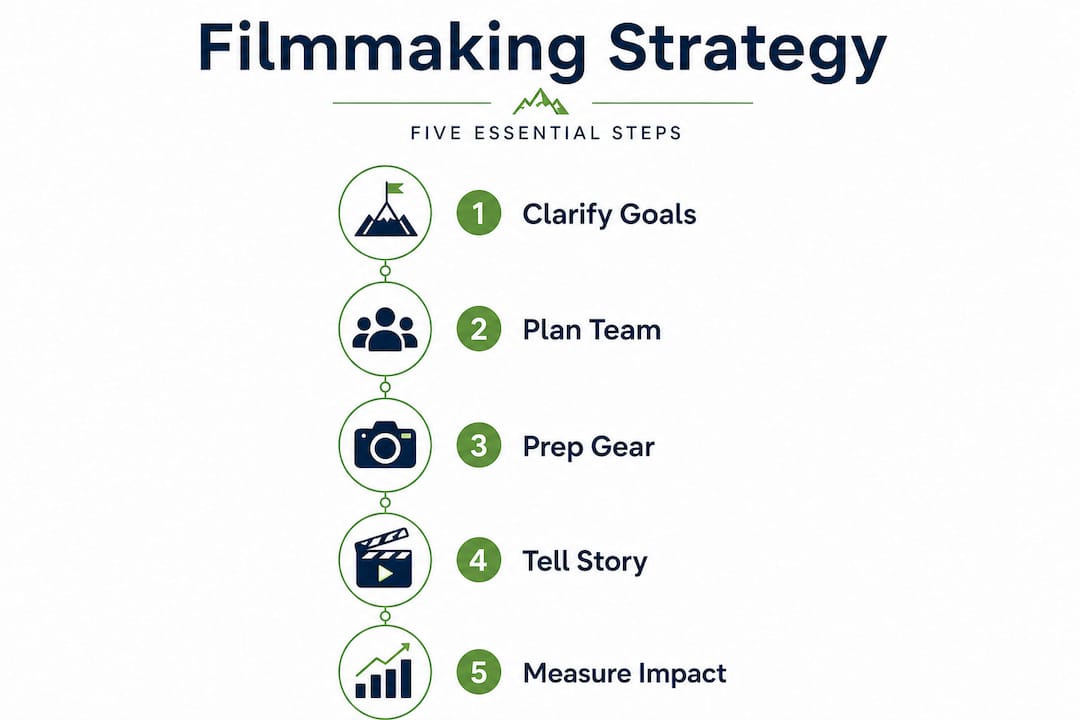
When you boost your brand through strategic filmmaking, you build an asset that keeps working long after the shoot wraps. But that only happens when the creative work is rooted in a clear, measurable objective from day one.
Plan your shoot: Tools, team, and creative prep
With your strategy and story defined, it is time to map out the nuts and bolts of execution. Planning an outdoor film shoot is categorically different from a studio production. Weather changes fast, permits take time, athletes have narrow availability windows, and golden-hour light waits for no one.
Here is a practical numbered framework for pre-production:
- Lock your locations. Scout physically or use detailed satellite imagery. Confirm permit requirements, access logistics, and seasonal conditions. Build in alternative locations for bad weather days.
- Build your team. Assign clear roles before the shoot, not during it.
- Assemble your gear list. Match equipment to the story requirements and environmental conditions.
- Create a shot list and storyboard. Map story beats to specific locations and lighting windows.
- Schedule around light. Golden hour and blue hour are non-negotiable for outdoor content. Build your entire daily timeline around them.
Core gear and team roles
| Category | Essential items | Key team roles |
|---|---|---|
| Camera | Cinema camera or mirrorless hybrid, backup body | Director, cinematographer |
| Stabilization | Gimbal, tripod, slider | Camera operator |
| Audio | Lavalier mics, directional mic, recorder | Sound recordist |
| Lenses | Wide, standard, telephoto, fast prime | Fixer or location scout |
| Power | Extra batteries, solar charger, power bank | Talent or athletes |
| Safety | First aid kit, communication device | Editor (post-production) |
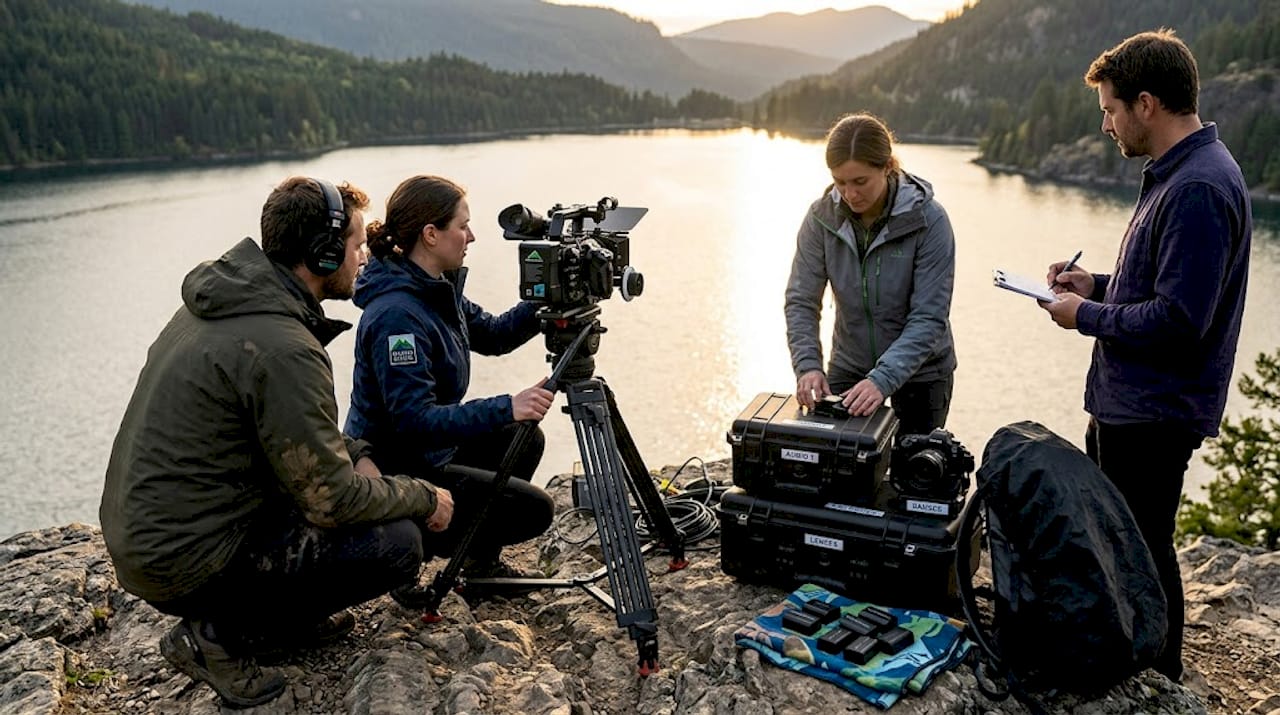
As outdoor production guidance consistently shows, most outdoor-video guidance focuses on craft and shot planning, and this is crucial, but it must go alongside strategy. That means your production plan needs a column for “Why does this shot serve the brand story?” next to every technical note.
Explore detailed production tips to sharpen your pre-production checklists before your first scout. You can also study dynamic storytelling techniques to see how story beats map to specific shot types in the field.
Pro Tip: Always pack for unexpected conditions. A sudden thunderstorm at altitude can destroy a shoot, or create your most powerful footage if your team is equipped and mentally ready to adapt. Flexibility is not a luxury in outdoor filmmaking. It is a core skill.
Backup planning is not pessimism. It is professionalism. Have a rain plan, a wind plan, and a “talent is running two hours late” plan ready before you ever leave base camp.
Shoot for story: Techniques that drive brand engagement
With cameras rolling, the focus shifts to capturing moments that truly serve the story and brand message. This is where many outdoor shoots drift into producing beautiful landscapes that feel emotionally empty. Gorgeous drone footage of a mountain range is not a story. An athlete reaching a summit and exhaling with relief, that is a story.
Shot for beauty vs. shot for story
| Approach | What you capture | Brand outcome |
|---|---|---|
| Shot for beauty | Sweeping vistas, perfect light, clean composition | Visually impressive but forgettable |
| Shot for story | Human moments, struggle, triumph, connection | Emotionally resonant, shareable, conversion-ready |
The difference is not technical. It is intentional. When you frame your camera around a human experience, every landscape becomes a backdrop that amplifies emotion rather than replacing it.
Key techniques to capture adventure and impact effectively include:
- Capture real, unscripted moments. Brief hesitations before a difficult drop. A fist bump after a hard climb. These moments cost nothing and earn everything in audience trust.
- Integrate athletes and talent authentically. Give your subjects direction for feeling, not line readings. Ask them to talk about what this moment means to them. The camera will do the rest.
- Use environmental sound deliberately. The crunch of snow underfoot, rushing water, wind through pines. These sounds place the viewer physically inside the experience. Do not let music bury them.
- Keep the focus on human experience. Your product or brand exists within the story, not as the story. The outdoor environment is the stage. Your athlete’s journey is the narrative.
As story-driven filming evidence shows, technical excellence alone is not enough. Story-driven filming is what ultimately moves the needle for brands. This is a critical insight that separates hobbyist production from professional brand filmmaking.
Understanding the photojournalist’s role in outdoor storytelling can also sharpen your instincts for finding and preserving authentic moments under pressure. The best outdoor filmmakers think like journalists: always looking for the story happening around the planned shot.
Pro Tip: Prioritize scenes that convey challenge, triumph, or transformation. These three emotional arcs are the backbone of every memorable outdoor brand film. If a scene does not contain at least one of them, question whether it belongs in the final cut. You can also use the approach outlined in captivating action content to structure your shoot around moments of peak emotional intensity.
Edit and deploy: Measuring impact and iterating
With footage in hand, the post-production and deployment stage is where brand goals are realized and measured. Editing outdoor brand films is not just a technical exercise. It is the final act of strategic storytelling.
Follow these numbered steps to move from raw footage to deployed content:
- Edit for narrative flow first. Before you touch color or music, cut your story with no audio. If it works silently, it will work with everything added on top.
- Color grade for emotional mood. Cooler tones for isolation and challenge. Warmer tones for community and reward. Your grade should reinforce the brand emotion you defined in pre-production.
- Score with intention. Music shapes how audiences interpret what they see. Choose tracks that build tension, release, or inspiration in sync with your story beats. Do not default to generic action music just because it fits the genre.
- Create channel-specific exports. A three-minute film works on your website and YouTube. Cut a 60-second version for Instagram and Facebook. Pull a 15-second vertical teaser for Stories and Reels. One production should yield multiple deployable assets.
- Publish with context. Captions, thumbnails, first frames, and posting times all affect performance. Treat distribution as part of production.
“Story without metrics is just entertainment. The magic is in measurable action.”
Once your film is live, track these KPIs consistently:
- Engagement rate. Likes, comments, shares, and saves relative to reach. High engagement signals emotional resonance.
- View duration. The percentage of viewers who watch past the first 15 seconds, the 50% mark, and to completion. Drop-off points reveal weak story moments.
- Click-through rate. How many viewers take the next step you designed? This measures conversion intent.
- Conversion rate. Purchases, sign-ups, or inquiries generated directly from the film’s deployment.
As strategy-to-KPI alignment research demonstrates, this kind of measurement is often overlooked but vital. Brands should track whether their films achieve the specific marketing outcomes they targeted before the shoot even began. When you use measuring video impact data to guide your next project, each film gets smarter and more effective than the last. Iteration is not optional. It is how professional content teams compound results over time.
Why strategic alignment beats beautiful footage every time
Here is an uncomfortable truth that most production-focused guides will not tell you: the outdoor brand films that truly move markets are not necessarily the most visually stunning. They are the ones where every creative decision traces back directly to a business objective.
Many outdoor brands fall into what we call the “beautiful trap.” They invest in elite athletes, remote locations, and world-class cinematography. The resulting film is genuinely gorgeous. It wins awards at outdoor film festivals. And then it generates a polite spike in social engagement and almost zero measurable business impact. The brand team calls it a brand-building success. The CFO calls it an expensive experiment.
The brands that consistently win treat filmmaking as a strategic marketing tool, not an art project with a logo on it. That means the director’s brief includes KPIs. That means the editor is told which emotional beat needs to drive the call-to-action moment. That means the distribution plan is built before the shoot, not after the edit is delivered.
Explicit alignment between filmmaking and business objectives is what many guides miss, yet it defines real brand success. We have seen this pattern repeatedly in high-performing outdoor content. The film that drives actual sales is rarely the prettiest one. It is the one where the story was engineered around a specific audience insight and a measurable desired behavior.
This does not mean abandoning creative ambition. Quite the opposite. When strategy is tight, creative freedom actually expands. You know exactly what emotional territory you need to cover, so you can be bold and experimental in how you cover it. The constraint sharpens the work. You can explore dynamic outdoor videography to see how creative technique and strategic clarity reinforce each other rather than compete.
The most effective outdoor brand filmmakers are not the ones who chase the most dramatic shot. They are the ones who ask, “Does this serve the story and the strategy?” every single time they raise the camera.
Access expert filmmaking and photography for your brand
If you’re ready to turn strategy into world-class outdoor brand content, expert help is just one step away. Translating the frameworks in this guide into actual production requires technical depth, creative instinct, and years of field experience in demanding outdoor environments.
Explore the full range of styles and techniques that define high-impact outdoor visual content. Dig into practical action videography tips to sharpen your team’s execution on location. And if you want a deeper creative foundation, the outdoor storytelling techniques resource will help you build narrative structure into every shot. Whether you are planning a major campaign or an editorial shoot, working with a specialist who lives and works in these environments means your brand gets content that is both technically precise and emotionally authentic. That combination is what converts viewers into customers.
Frequently asked questions
Why is filmmaking important for outdoor brands?
Filmmaking brings outdoor brands to life by showcasing authentic experiences that connect emotionally with audiences and drive engagement far more effectively than static imagery alone.
What’s the most common mistake outdoor brands make with video?
Most brands focus heavily on visuals and production craft but fail to align their videos with specific marketing goals and KPIs, which means beautiful films never generate measurable business results.
How can brands measure the success of their films?
Track key indicators like engagement rates, view duration, click-through rates, and conversions. Measuring these outcomes against the objectives set before production is the clearest way to determine a film’s real marketing value.
Do outdoor brand videos need a big budget to be effective?
No. A strategic story aligned tightly with brand goals will consistently outperform expensive but unfocused productions. Budget matters far less than clarity of purpose and quality of storytelling.


