

Outdoor production planning is the process of designing and managing every technical and logistical element needed to execute a successful event in an open-air environment without permanent infrastructure. Unlike a ballroom booking, outdoor production management requires roughly 200% more logistical foresight because planners must build a world-class temporary venue from nothing. Power, structures, weather protection, site access, and vendor coordination all start at zero. For event planners and production managers working on adventure and action-focused projects, mastering this discipline is the difference between a flawless production and a costly, chaotic failure.
What is outdoor production planning and why does it matter?
Outdoor production planning is the systematic orchestration of technical infrastructure, site logistics, environmental risk management, and scheduling to deliver a controlled event in an uncontrolled setting. The industry term used by production professionals is outdoor event production management, and it covers everything from power generation to stage anchoring to weather contingency protocols. Planners who treat it as simply “moving an indoor show outside” consistently run into expensive problems.
The core challenge is that outdoor environments offer no fixed utilities, no climate control, and no structural anchor points. Every element must be sourced, transported, installed, and protected. That scope demands a master blueprint before any vendor is contacted or any budget is committed.
| Element | Indoor production | Outdoor production |
|---|---|---|
| Power supply | Fixed building circuits | Industrial generators, 5,000–12,000 watts |
| Structural anchoring | Permanent walls and rigging | Ground anchors, ballast, engineered staging |
| Weather protection | Climate-controlled building | IP65-rated gear, stage roof structures |
| Site data | Floor plans available | Physical survey with laser mapping required |
| Lead time | 4–8 weeks typical | 3–12 months depending on scale |
This comparison shows why outdoor production strategies require a fundamentally different planning mindset. Every category demands a custom solution rather than a standard booking.
How do site assessment and terrain management impact outdoor production success?
Site assessment is the foundation of every outdoor production. Satellite imagery misses critical terrain variables like slope gradient, soil stability, drainage patterns, and prevailing wind direction. A physical survey using laser-point mapping, converted into a CAD model, gives planners exact elevations and safe rigging positions.
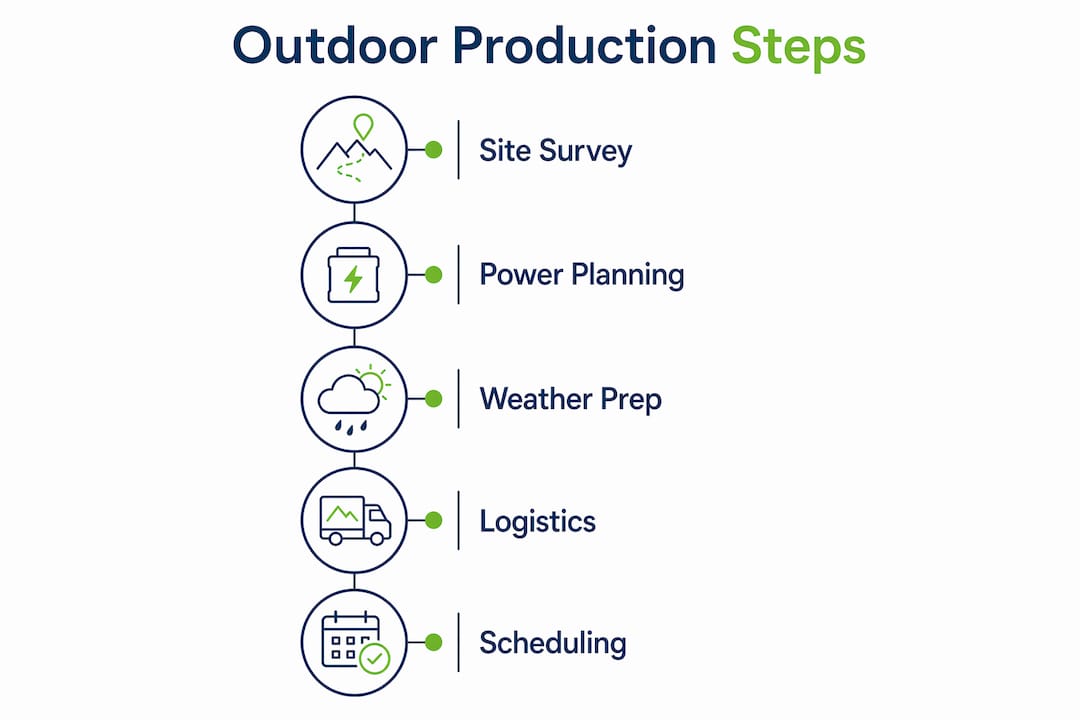
Skipping a thorough site survey is one of the most expensive mistakes in planning outdoor projects. Lack of site assessment leads to mid-project pivots, extended timelines, and budget overruns that could have been avoided entirely. A mountain biking event staged on a slope that looks flat on a map but drops two meters across the stage footprint creates structural and safety failures that no amount of day-of problem-solving can fix.
Before any build begins, check these site variables:
- Slope and elevation changes across the full footprint, not just the stage area
- Soil type and load-bearing capacity for heavy equipment and vehicle access
- Drainage paths to identify flood risk zones during rain events
- Wind exposure from all compass directions, including seasonal patterns
- Access routes for trucks, generators, and emergency vehicles
- Underground utilities that restrict ground anchor placement
- Proximity to noise-sensitive zones that affect permit conditions
Pro Tip: Run a collaborative “same page” meeting with your survey team, rigging crew, and production manager before finalizing the site plan. Early team alignment eliminates conflicting assumptions that cause costly rework during the build.
What are best practices for power and technical infrastructure planning outdoors?
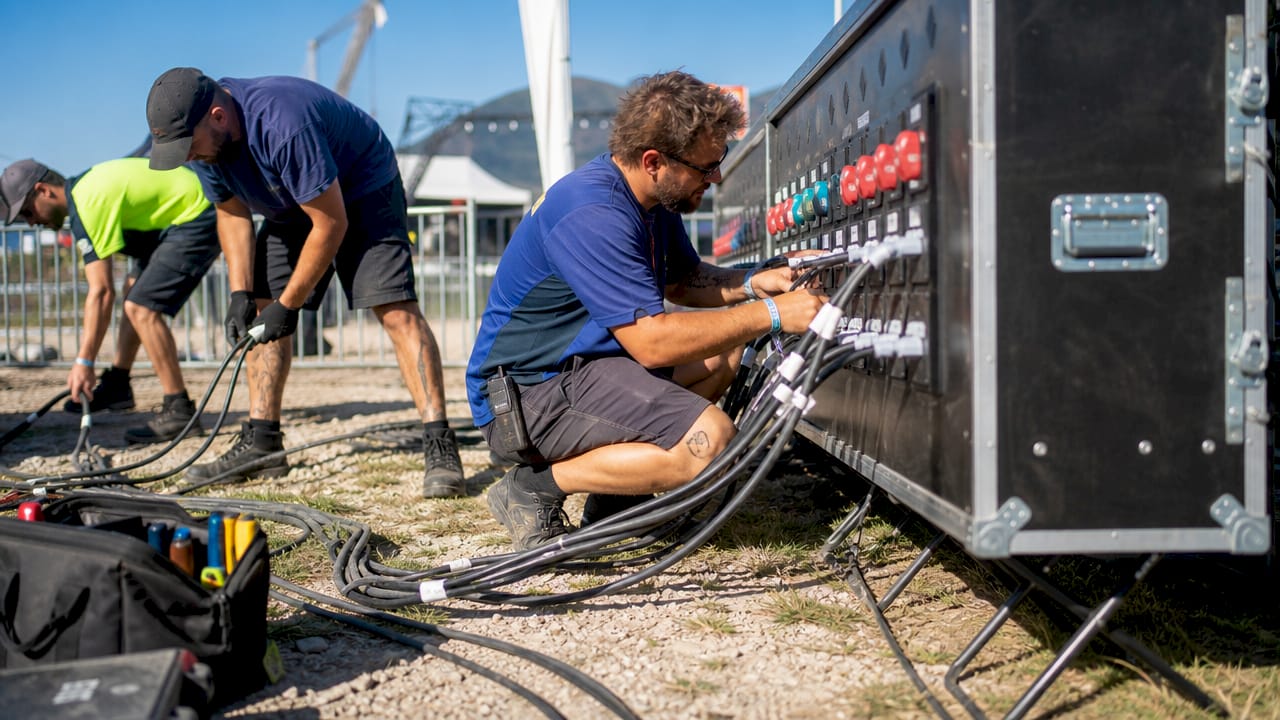
Power planning is the most underestimated technical challenge in outdoor production management. A standard 15-amp residential circuit delivers 1,800 watts. A professional outdoor setup requires 5,000–12,000 watts to run audio systems, lighting rigs, video walls, and catering equipment simultaneously. That gap cannot be bridged with extension cords and household circuits.
The industry standard is to add a 20–25% power safety margin on top of your calculated load. This buffer absorbs environmental stress, motor startup surges, and unexpected equipment additions. Whisper-quiet industrial generators such as the Honda EU7000i are the preferred choice for events where generator noise would bleed into audio zones.
Weather protection for technical equipment is not optional. IP65-rated equipment and robust stage roof structures prevent weather-related failures that can shut down an entire production. IP65 means the equipment is fully protected against dust and water jets from any direction. Specifying this rating at the procurement stage, not as a last-minute upgrade, keeps the production running through unexpected weather.
A centralized Technical Operations Center is the command hub for every outdoor event. The TOC monitors audio, power, network, and weather conditions in real time, functioning as air traffic control for the entire production. Without a TOC, technical issues escalate before anyone with authority to act even knows they exist.
Follow these steps to set up technical infrastructure before event day:
- Complete the site CAD model and identify power distribution node locations.
- Calculate total wattage for all technical departments, then add the 25% safety margin.
- Select and position generators based on noise zones, fuel access, and load requirements.
- Design the power distribution layout with dedicated circuits for audio, lighting, and video.
- Install the TOC with monitoring feeds for power draw, network status, and weather alerts.
- Test all IP65-rated equipment under simulated load before the first rehearsal.
- Run a full technical rehearsal at least 24 hours before the event opens.
Pro Tip: Label every circuit breaker and cable run at installation. During a live event, a labeled system cuts fault-finding time from minutes to seconds.
How to develop a production schedule and logistics plan for outdoor events?
Scheduling is where outdoor production strategies either hold together or fall apart. Major outdoor events require 6–12 months of advance planning. Smaller productions still need 3–4 months to secure permits, book vendors, and confirm site access. Peak season runs from may through october, and demand for quality vendors in that window is high. Book early or accept compromises.
The production schedule must account for every phase of the project, not just the event day itself. Site preparation, equipment staging, crew travel, rehearsals, and teardown all require dedicated time blocks with buffer built in. A schedule with no buffer is a schedule that will fail.
A practical outdoor project scheduling timeline looks like this:
- 6–12 months out: Secure venue permits, confirm site survey, book key vendors and generators
- 3–6 months out: Finalize technical rider, confirm power and structural engineering, order long-lead equipment
- 6–8 weeks out: Conduct full site walkthrough with all department heads, finalize CAD drawings
- 2–4 weeks out: Confirm crew travel, accommodation, and catering logistics
- Build week: Stage equipment delivery, infrastructure installation, TOC setup
- Day before: Full technical rehearsal, weather briefing, contingency protocol review
- Event day: TOC active from first crew call, all department heads on radio check-in schedule
- Teardown: Scheduled with the same rigor as build, including site restoration requirements
Communication workflows are as critical as the schedule itself. Stakeholders who receive updates only at formal meetings miss real-time changes that affect their departments. A shared digital production schedule with daily update protocols keeps every vendor, crew chief, and client contact working from the same information. Collaborative team meetings that integrate survey data, rigging plans, and production timelines prevent the kind of conflicting assumptions that derail builds mid-execution.
Budget contingency follows the same logic as power margins. Build a reserve of at least 15–20% of total production budget for weather-driven changes, permit delays, and equipment substitutions. Outdoor environments are unpredictable by definition. A contingency fund is not pessimism. It is professional practice.
Key Takeaways
Outdoor production planning succeeds when site data, power infrastructure, weather contingency, and scheduling are treated as integrated design elements, not separate checklists.
| Point | Details |
|---|---|
| Site survey is non-negotiable | Physical laser mapping into CAD prevents costly structural and safety failures. |
| Power needs a safety margin | Add 20–25% above calculated load to handle surges and environmental stress. |
| IP65 rating is the baseline | Specify weather-rated equipment at procurement, not as a last-minute upgrade. |
| Lead times are longer than expected | Book major event vendors 6–12 months out; peak season fills fast. |
| A TOC prevents crises | Centralized monitoring of power, audio, and weather stops small issues from becoming shutdowns. |
What I’ve learned from years of working in uncontrolled outdoor environments
The biggest misconception I see from planners new to outdoor production is treating the environment as a backdrop. They focus on the program, the talent, the brand experience, and assume the technical side will sort itself out. It never does.
Every outdoor location I have worked in, from alpine trails to desert flats, has taught me the same lesson. The environment is not a setting. It is an active variable that will test every decision you made in the planning phase. The planners who thrive are the ones who treat weather contingency as a primary design element, not a footnote. They spec IP65 gear from day one. They build the TOC before they build the stage. They run the site survey before they sign the contract.
The other mistake I see constantly is “feature-first” planning. A client wants a specific visual effect, a dramatic stage position, a particular camera angle for outdoor brand visuals. So the team designs around that feature without a master blueprint. Then the survey reveals the soil won’t hold the anchor loads. Or the drainage runs directly under the proposed stage footprint. Fixing those problems mid-build costs more than the feature was ever worth.
The workflow that actually works converts every piece of field data into a digital model before any vendor is confirmed. That model becomes the single source of truth for every department. When the rigging team, the power team, and the production team are all working from the same CAD file, conflicts get resolved in a meeting room, not on-site during a build. That shift alone separates productions that run clean from productions that limp across the finish line.
— Martin
Bissig’s outdoor production expertise in action
Effective outdoor production planning creates the conditions for extraordinary visual storytelling. When the technical foundation is solid, the creative work can reach its full potential.
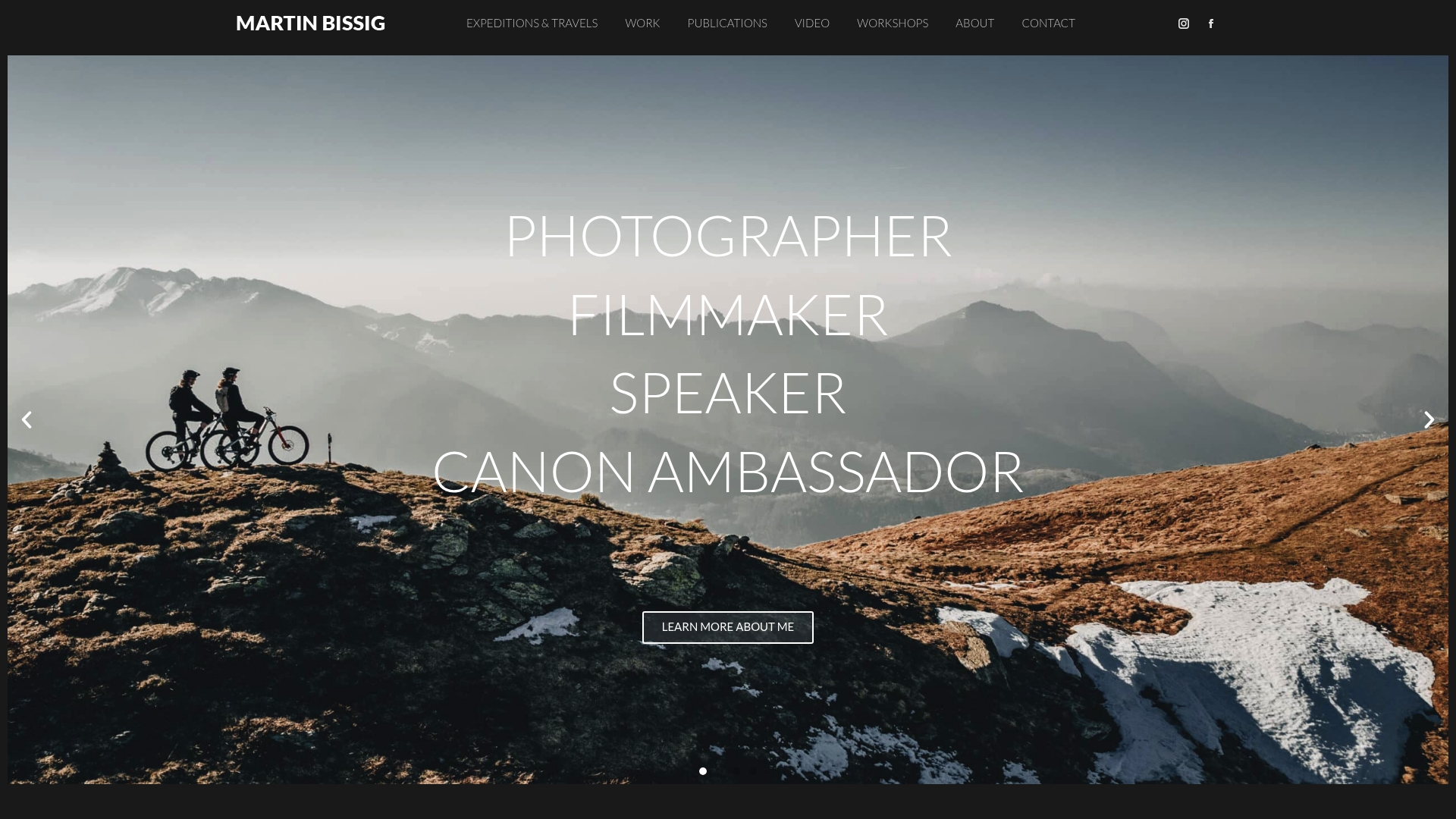
Bissig specializes in action sports videography and outdoor photography for adventure brands, capturing dynamic footage in the same demanding environments that challenge production managers every day. From mountain biking sequences to high-altitude expedition coverage, Bissig’s work is built on the same principles that drive great outdoor production: precise preparation, deep site knowledge, and contingency thinking baked in from the start. Brands and event producers looking for outdoor photography and filmmaking that matches the quality of their production investment will find that expertise at bissig.ch.
FAQ
What is outdoor production planning?
Outdoor production planning is the process of coordinating all technical, logistical, and environmental elements needed to execute an event in an open-air setting without permanent infrastructure. It covers power generation, site assessment, weather contingency, structural staging, and scheduling.
How far in advance should you start planning an outdoor event?
Major outdoor events require 6–12 months of advance planning. Smaller productions need at least 3–4 months, particularly for securing permits and booking vendors during the peak may through october season.
Why is a physical site survey necessary for outdoor events?
Satellite imagery cannot capture slope, soil stability, drainage, or wind exposure with the accuracy needed for safe staging. A physical survey using laser-point mapping converted into a CAD model gives planners the precise data required for structural and rigging decisions.
What power capacity does a professional outdoor event need?
Professional outdoor setups typically require 5,000–12,000 watts, far beyond what standard circuits provide. Planners add a 20–25% safety margin on top of the calculated load to handle environmental stress and equipment surges.
What is a Technical Operations Center in outdoor production?
A Technical Operations Center is a centralized monitoring hub that tracks audio, power, network, and weather conditions in real time during an outdoor event. It functions as the command point for all technical departments, allowing crews to identify and resolve issues before they affect the audience.


