

Most business leaders assume that a polished smartphone clip gets the job done. It does not. The question of why invest in professional video comes down to measurable outcomes: conversion rates, brand authority, and long-term search traffic that low-budget production simply cannot replicate. In 2026, with video ad spending at $236 billion globally, the stakes for getting video right have never been higher. This article gives you the data, the framework, and the honest perspective to make that investment decision with confidence.
Table of Contents
- Key takeaways
- Why invest in professional video: the 2026 data case
- Core benefits of professional video for brands
- Professional vs. DIY video: what actually matters
- How to maximize the return on your video investment
- My take on professional video investment
- Work with Bissig on your next video project
- FAQ
Key takeaways
| Point | Details |
|---|---|
| ROI is real but measurable | 82% of video marketers report good ROI, but only when production is tied to clear KPIs. |
| Quality alone does not convert | Beautiful video without strategic messaging fails to move buyers; story and intent drive results. |
| Video multiplies other channels | Landing pages, email campaigns, and SEO all perform significantly better with integrated video assets. |
| Professional vs. DIY has a clear line | Skilled storytelling, crew expertise, and production planning separate content that builds brands from content that gets scrolled past. |
| Measure before you shoot | Define funnel-stage KPIs and attribution paths before production begins, not after the invoice arrives. |
Why invest in professional video: the 2026 data case
The skepticism is understandable. AI tools now generate acceptable video content at a fraction of historical costs, and social platforms reward volume over polish. So why should a business leader write a check for professional production?
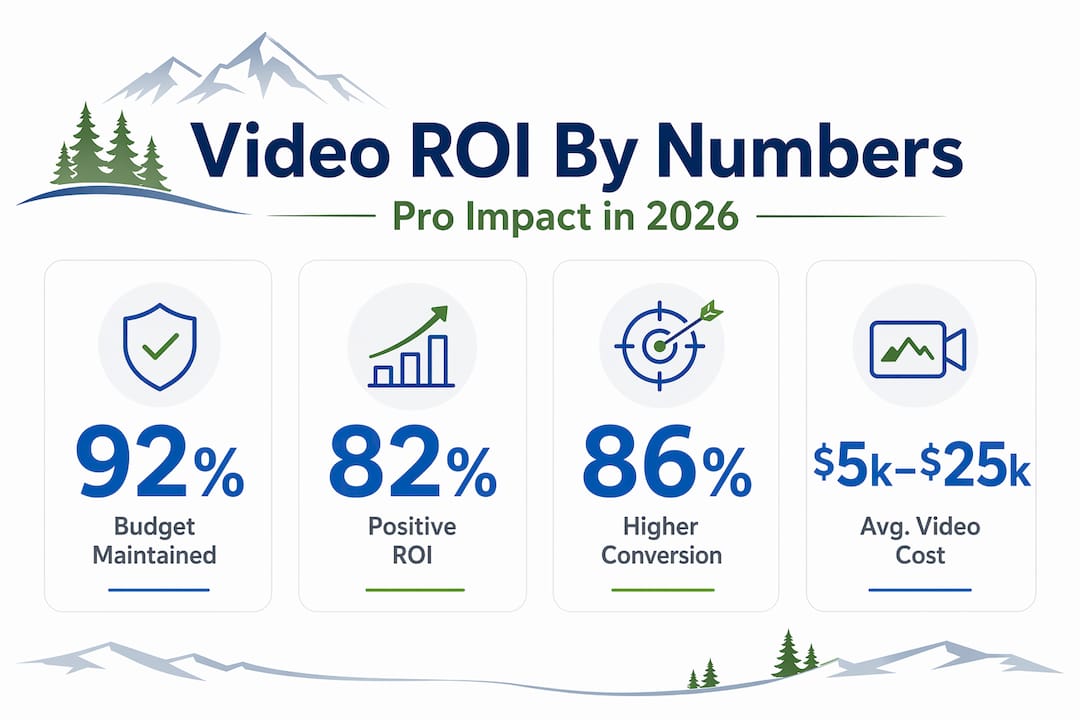
Here is what the numbers actually show. 92% of marketers maintained or increased their video budgets in 2026, not because it feels right, but because video consistently outperforms other content formats across awareness, consideration, and conversion stages. The global video ad market reflects a decade of compounding proof, not trend-chasing.
The ROI picture is nuanced. 82% of video marketers report solid ROI in 2026, a figure that dropped from 93% the prior year. That decline is meaningful. Expectations from audiences have risen sharply because the volume of video content has exploded. Generic, low-effort video no longer clears the bar. Professional production does not just look better. It performs better because it is built with a strategy.
Consider the traffic and conversion implications. Video on landing pages drives 86% higher conversions and generates 41% more web traffic from organic search. Those are not marginal gains. For a B2B company generating 500 leads per month, that conversion lift translates directly to pipeline. The math on a $15,000 production investment gets straightforward fast.
On the production cost side, professional brand videos range from $5,000 to $25,000 depending on scope, talent, and location. That range sounds wide, but it reflects the flexibility available to brands at different stages. What does not flex is the return: increased SEO ranking, consumer trust, and conversion improvements in the range of 32%.
| Video type | Avg. cost range | Primary business impact |
|---|---|---|
| Brand story film | $10,000 to $25,000 | Awareness and trust building |
| Product demo video | $5,000 to $15,000 | Consideration and conversion |
| Social content series | $3,000 to $10,000 | Engagement and retargeting |
| Testimonial video | $2,000 to $8,000 | Late-funnel purchase confidence |
Core benefits of professional video for brands
The importance of video marketing goes well beyond visibility. Professional video changes the relationship between a brand and its audience in three specific ways that DIY content rarely achieves.
Credibility and trust. Viewers form judgments about a brand’s competence and reliability within seconds of hitting play. Shaky footage, inconsistent audio, and flat lighting do not just look amateurish. They signal that the brand does not take itself or its customer seriously. Professional production communicates that a brand is worth paying attention to before a single word of copy lands.

Comprehension and decision influence. This is one of the most underappreciated benefits of professional video. People process visual information dramatically faster than text. A well-produced product explanation or brand film compresses a complex value proposition into 90 seconds in a way that a landing page paragraph never will. Viewers who watch a product video are significantly more likely to purchase than those who only read about it.
Search and long-term discoverability. YouTube’s 2.53 billion monthly users make it the second-largest search engine on the planet. A professionally produced video optimized for YouTube does not just perform at launch. It accumulates views, backlinks, and search authority over months and years. That is a compounding asset, not a one-time spend. The advantages of hiring videographers who understand both storytelling and search optimization multiplies that long-term return.
“The brands that win with video are the ones that treat each production as a strategic asset with a clear audience, a clear goal, and a clear measurement plan. Everything else is expensive decoration.”
Beyond those three pillars, professional video drives measurable social sharing, improves email campaign performance, and strengthens brand recall in ways that text and static image content cannot match. The value of corporate video production is not abstract. It shows up in your analytics.
Professional vs. DIY video: what actually matters
The conversation about production quality versus DIY is frequently framed wrong. It is not purely about resolution or camera gear. The distinction between quality and storytelling is more consequential than most business leaders realize when approving a budget.
Professional production brings three things that no AI tool or in-house team replicates without significant experience: strategic script development tied to audience psychology, technical execution across lighting, color, and audio that communicates brand standards subliminally, and post-production judgment that shapes pacing, music, and emotion. These are craft skills. They take years to develop.
That said, over half of companies now build some in-house video capability, and that makes sense for high-frequency, lower-stakes content like behind-the-scenes clips, quick social updates, and internal communications. Where professional production becomes non-negotiable is at the brand level: hero content, product launches, campaign films, and anything that represents the brand in a paid media context.
AI tools have genuinely lowered the floor for basic video production. But they have simultaneously raised the ceiling of audience expectations. Consumers in 2026 favor highly relevant personalized video over generic polished content, which means professional producers must now deliver both technical excellence and authentic storytelling. That combination requires human judgment, not just better software.
Pro Tip: Before committing to a production budget, ask one question: what specific funnel action does this video need to drive? If you cannot answer that cleanly, the brief is not ready. Defining KPIs before production is the single fastest way to stop funding beautiful content that does not convert.
Here is where most brand video investments go wrong. The team spends weeks obsessing over cinematography and zero time planning how the video integrates into a campaign. A stunning 3-minute brand film sitting on a homepage with no promotion strategy, no A/B testing, and no tracking is not a video marketing investment. It is an expensive art project. Strategic outdoor filmmaking for brands requires marrying production craft with distribution and measurement thinking from day one.
How to maximize the return on your video investment
The impact of quality video content is only realized when production is connected to a deliberate marketing system. Here is a practical framework for making that connection.
-
Set KPIs before the brief. Every video should trace back to a specific business metric: lead volume, conversion rate, time on page, or email click-through rate. Without that anchor, you have no basis for evaluating success or iterating on future productions.
-
Match content type to funnel stage. Brand films and documentary-style content belong at the top of the funnel where awareness is the goal. Product demos and case study videos belong in the middle where consideration happens. Testimonial and social proof videos close at the bottom. Mixing these up burns budget and dilutes messaging.
-
Integrate video with landing pages and email campaigns. Video thumbnails in email campaigns drive 200 to 300% higher click-through rates than text-only messages. This is one of the highest-leverage, lowest-cost ways to extract more value from an existing video asset. Critically, link those thumbnails to owned hosting pages rather than YouTube to keep traffic in your controlled environment.
-
Build attribution into your tracking setup. UTM parameters, heatmaps, and video engagement analytics tell you which assets are driving pipeline movement. Without these, video marketing devolves into a feel-good exercise with no accountability.
-
Use AI tools for speed, not substitution. AI-assisted editing, captioning, and clip repurposing dramatically reduce the cost of content distribution. Use those tools to extend the reach of professionally produced hero content, not to replace it.
Pro Tip: For outdoor and adventure brands, the return on professional video is amplified when raw footage libraries are captured during a single production and then repurposed across seasons. One well-planned shoot can supply a full quarter of content across social, email, and paid media.
My take on professional video investment
I have spent years shooting commercial video for outdoor and adventure brands across some of the most demanding environments on earth, from alpine ridgelines in the Alps to red rock canyons in California. What I have learned about why invest in professional video has less to do with camera specs and everything to do with trust.
Brands come to me when they have already tried the shortcut. They have the intern-shot reel, the AI-generated product highlight, and the founder’s talking-head video filmed in a conference room. Those assets are not useless, but they are rarely doing the heavy lifting of brand building. The brands that see genuine returns from video are the ones that treat production as a marketing function, not a creative indulgence.
What most business leaders overlook when budgeting for video is not the shoot cost. It is the distribution and measurement infrastructure around it. I have seen $20,000 productions sit unwatched because there was no plan to get them in front of the right audience at the right moment. And I have seen $8,000 productions generate six-figure pipeline because they were embedded into a campaign with clear attribution and a smart media buy behind them.
The balance between quality, relevance, and authenticity is real. A technically perfect video that feels staged loses to an authentic one with genuine story every time. My job is to find that story in the environment, in the athlete, in the product working under real conditions, and to capture it in a way that makes the viewer feel something before they even consciously register the brand.
Professional video ROI is not guaranteed by budget. It is earned by strategy, craft, and follow-through.
— Martin
Work with Bissig on your next video project
Bissig brings over a decade of commercial filmmaking experience to outdoor and adventure brands that need more than footage. They need a story that performs. Whether you are launching a product, building brand authority in a competitive outdoor market, or looking to anchor a campaign with a hero film that works across channels, Bissig’s commercial outdoor videography work delivers the technical excellence and narrative depth that moves audiences. From pre-production strategy through final delivery, the focus stays on content that serves your marketing goals, not just your creative brief. Explore Bissig’s video portfolio or reach out directly to discuss your next production.
FAQ
What is the ROI of professional video marketing?
82% of video marketers report good ROI from video in 2026, with the strongest returns coming from video integrated into landing pages, email campaigns, and organic search through YouTube.
How does professional video differ from DIY content?
Professional video combines strategic scripting, technical production quality, and intentional storytelling built around audience psychology. DIY content may look visually adequate but rarely delivers the brand authority or conversion performance that professional production achieves.
Can small businesses justify investing in professional video?
Yes. The advantages of hiring videographers compound over time as professionally produced assets are repurposed across email, social, and paid channels. A single well-planned shoot can supply months of marketing content.
How much does professional brand video production cost?
Brand video production typically ranges from $5,000 to $25,000 depending on scope, crew size, and location. That investment delivers measurable returns across SEO rankings, consumer trust, and conversion rates.
What KPIs should I track for video marketing?
Track video completion rates, landing page conversion rate before and after video integration, email click-through rate with video thumbnails, and organic search traffic growth tied to YouTube content. Defining these metrics before production is what separates effective video marketing from expensive guesswork.


