

Sports photography doesn’t forgive indecision. When a mountain biker launches off a cliff edge or a sprinter breaks the tape, you have fractions of a second to get the shot. The must-have gear for sports photographers isn’t about buying the most expensive kit. It’s about matching the right tools to the demands of speed, unpredictable light, and physical endurance that define every serious shoot. This guide breaks down exactly what belongs in your bag, why it matters, and how to build your kit without wasting money on redundant gear.
Table of Contents
- Key takeaways
- 1. Must-have gear for sports photographers: the right camera body
- 2. Best lenses for sports shooters
- 3. Camera accessories that keep you shooting longer
- 4. Camera settings and techniques your gear must support
- 5. Comparative gear overview
- My honest take on gear versus skill
- Take your sports photography further with Bissig
- FAQ
Key takeaways
| Point | Details |
|---|---|
| Burst rate and autofocus are non-negotiable | Modern sports cameras offer up to 120 fps with AI subject tracking to capture split-second action. |
| The 70-200mm f/2.8 is your foundation lens | Start with this versatile zoom before adding specialized glass to your kit. |
| Accessories determine your stamina | Extra batteries, fast memory cards, and a monopod separate a full shoot from a frustrating one. |
| Shutter speed wins the moment | Use 1/1000s as your baseline, with 1/2000s or faster for racquet and high-speed sports. |
| Skill compounds gear investment | Understanding sport rhythm and timing returns more than owning every piece of new equipment. |
1. Must-have gear for sports photographers: the right camera body
The camera body is where every gear decision starts. For sports, the spec that matters first is burst rate. Up to 120 fps bursts with AI-driven subject detection have become the new standard in flagship bodies, and that gap between 10 fps and 30 fps is the difference between getting the peak moment and getting the frame just before it.
Three bodies define the top tier right now:
- Sony A9 III uses a global shutter to eliminate rolling shutter distortion, making it exceptional for fast lateral movement like cycling sprints or skateboarding.
- Canon EOS R3 offers eye-controlled autofocus that moves the AF point wherever you look through the viewfinder, a genuine advantage when tracking unpredictable athletes.
- Nikon Z9 delivers a mechanical-shutter-free design with serious weather protection, making it a top choice for outdoor and adventure sports.
All three share the features that matter most on the field: blackout-free EVFs for uninterrupted tracking, dual card slots for redundancy, and magnesium alloy bodies with full weather sealing.
Pro Tip: If you’re working with a mid-range budget, look for cameras offering at least 15 fps with phase-detect autofocus across the full sensor. You don’t need 120 fps for most sports. You need consistent, reliable tracking.
2. Best lenses for sports shooters
Lenses shape what’s possible more than any other piece of gear. The 70-200mm f/2.8 is the workhorse of sports photography for one simple reason: it covers the distance range where most action happens while keeping the wide f/2.8 aperture you need in variable light. Get one of these first. Everything else is specialized.
From there, your lens selection depends on the sport:
- 300mm f/2.8 or 400mm f/2.8 prime for football, soccer, and track and field where athletes are far from the sideline and you need maximum reach with fast glass.
- 100-400mm or 150-600mm zoom for versatility at events where your position changes and you can’t carry multiple primes.
- 85mm f/1.4 or 135mm f/1.8 for indoor sports like basketball or gymnastics, where high ISO and wide apertures compensate for arena lighting and let you hold shutter speeds fast enough to freeze motion cleanly.
Image stabilization matters more on telephoto lenses than most photographers realize. At 400mm, even a steady hand introduces blur at the shutter speeds slower sports require. Optical or in-body stabilization gives you real latitude. Autofocus speed matters too. Lenses with linear focus motors lock onto subjects noticeably faster than older ring-type motors, and that millisecond counts when a rider is coming straight at you.
Pro Tip: Rent before you buy. A 600mm prime rental for a weekend event will tell you whether the weight and working distance actually suit how you shoot. Most photographers who commit to one early discover it’s not their primary lens.
3. Camera accessories that keep you shooting longer
The right camera accessories for sports photographers are the ones that remove friction. Your body and lens are only as useful as the support system around them.
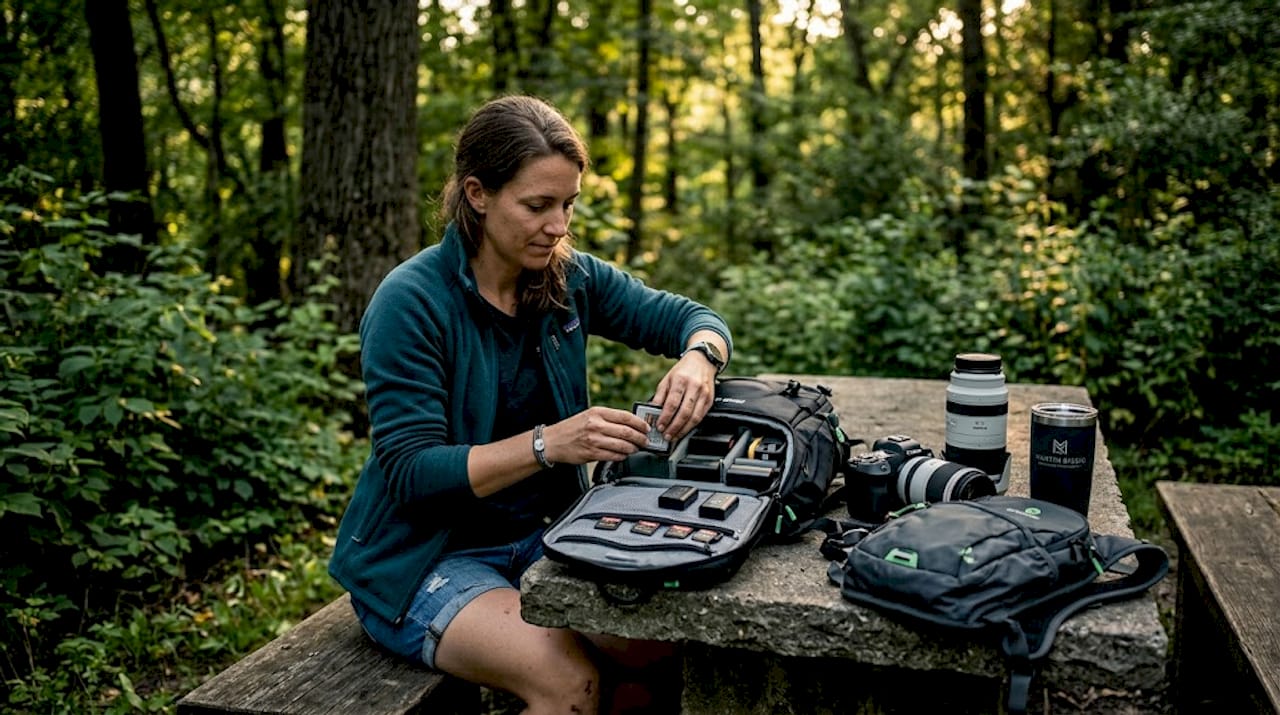
Monopods give you the stability of a tripod with the mobility of shooting handheld. At a three-hour football match with a 400mm f/2.8, your arm will fail before the final whistle. A quality monopod cuts fatigue and delivers sharper images through the whole session.
Extra batteries and CFexpress cards are not optional. Cold-weather outdoor events can halve battery life. Burst shooting fills cards faster than you expect. Carry at minimum two extra batteries and two backup cards for any serious assignment. CFexpress Type B or Type A cards matched to your body’s slot type give you the write speeds necessary when you’re hammering 30 fps bursts.
Rain covers protect expensive gear from getting saturated during outdoor events. Most pro bodies include solid weather sealing, but a rain sleeve adds cheap insurance, especially for lenses that seal less comprehensively than bodies. A padded, modular camera bag or holster lets you access a second body or swap lenses on the sideline without setting anything on wet grass.
Pro Tip: Invest in a dual-body harness if you regularly shoot events where you need two focal lengths ready instantly. Swapping lenses costs you shots. Running two bodies costs you nothing except weight.
4. Camera settings and techniques your gear must support
Great gear only produces great images when your settings match the moment. The first number every sports photographer needs to internalize is shutter speed. At 1/1000s, you can freeze most athletic movement cleanly. For racquet sports, motocross, or any sport with fast rotation or impact, push to 1/2000s or above. The only way to hold those shutter speeds in low light is with wide apertures and high ISO. This is why f/2.8 glass and modern sensors with strong high-ISO performance aren’t luxuries. They’re functional requirements.
Burst mode is powerful and easy to misuse. Shorter, targeted burst sequences give you the decisive moment without flooding your card with 200 near-identical frames. Anticipate the peak of action and fire in a controlled two- to four-frame burst at that moment. Your editing time drops significantly and your keeper rate improves.
Back-button autofocus separates AF activation from the shutter button, giving you independent control over when focus locks and when you shoot. Combined with subject-tracking or zone AF modes, it lets you pre-acquire focus on an approaching athlete and hold it without accidentally resetting. For anything faster than a hiking trail, this setup is worth spending an afternoon to master.
Pro Tip: Set your camera’s high ISO noise reduction to low or off and handle noise in post. In-camera processing can soften fine details, and you’ll want full resolution data from your RAW files when sharpening edge detail on fast subjects.
5. Comparative gear overview
| Gear | Key spec | Best for | Consideration |
|---|---|---|---|
| Sony A9 III | Global shutter, 120 fps | High-speed lateral action | Premium price point |
| Canon EOS R3 | Eye-tracking AF, 30 fps | Unpredictable movement | Heavy body |
| Nikon Z9 | No mechanical shutter, dual slots | Outdoor / weather environments | Large form factor |
| 70-200mm f/2.8 | Versatile range, fast AF | All-around sports | Essential first lens |
| 300mm or 400mm f/2.8 prime | Maximum reach and aperture | Field sports, track | Heavy and expensive |
| 100-400mm zoom | Variable reach | Event and sideline shooting | Smaller max aperture |
| Carbon fiber monopod | Lightweight, stable | Long telephoto support | Requires practice |
| CFexpress card | High write speed | Burst mode shooting | Specific to body slot type |
The table above reflects the sports photography gear checklist that covers most professional shooting scenarios. Budget entry points exist for every category. The Canon EOS R7 or Sony A6700 serve as capable APS-C alternatives to the flagships for photographers building their kit progressively.
My honest take on gear versus skill
I’ve watched photographers spend more on a single lens than I spent building my first complete outdoor kit. And I’ve watched them come home disappointed because their images still didn’t deliver.
Here’s what I’ve learned across years of shooting mountain biking, adventure sports, and outdoor action: timing and anticipation are skills you cannot buy. Mastering a versatile lens like the 70-200mm f/2.8 teaches you more about sports photography than cycling through six specialized lenses ever will. You start to understand the sport’s rhythm. You learn where the decisive moment actually lives, not where you assume it does.
The risk with essential equipment for sports photography discussions is that they can feed gear acquisition as a substitute for practice. I’ve made that mistake. I upgraded a body when I should have spent that money on more days shooting. The camera I already owned was faster than my eye.
My advice: buy one solid, weather-sealed body, one fast zoom, and spend the rest of your budget on access. More events, more practice, more sports you don’t yet know how to read. When your timing and skill consistently outrun your gear, that’s when the upgrade pays off.
— Martin
Take your sports photography further with Bissig
If this guide gave you a clearer picture of your kit, the next step is putting those tools to real use in the field.
Bissig’s resources go deep on the technical and creative side of outdoor action photography. Whether you’re refining your outdoor photography techniques or looking for practical guidance on capturing dynamic moments, you’ll find content built from real experience in demanding environments. For photographers working specifically in adventure and outdoor settings, the adventure sports photography guide covers field-tested approaches to gear choices, positioning, and light management that go well beyond generic advice. Explore Bissig’s full range of guides at bissig.ch.
FAQ
What burst rate do I need for sports photography?
15 to 20 fps is the professional baseline, with flagship bodies reaching 30 to 120 fps for the most demanding action. Match burst rate to your sport. Most scenarios don’t require maximum fps.
What is the best lens for sports photographers starting out?
The 70-200mm f/2.8 is the standard workhorse lens for sports photography, offering the reach, aperture, and autofocus speed to cover most situations before you invest in longer glass.
How do I keep my sports photography gear safe in bad weather?
Use a camera body with full weather sealing and add a rain sleeve for extended outdoor shoots. Most pro-grade lenses also carry gasket sealing, but rain covers add a second layer of protection that costs very little.
What shutter speed should I use for sports?
Start at 1/1000s for most sports and push to 1/2000s or faster for high-speed action like racquet sports or motocross. Use wide apertures and higher ISO to maintain exposure at those speeds.
Do I need the most expensive camera body for sports photography?
No. A mid-range mirrorless body with fast phase-detect autofocus and 15 fps will handle most sports competently. Invest in sharp, fast glass before upgrading your body, since lenses return more image quality per dollar than a body upgrade alone.


