

Most people assume photojournalism is just photography with a press badge. It is not. What is photojournalism, really? It is a rigorous discipline where images serve as legal, ethical, and factual records of events. The photographer is not an artist seeking beauty. They are a reporter whose medium happens to be visual. This guide breaks down the definition of photojournalism, the ethical codes that govern it, the techniques practitioners use, and why it continues to matter in a world flooded with images. If you are serious about working in this field, this is where you start.
Table of Contents
- Key Takeaways
- What is photojournalism and how it differs from other photography
- The ethics that govern photojournalism
- How photojournalism works in practice
- Why photojournalism matters
- My take on photojournalism’s real challenges
- From photojournalism principles to outdoor photography
- FAQ
Key Takeaways
| Point | Details |
|---|---|
| Photojournalism is journalism | Images are primary news reports, not decorative additions to written stories. |
| Ethics are non-negotiable | The NPPA Code of Ethics sets binding standards for accuracy, restraint, and public trust. |
| Operational restraint matters | Photojournalists must document events without interfering in or staging what unfolds. |
| Collaboration shapes the story | Editorial teams provide context that single images alone cannot always deliver. |
| Visual storytelling is a skill | Composition, timing, and selection of images determine whether a story lands or disappears. |
What is photojournalism and how it differs from other photography
Oxford defines photojournalism as “the work of giving news using mainly photographs.” That one sentence carries enormous weight. Notice it does not mention artistic vision, personal style, or creative interpretation. The definition frames photojournalism as a news activity first, and a photographic activity second.
That distinction matters more than most beginners realize. An art photographer pursues a feeling. A documentary photographer constructs a long-form narrative over months or years. A photojournalist reports a specific event, at a specific moment, with accuracy that must hold up to public scrutiny. The primary obligation is to the facts on the ground.
Here is how photojournalism compares to related disciplines:
| Discipline | Primary goal | Editing freedom | Time pressure |
|---|---|---|---|
| Photojournalism | Report facts through images | Minimal, truth-bound | High |
| Documentary photography | Explore a theme or subject over time | Moderate | Low to moderate |
| Art photography | Express personal vision | Unrestricted | None |
| Commercial photography | Serve a client brief | High | Variable |
The line between documentary photography and photojournalism is the one most frequently blurred. Both deal in reality, but photojournalism operates within news cycles and journalistic accountability structures. Images communicate entire narratives in photojournalism, making the photograph the story rather than an illustration of it.
What defines photojournalism as a practice:
- Timeliness. The image must be relevant to a current news event.
- Accuracy. The photograph must represent what actually happened.
- Journalistic purpose. The goal is to inform the public, not to create art.
- Accountability. Photojournalists answer to editorial standards, just like writers.
Understanding the role of a photojournalist in storytelling helps clarify why these boundaries exist. Without them, news photography becomes indistinguishable from advertising or propaganda.
The ethics that govern photojournalism
No other photography discipline carries the same ethical weight as photojournalism. The NPPA Code of Ethics treats photojournalists as “trustees of the public” and makes it clear that faithful and comprehensive depiction of events is not optional. It is the baseline requirement for practicing in this field.
Why does this matter in practice? Because the camera can lie. A photograph taken from a specific angle, in a specific moment, with a specific crop can completely misrepresent what actually happened. The ethical framework exists precisely to prevent that misrepresentation.
The core ethical obligations include:
- Truthful representation. Show what happened, not what you wish had happened or what makes a more dramatic frame.
- Avoidance of manipulation. The NPPA sets clear limits on editing to prevent alterations that change the factual content of an image.
- Operational restraint. NBC News senior photo director Zara Katz is direct on this point: the visual cue is reporting unto itself, and photojournalists must not disturb the events they cover.
- Public accountability. Publishing a misleading image is not a creative misstep. It is an ethical violation with real consequences for real people.
The manipulation question comes up constantly as editing software becomes more accessible. The working rule is straightforward: you may adjust exposure, contrast, and color to accurately reflect what the eye would have seen. You may not add, remove, or reposition elements within the frame.
Pro Tip: When in doubt about an edit, ask yourself whether the change makes the photograph more accurate or less accurate. If the answer is less, do not make the change.
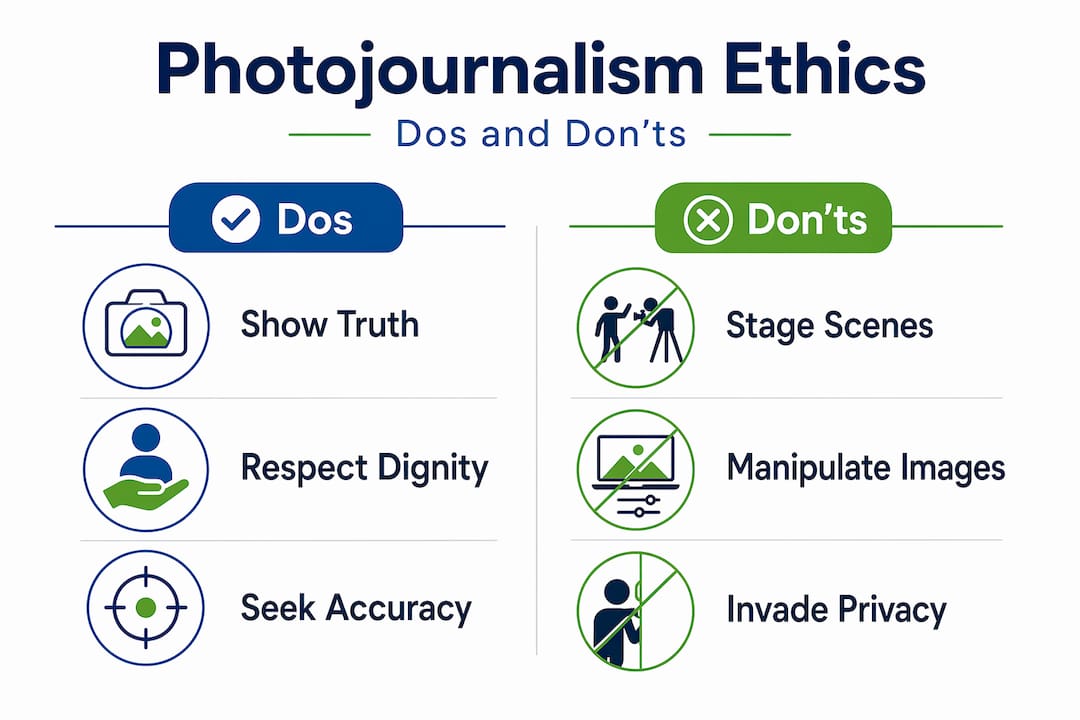
The ethical standards in photojournalism also extend to subject consent and dignity. Photographing victims of violence, disaster, or grief requires professional judgment. The NPPA framework does not prohibit such images, but it does require that they serve the public interest rather than gratuitous spectacle.
How photojournalism works in practice
Knowing the definition and ethics of photojournalism is necessary. Knowing how it actually functions in a news environment is what makes you employable.
The editorial collaboration process is central to professional photojournalism. A single image rarely tells the whole story on its own. Editors provide captions, sequencing, and context that transform a strong photograph into a complete news report. Understanding that process will make you a better photographer because you will shoot with that context in mind.
Here is how a photojournalism assignment typically unfolds:
- Assignment briefing. An editor assigns coverage of a specific event, issuing editorial direction on what aspects of the story need visual documentation.
- Pre-production research. The photojournalist researches the subject, location, and people involved. Knowing the story before you arrive means you recognize the key moment when it happens.
- On-location shooting. You document the event as it unfolds, applying restraint and avoiding interference. Operational restraint during live events is non-negotiable.
- Image selection and editing. You select images that accurately represent the event and apply only technical adjustments within ethical boundaries.
- Editorial review. Your editor reviews the selection, writes captions, and integrates your photographs into the broader news narrative.
- Publication and accountability. Once published, the images become part of the public record. Any error in representation carries consequences.
The technical and compositional skills that serve photojournalism best are not complicated in theory but demand practice. Outdoor videography techniques and photographic principles overlap here significantly. You need the ability to work in rapidly changing light, read a crowd or landscape for the decisive moment, and compose an image quickly without sacrificing clarity.
Photojournalistic outputs also vary considerably. A portrait of a public figure requires different skills than covering a protest, a natural disaster, or a sporting event. Each assignment type demands that you understand the story well enough to anticipate where the moment will happen before it does.
Why photojournalism matters
The importance of photojournalism goes beyond any single image. Images reveal truths and inspire understanding in ways that written words often cannot. That is not a sentiment. It is a functional reality of how human perception works.
Consider what photojournalism has actually accomplished historically. Images from war zones have turned public opinion and ended political careers. Photographs of civil rights confrontations in the American South during the 1960s made the abstract concrete and moved millions of people who had never witnessed such events firsthand. More recently, real-time photojournalism from conflict zones and climate disasters drives news consumption decisions and shapes how audiences understand events happening far from their daily lives.
The contrast with other media forms is worth examining. Written reporting can describe a scene in 1,000 words. A single well-made photograph can accomplish the same emotional transmission in one glance. That speed of understanding is what makes photojournalism so powerful and why it carries such ethical responsibility.
“Photojournalists are visual journalists whose work appears in news media, documentaries, and archives — images that form the public memory of our time.” — NPPA Code of Ethics framework
The challenges in photojournalism today are not mainly technical. The real pressure comes from the speed of distribution, the economics of media, and the question of trust. In an environment where cover-shot-quality images flood social platforms daily, distinguishing verified photojournalism from manipulated or miscontextualized imagery matters more than at any previous point in the profession’s history.
Photojournalism also serves an educational function that gets underappreciated. People who will never travel to a conflict zone, a climate disaster, or a political demonstration build their understanding of those events through photographs. That places an enormous responsibility on the photojournalist to get it right.
My take on photojournalism’s real challenges
In my experience working in outdoor and adventure photography, I see photographers underestimate how much discipline ethical visual reporting actually demands. It is easy to talk about objectivity. It is harder to stand in front of a scene that contradicts your expectations and still deliver an honest frame.
What I have learned is that the instinct to make the image more interesting is the most dangerous instinct a photojournalist can have. Adjusting your position to find a more dramatic angle is legitimate technique. Waiting for a subject to do something more photogenic is interference. That line is thinner than it sounds when you are in the field with a deadline and a story to tell.
The influence of social media on photojournalism concerns me more than most practitioners will admit. The platforms reward impact over accuracy. They move faster than editorial review can follow. Aspiring photojournalists entering this environment need to build their ethical foundation before their social media presence, not after.
What actually works is studying the NPPA ethics framework not as a rulebook to memorize but as a way of thinking. When I approach any assignment, I ask whether my choices serve the story or serve my ego. The answer usually makes the right path obvious.
If you want to build a sustainable career in this field, spend more time developing your editorial judgment than your editing skills. The technical side is learnable in months. The judgment takes years.
— Martin
From photojournalism principles to outdoor photography
The core discipline of photojournalism, seeing clearly, shooting honestly, and letting the image carry the story, applies directly to high-stakes outdoor and adventure photography. At Bissig, the same commitment to authentic visual storytelling drives every shoot, whether it is documenting an alpine expedition or delivering editorial imagery for a magazine spread. If you want to understand how those principles translate into professional outdoor photography, Martin Bissig’s work demonstrates exactly what rigorous visual storytelling looks like outside the news environment. For a deeper look at styles, techniques, and professional practice, the guide to outdoor photography styles covers the ground you need.
FAQ
What is the definition of photojournalism?
Photojournalism is the practice of reporting news through photographs rather than primarily through words. It combines journalistic standards of accuracy and accountability with visual storytelling.
How does photojournalism differ from documentary photography?
Photojournalism operates within news cycles and requires timely, accurate reporting of specific events. Documentary photography explores subjects over longer periods with more editorial flexibility.
What do photojournalists do on assignment?
Photojournalists research their subjects, document events without interfering, select images that accurately represent what occurred, and collaborate with editors to frame the story in context.
What ethical rules govern photojournalism?
The NPPA Code of Ethics sets the standard, requiring photojournalists to accurately and faithfully depict events, avoid image manipulation, and treat subjects with dignity.
Why is photojournalism important in modern media?
Photojournalism builds public understanding of events that audiences cannot witness directly. Images transmit information faster than written language and create lasting records that shape public memory.


