

Directing action shoots well comes down to three things: clear choreography, deliberate camera placement, and a set where everyone feels safe enough to perform at their limit. Wide shots establish the environment, medium shots carry the choreography, and close-ups land the emotional beats. Film at 60fps with a 1/120 shutter speed for smooth action sports footage that allows for slow-motion at 40% speed on a standard 24fps timeline. Use 120fps or 240fps for hero shots to achieve dramatic slow-motion effects that enhance key moments. None of that matters, though, if your cast doesn’t trust you or your crew doesn’t know the plan.
Core principles to lock in before you call action:
- Choreograph every movement to play to the camera lens, not just to look good in the room
- Mix wide, medium, and close-up shots so the editor has real options
- Shoot the full sequence first, then return for inserts and pickups
- Stay in sync with your performers: if they move fast and the camera operator lags, you miss the hit
- Brief every crew member on safety before the first take
- Collaborate with your stunt coordinator from pre-production, not the morning of the shoot
How to direct action shoots: choreography and camera technique
Fight choreography must be legible to the audience. Shaky cam cannot rescue poor staging, and tight close-ups alone cannot substitute for clear spatial geography. The audience needs to know where everyone is before they can feel the tension of what happens next.
Camera stabilization and movement:
- Use a gimbal for smooth tracking shots through complex terrain
- Switch to handheld for raw, high-energy moments that need a chaotic edge
- Lock to a tripod for static reaction shots or wide establishing frames
- Telephoto lenses (70–200mm) let you shoot from a safe distance while compressing space between performers, making near-misses look convincing
- Wide-angle lenses (16–35mm) accentuate movement and give the viewer a sense of immersion
Angles and lens choices that sell the action:
- Profile shots work best for hook punches because they reduce the visible gap between the puncher and the target
- Over-the-shoulder angles with a longer lens compress the space between characters, making a near-miss read as contact
- Frontal shots suit straight punches; profile suits hooks. Knowing the difference before you shoot saves takes
- A higher f-stop (f/5.6 to f/8) keeps more of the action in focus when performers move unpredictably
Sequencing the shoot:
Shoot the entire fight sequence first before going back for insert shots. The editor gets a complete reference, continuity stays intact, and you avoid the trap of cutting away to a pickup that no longer matches the master.
Pro Tip: Sync your camera operator to the performers’ rhythm before you roll. If the fighters are moving fast and the operator is slow, you will miss the key hit. Walk through the sequence with the operator and stunt performers together, at speed, before the first take.
Slow motion is a storytelling tool, not the default. Reserve 120fps or 240fps for the moments that deserve emphasis: the decisive blow, the fall, the reaction. Using it on every shot dilutes the impact.
The single-take “oner” is worth understanding even if you never attempt one on your first shoot. When a fight runs in one uncut shot, the audience cannot look away. The camera has to do the editing work in real time, moving to the right position to sell each hit before the next one lands. It demands precise camera choreography and extensive rehearsal, but the tension it creates is unlike anything you can achieve in the edit.
How to build trust and keep your cast safe on set
Trust is the foundation of every action shoot. Without it, actors hold back, stunts get tentative, and the footage shows it. Building that trust starts before cameras roll: sit down with your cast, talk through the character’s stakes, and make sure everyone understands what the scene demands physically and emotionally.
Safety measures that protect performance:
- Run a full safety briefing with cast and crew before any stunt sequence
- Rehearse each action beat at slow speed, then at full speed, before filming
- Involve actors in stunt planning so they understand every movement, not just their own
- Assign a dedicated safety officer or stunt coordinator to monitor each take
- Establish a clear stop word that halts the action immediately if something feels wrong
Professional stunt performers are worth every dollar, even on a tight indie budget. They know how to take a hit, sell a fall, and do it convincingly in front of the camera. An experienced stunt performer saves you takes, which saves you time, which saves you money. For high falls, fire, or explosions, there is no substitute: bring in a trained professional and do your due diligence.
Communication strategies on set:
- Give clear, specific direction: “step left two feet before the punch” beats “move around more”
- Keep the stunt coordinator in the loop on every camera angle change
- Invite the stunt coordinator into the editing room when possible. They become an ally who helps you get the most out of the footage you have
- Check in with actors between takes, especially after physically demanding sequences
A well-prepared actor performs with confidence. Encourage physical conditioning ahead of the shoot so performers feel capable, not anxious, when the camera rolls.
How lighting and timing shape your action footage
Shoot during golden hour whenever the schedule allows. The soft, directional light at sunrise and sunset enhances texture and color, wraps around moving subjects naturally, and gives your footage a cinematic quality that no color grade fully replicates. Midday overhead light flattens the image, kills shadow depth, and reduces the emotional impact of even well-choreographed action.
Lighting setups and timing best practices:
- Plan your shoot schedule around the light, not just the location
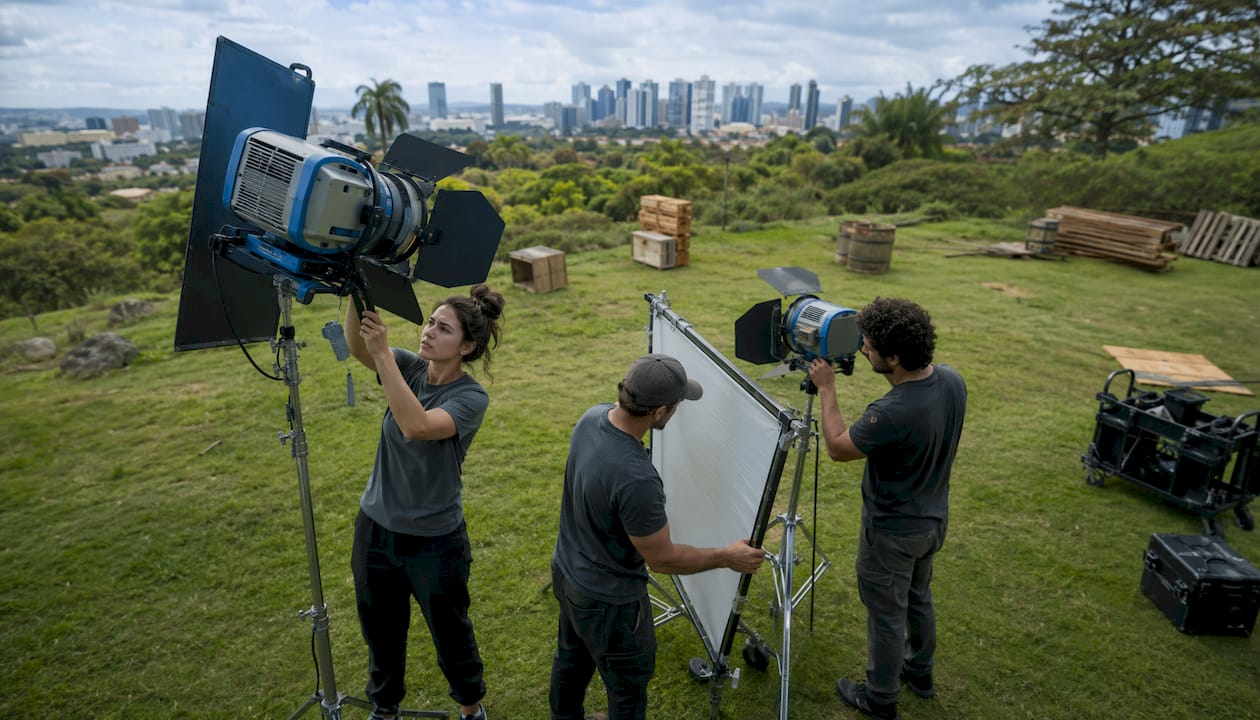
- Use reflectors or portable LED panels to fill shadows when you cannot control the sun’s position
- Dress performers in colors that contrast with the background so they read clearly on camera
- Avoid placing two similarly dressed characters against a bright background: they merge into an unreadable shape
- Test your lighting setup with stand-ins before the stunt performers arrive
Key insight: Lighting choice is not a post-production problem. The moment you put two characters in black against bright venetian blinds and shoot with tight, shaky close-ups, you lose the choreography entirely. The audience sees an indistinct shape, not a fight. Costume, lighting, and camera angle work together to make action legible.
Timing also means reading your performers. Action sequences are physically exhausting. Schedule the most demanding stunts early in the day when energy is highest, and build in recovery time between takes. A tired performer is a slower, less precise performer, and that shows in the footage.
What Martin Bissig’s approach to action filmmaking teaches you
Martin Bissig has spent years shooting action, outdoor sports, and mountain biking for commercial and editorial clients, working in demanding environments from the Swiss Alps to Pakistan. That kind of work sharpens a specific skill set: you learn to read terrain, anticipate movement, and make camera decisions fast. As a Canon ambassador, Bissig’s work reflects a consistent philosophy: clarity and storytelling come before spectacle.
Key principles from professional action filmmaking:
- Know the sport or activity before you film it. When you understand the rhythm of the action, you position yourself correctly before the moment happens
- Design choreography for the camera lens specifically. What looks impressive in rehearsal can disappear on screen if the angles are wrong
- Use stunt professionals as creative collaborators, not just safety resources. Their knowledge of what reads on camera is often better than a director’s instinct
- Vary your stabilization: gimbal for tracking, handheld for energy, tripod for precision. Switching between them gives the editor contrast to work with
- Shoot for the edit from the first take. Every shot should have a clear purpose in the sequence
For action sports videography, the same principles apply whether you are filming a mountain bike descent or a scripted fight scene. The camera must anticipate, not react.
Storyboarding and shot listing before rehearsals is standard practice at the professional level. Once you see the choreography in rehearsal, you refine the boards. Being present for rehearsals answers the questions a shot list cannot: which moves need a wide frame, which need a tight lens, and where a camera move would add energy rather than confusion.

Managing budget and time on action shoots
Action sequences cost more and take longer than almost any other type of scene. The gap between what a director imagines and what the budget allows is where most action shoots go wrong.
Where the money actually goes:
- Stunt coordinator fees and stunt performer day rates
- Equipment: gimbals, additional camera bodies for multi-angle coverage, specialty lenses
- Location permits, especially for exterior action with vehicles or pyrotechnics
- Extra shooting days for rehearsal and safety preparation
- Post-production: slow-motion footage requires more storage and longer edit times
The single most effective way to control costs is pre-production discipline. A detailed shot list and storyboard mean you arrive on set knowing exactly what you need. Over-coverage, filming more angles than the edit requires, wastes time and burns through your shooting day. Capture the wide, medium, and close-up coverage that the sequence needs, then stop.
For car stunts on a limited budget, a practical option is purchasing a junker vehicle at auction. A veteran stunt driver can advise on camera placement: one camera inside the car, one showing the point of impact, and one wide master. The sequence may run only 2–3 seconds in the final cut, so every camera position has to earn its place.
Producers without action experience tend to be cautious in ways that shut sequences down. Assess early whether your producer understands action production. If they don’t, bring your stunt coordinator into budget conversations from the start. A coordinator who can speak the language of risk management and scheduling carries more weight in those discussions than a director alone.
Time-saving habits on action shoot days:
- Walk through every stunt at slow speed before full-speed rehearsal
- Set camera positions while stunt performers rest between takes
- Shoot the master sequence before any inserts or pickups
- Keep communication short and specific on set: long notes between takes kill momentum
If you want to go deeper on the technical side of outdoor action production, Bissig’s guide to improving outdoor shoots covers the practical details that make a real difference on shoot day.
Key Takeaways
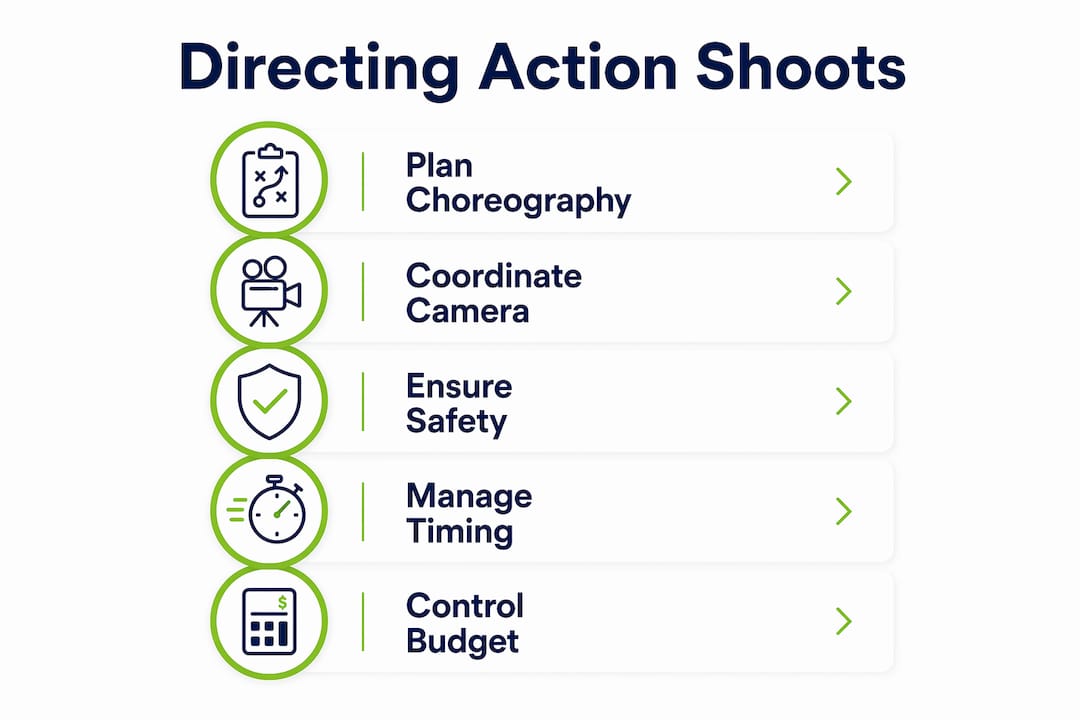
Directing action shoots effectively requires clear choreography, deliberate camera placement, and a safety-first set culture built on trust and preparation.
| Point | Details |
|---|---|
| Shoot at the right frame rate | Film at 60fps with a 1/120 shutter speed for smooth action sports footage (allowing slow-motion at 40% speed on 24fps timelines); use 120fps or 240fps for hero shots to achieve dramatic slow-motion effects. |
| Sequence your coverage correctly | Shoot the full sequence before inserts so the editor has a complete reference and continuity stays intact. |
| Choreograph for the camera | Design every movement to play to the lens, not just to look good in the room, or the audience loses the action. |
| Light for legibility | Shoot during golden hour for soft, directional light; avoid midday overhead light that flattens performers and kills depth. |
| Use professional stunt performers | Even on a tight budget, experienced stunt performers save takes, reduce risk, and make the action read convincingly on screen. |


