

Most photographers assume that strapping a camera to a backpack and heading somewhere remote makes them expedition photographers. It doesn’t. Expedition photography is a discipline shaped by physical endurance, constraint-driven decision-making, and a deep commitment to visual storytelling under pressure. You may be moving alongside your subject, racing shrinking light, or battling altitude sickness while trying to nail focus. As National Geographic notes, expedition photography is defined by working with whatever conditions arrive, not the conditions you planned for.
Table of Contents
- What is expedition photography?
- Core fieldcraft and technical skills
- Blending storytelling with technique and fieldcraft
- Practical tips for your next expedition
- What most people miss about expedition photography
- Ready for your own expedition?
- Frequently asked questions
Key Takeaways
| Point | Details |
|---|---|
| More than travel photos | Expedition photography demands technical skill, fieldcraft, and adaptability beyond ordinary travel shots. |
| Master adaptive readiness | Success depends on rapid adjustments and being prepared for shifting conditions in the field. |
| Storytelling meets technique | Great expedition images blend anticipation, naturalist knowledge, and compositional skill for powerful stories. |
| Preparation is essential | Physical and mental readiness matter as much as gear for capturing dynamic adventure scenes. |
What is expedition photography?
Let’s clear up the most common confusion first. Expedition photography is not travel photography with a better backdrop. It is not adventure photography simply because you’re in a dramatic landscape. It is its own discipline, one that demands a specific mindset, a specific skill set, and a genuine tolerance for controlled chaos.
National Geographic defines it as the practice of making images during expeditions, often remote and challenging journeys, that combine field techniques with guidance geared toward unpredictable, high-stakes conditions. That definition matters because it centers the difficulty, not the destination.
Here’s a simple breakdown of how the three disciplines differ:
| Category | Environment | Primary goal | Key challenge |
|---|---|---|---|
| Travel photography | Accessible, tourist-friendly | Document culture and place | Finding fresh angles in familiar spots |
| Adventure photography | Outdoor, active | Capture energy and excitement | Timing and physical positioning |
| Expedition photography | Remote, unpredictable | Tell a complete field story | Constraint-driven problem solving under pressure |
What makes expedition photography distinct comes down to a few core hallmarks:
- Challenging environments: You are often working in extremes, whether that’s high altitude, sub-zero temperatures, dense jungle, or open ocean, where gear, light, and your body are all being tested.
- Constraint-driven problem solving: The shot you want may be physically inaccessible, fogged out, or available for only a 30-second window. You adapt or you miss it.
- Team integration: On a serious expedition, you are not a solo artist. You are embedded in a group with guides, scientists, or athletes, and your access to great images depends on how well you communicate your needs and earn trust within that team.
- Story-driven intent: The goal is rarely a single beautiful frame. You’re building a body of work that communicates something real about the journey, the environment, or the people involved.
Understanding good outdoor photography techniques is a starting point, but expedition work layers on a complexity that requires you to draw from photojournalism in storytelling as well. You’re not just a technician. You’re a witness with a responsibility to the story.
Core fieldcraft and technical skills
Once you grasp what expedition photography entails, the next step is mastering the skills and techniques to succeed in the field. Technical knowledge alone is not enough. What separates a competent photographer from an expedition photographer is the ability to make fast, accurate decisions when everything around you is moving or changing.
Adaptive exposure decisions are central to this. Light and action change quickly. You may be physically moving yourself, clinging to a ridgeline or paddling beside a kayaker, while simultaneously trying to frame a shot. There is simply no time to dig through menus or second-guess your settings.
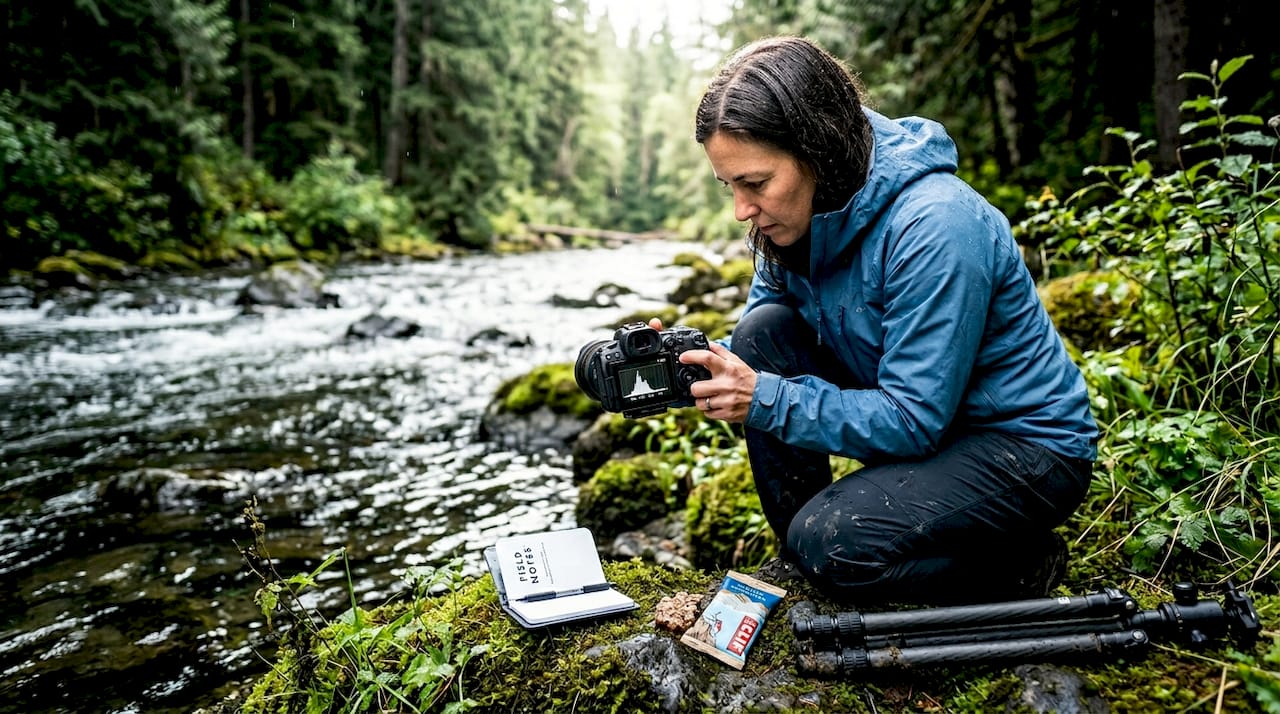
National Geographic’s field guidance is telling: shooting at higher ISO and keeping your camera framed and ready are standard tactics for capturing fleeting moments in fast-changing conditions. This isn’t a concession to imperfect technique. It’s the technique.
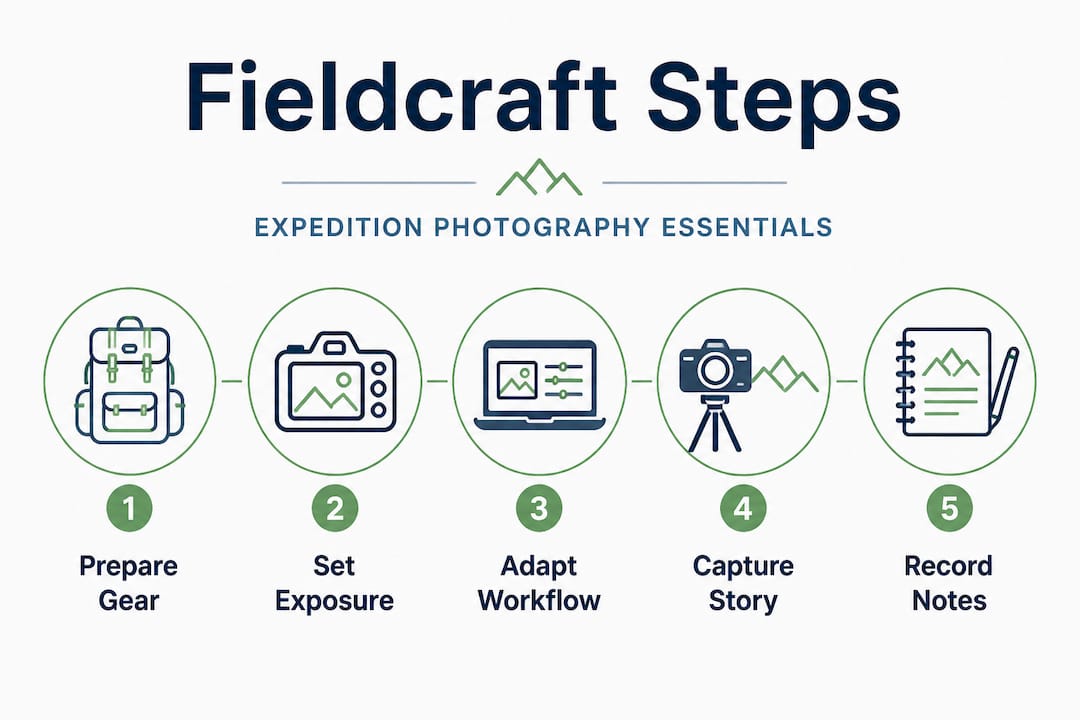
Here are five must-have fieldcraft skills every expedition photographer needs to develop:
- Rapid exposure fluency: You should be able to shift between aperture, shutter speed, and ISO without looking at your camera. Muscle memory replaces the time you don’t have.
- Environmental reading: Anticipating how the light will behave in the next ten minutes, or how a subject will move through a terrain feature, is a learned skill built through repeated field time.
- Physical conditioning: You cannot shoot well if you’re exhausted. Managing gear weight, staying hydrated at altitude, and knowing your own physical limits are all part of the job.
- Gear accessibility: If your camera is buried in your pack, you will miss shots. Your system for carrying equipment needs to be purpose-built for your specific expedition type.
- Failure tolerance: Equipment fails. Weather cancels plans. Subjects behave unpredictably. The ability to reset quickly and stay creatively engaged despite setbacks is what keeps your shot count high under pressure.
Pro Tip: Before heading into the field each day, set your camera to the exposure profile that matches the prevailing conditions, even if you think conditions might improve. You can always refine upward. You cannot recover a missed moment.
Your outdoor photography workflow should be designed around the assumption that conditions will be harder than you expect, not easier. And if you’re working in fast action environments, building your skills through a dedicated action photography guide gives you the reflex training that field time alone can’t fully replace.
Blending storytelling with technique and fieldcraft
Having highlighted core skills, let’s see how storytelling sensibility and natural history expertise distinguish truly great expedition images. There is a meaningful difference between a technically correct photo and one that stops people in their tracks. The gap is almost always narrative.
Successful expedition images in wildlife and field contexts depend heavily on fieldcraft and natural history understanding. Knowing where to position yourself, when a behavior is about to happen, and how the light will fall on a specific slope at a specific hour are factors that no camera setting can replicate. You have to understand what you’re photographing well enough to predict it.
Lindblad Expeditions describes it clearly: expedition photography blends storytelling with technique, which means composition, light, and exposure, with fieldcraft, which means positioning, anticipating behavior, and being ready as conditions change. These two elements reinforce each other. A technically perfect image of an empty landscape tells no story. A slightly imperfect image of a rare wildlife behavior in perfect contextual light is unforgettable.
Here’s how specific skills translate to storytelling impact:
| Skill | Technical role | Storytelling impact |
|---|---|---|
| Composition | Frames the subject | Guides emotional response |
| Timing | Captures peak action | Communicates drama and tension |
| Positioning | Controls perspective | Creates intimacy or scale |
| Natural history knowledge | Predicts subject behavior | Enables access to rare moments |
| Light reading | Manages exposure | Sets mood and atmosphere |
To build stronger narrative anticipation, focus on these habits in the field:
- Study your subject before you shoot. Whether it’s a mountain athlete or a migratory bird, understand its movement patterns, timing, and preferred terrain before you reach for the camera.
- Scout before sunrise. The best expedition images are rarely captured spontaneously at mid-day. They are the result of deliberate positioning made hours earlier.
- Think in sequences, not single frames. A story told across five related images is more powerful than one great shot with no context around it.
- Watch the edges. The most interesting moments in any expedition often happen at the margins: the rest stop, the gear-repair moment, the quiet exchange between teammates. These humanize the narrative.
This is why reputable expedition programs often pair photographers with naturalist instructors. The naturalist knows when the whale will surface, where the gorillas move at dawn, or how the storm system will affect the valley light. That knowledge transforms a technically skilled photographer into one who is positioned at the right place at the right moment. Explore real expedition examples to see how this integration plays out in actual field scenarios.
Practical tips for your next expedition
Now, let’s turn theory into action with specific tips to help you excel during your next expedition. Preparation is where most photographers underinvest. They obsess over gear lists and underestimate the operational planning that determines whether they can execute in the field at all.
As National Geographic frames it, constraint-driven decision-making defines the discipline. You may be moving with the subject, limited by weather or gear access, and forced to work with whatever conditions arrive. Accepting this reality in advance changes how you prepare.
Here’s a practical preparation checklist:
- Research the environment thoroughly. Study the weather windows, sunrise and sunset timing, seasonal light characteristics, and any access restrictions you’ll encounter.
- Pack a minimal but redundant gear kit. One weather-sealed body, one fast zoom, one prime for low light, spare batteries, extra cards, and a lightweight support system. Redundancy matters more than variety.
- Brief your guides and teammates on your shooting needs. Tell them which moments are critical to capture, what you need them to do or not do, and how you’ll communicate during fast-moving situations.
- Build in recovery time. Shooting at altitude, in cold, or while physically active depletes you faster than studio work. Exhaustion leads to missed shots and poor decisions.
- Create a shot priority list. Before the expedition starts, identify the three to five images that would make the trip a success. These become your anchors when conditions get chaotic and decision-making gets hard.
- Practice camera access daily. Whatever carrying system you’re using, practice retrieving and powering your camera in under five seconds. Repeat until it’s reflex.
Adapting to uncontrollable elements requires mental flexibility as much as technical skill. When weather shuts down your planned shoot, ask yourself what the weather itself reveals. A storm rolling across a mountain range can be more visually powerful than the blue-sky conditions you wanted.
Pro Tip: Don’t wait for perfect conditions. The most memorable expedition images are almost never made in ideal settings. They are made when something unexpected happens, and you are already ready because your camera is in hand, your settings are dialed, and you’ve been paying attention. This matters especially in dynamic outdoor event settings where the action moves fast and waits for no one.
What most people miss about expedition photography
Here is the uncomfortable truth that most articles about expedition photography avoid. The images that define expeditions, the ones that end up on magazine covers or in grant-winning portfolios, are almost never technically perfect. They are rare. They are context-driven. And they are the result of a photographer who was present, prepared, and paying close enough attention to recognize the moment before it was obvious to everyone else.
This is not a romantic notion. It is a discipline. The photographers who consistently produce standout expedition work are not lucky. They have failed many times in similar situations and learned precisely what they did wrong. They know how to read environments because they’ve been humbled by them. They understand that preparation is the only legitimate substitute for luck.
“In expedition photography, the best image is rarely the easiest, or the obvious, moment.”
Expedition photography is also deeply collaborative, and this is the part most solo-minded photographers resist. Your relationship with your guide, your athlete, your subject, your fellow team members shapes the access you get. Trust is earned over shared discomfort. When a subject sees that you are genuinely invested in the expedition itself, not just extracting images from it, they open up. That openness is what you see in the most powerful expedition photographs.
The real impact of photography in storytelling contexts depends on exactly this kind of embedded trust and credibility, not just technical output.
Pro Tip: Keep a field journal or record quick audio notes after significant shooting days. Documenting the context, what you smelled, heard, felt, and thought, enriches the images beyond what the pixels alone can communicate. It also helps you identify patterns in when your best work happens and why.
Ready for your own expedition?
If this has shifted how you think about expedition photography, the next step is building the practical foundation to execute it in the field.
Understanding outdoor photography skills across different environments is a strong starting point. If you’re based in Europe or want to explore challenging alpine terrain, working with an experienced outdoor photographer in Switzerland gives you direct access to field-tested techniques honed across demanding mountain and adventure environments. Refining your improving your workflow from capture to delivery ensures that the images you fight for in the field are presented at their full impact. The gap between wanting to do expedition photography and actually doing it well is bridged by consistent practice, the right guidance, and an honest commitment to learning from every frame, whether it works or not.
Frequently asked questions
How is expedition photography different from regular travel photography?
Expedition photography demands specialized preparation, rapid decision-making, and working in challenging environments far beyond what typical travel photography requires. As National Geographic describes it, it combines field techniques with guidance geared toward unpredictable, high-stakes conditions.
What gear is essential for expedition photography?
Key essentials include a weather-sealed camera body, fast lenses, backup power sources, compact support gear, and a carrying system specifically adapted to the physical demands of your expedition activity.
How do you prepare for unpredictable shooting conditions?
Pre-set your camera for prevailing conditions before you move into the field, stay physically ready for the demands of the environment, and practice adapting your approach on the fly. Fast, adaptive exposure decisions are the standard expectation, not the exception.
Why do some expeditions include photography instructors or naturalists?
Instructors and naturalists help photographers anticipate wildlife behavior, identify the best timing and positioning for images, and elevate storytelling well beyond what camera settings alone can achieve. Successful expedition images depend heavily on this kind of natural history understanding and field knowledge.


