

Dynamic sports photography is the practice of capturing sharp, emotionally charged, kinetically alive moments in sport using precise gear, settings, and anticipation. Mastering it requires more than a fast camera. You need the right shutter speed, a disciplined approach to composition, and a post-processing workflow built for speed. This guide covers all three. Whether you shoot mountain biking, soccer, or track and field, the principles here apply directly. Cameras like the Sony A9 III, Canon EOS R1, and Nikon Z9 represent the current standard, but the techniques work across any serious system.
What camera settings and gear produce sharp, dynamic action shots?
The single most important setting in sports photography is shutter speed. Freezing fast-moving action requires 1/1000s or faster, with high-speed sports like tennis or soccer benefiting from 1/2000s to 1/4000s. Panning shots, which convey speed through motion blur, use a much slower 1/60s to 1/125s. That range gives you creative flexibility depending on whether you want to freeze or suggest motion.
Aperture is your second lever. Constant-aperture f/2.8 lenses let you maintain fast shutter speeds without pushing ISO into noise territory, and they isolate your subject from cluttered backgrounds. For indoor arenas or overcast outdoor events, f/2.8 is not optional. It is the baseline.
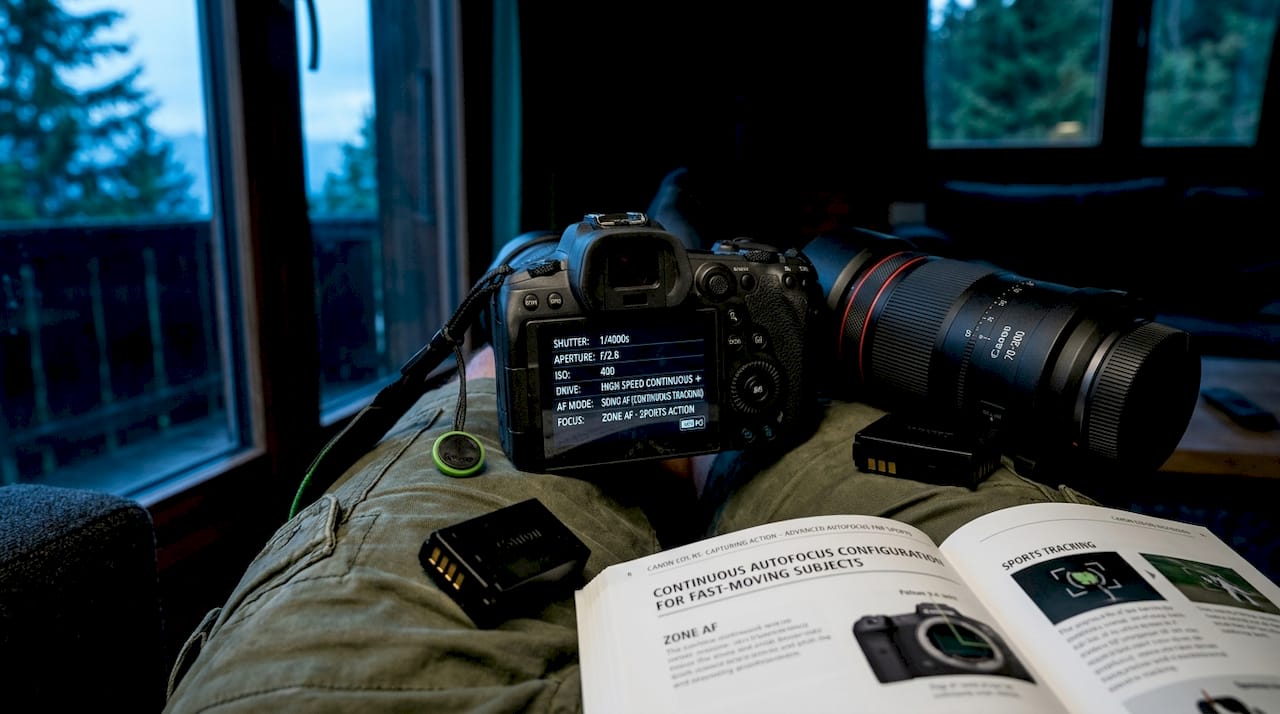
Exposure control works best in manual mode with Auto ISO. You fix shutter speed and aperture for motion control, then let ISO float to handle changing light as athletes move from shadow to sun. This is the industry standard for a reason. It removes one variable from your mental load during fast-moving events.
Autofocus mode matters as much as any setting. Continuous AF with subject tracking, including dynamic area, group AF, and 3D tracking, outperforms single-shot AF on moving athletes. Modern cameras use predictive algorithms that anticipate where a subject will be, not just where they are. Use this aggressively.
Top camera bodies for sports in 2026
The top professional sports bodies in 2026 are the Sony A9 III, Canon EOS R1, and Nikon Z9, each offering global shutter technology, advanced subject tracking, and burst rates that were unimaginable five years ago.
| Camera | Strength | Best for |
|---|---|---|
| Sony A9 III | Global shutter, 120 fps burst | Fast-action, no rolling shutter |
| Canon EOS R1 | Deep Learning AF, weather sealed | All-weather pro events |
| Nikon Z9 | Stacked sensor, 20 fps RAW | Wildlife and field sports |
| Canon R7 (APS-C) | 1.6x crop reach, affordable | Budget-conscious action shooters |
| Fujifilm X-H2S | Fast AF, film simulations | Editorial and lifestyle sports |
Pro Tip: APS-C bodies like the Canon R7 give you a 1.6x focal length multiplier, turning a 200mm lens into an effective 320mm. For photographers who need reach without the cost of a 400mm prime, this is one of the most practical advantages in sports photography today.
How to compose and anticipate winning sports shots
Composition in sports photography is not something you adjust after the fact. You build it before the action starts. Success in high-impact sports photography rests more on planning and anticipation than on reaction speed alone. Pro photographer Jean Fruth emphasizes written shot lists and mental checklists that map key images to specific event phases. That preparation is what separates a full card of sharp frames from a full card of missed moments.
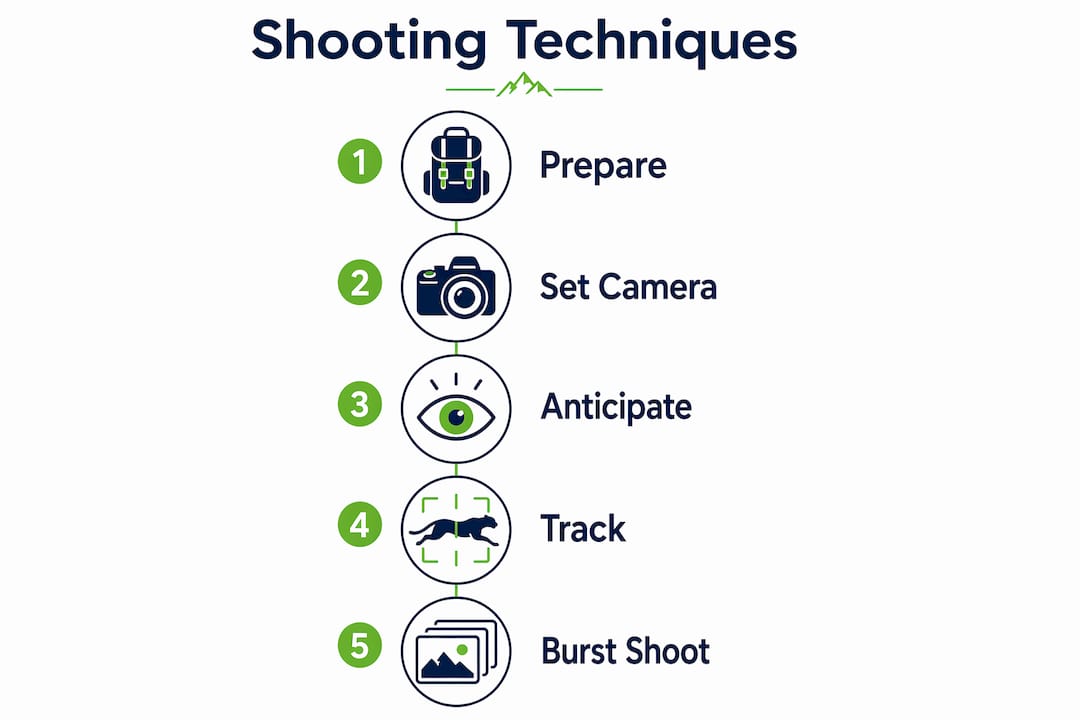
Understanding a sport’s flow is the foundation. In soccer, the action clusters around the penalty box and midfield transitions. In mountain biking, the decisive moments happen at jumps, berms, and tight corners. Knowing where peak action occurs lets you pre-focus, pre-position, and pre-compose before the athlete arrives.
Shooting angles change everything. A low angle looking up at a basketball player mid-dunk creates drama that a standing eye-level shot never will. Get on the ground for sprinters, position yourself at the apex of a jump for snowboarders, and shoot into the light when you want rim-lit silhouettes. The angle is a creative decision, not an afterthought.
Here are the core composition principles that consistently produce strong sports images:
- Apply the rule of thirds by placing the athlete off-center, with space in the direction of movement
- Prioritize the eyes and facial expression. A technically sharp image with a blank expression loses to a slightly softer image with raw emotion
- Include environmental context when it adds meaning. A cyclist surrounded by a mountain backdrop tells a bigger story than a tight crop alone
- Shoot spectator reactions at key moments. A crowd erupting in the background transforms a good action shot into a narrative image
- Plan your shooting position based on light direction. Front-lit subjects at midday look flat. Side-lit or back-lit subjects at golden hour look cinematic
Pro Tip: Concentrating on one play zone rather than chasing action across the entire venue increases your keeper rate significantly. Pick the corner where the ball or athlete will return repeatedly, and own that frame.
What are the proven shooting techniques for capturing dynamic sports moments?
Burst mode is the most misused feature in sports photography. Even with cameras capable of 120 fps, professionals fire short, targeted bursts at contact points like a tackle, a jump, or a ball strike. Holding the shutter down for five seconds straight produces 600 frames of mostly redundant images and a culling nightmare. Discipline with burst timing is a professional skill.
Here is a practical shooting sequence for any fast-paced event:
- Set your exposure before the action starts. Use manual mode with Auto ISO and confirm your shutter speed is at least 1/1000s for the sport you are shooting.
- Activate continuous AF with your camera’s best tracking mode. On Canon, that is Animal/Vehicle Detection or Action Priority. On Sony, use Real-time Tracking.
- Lock focus on the athlete before the decisive moment. Let the camera track, then fire a short burst of three to five frames at the peak of the action.
- Release the shutter between peaks. Do not hold it down through transitions or setup movements.
- Review your histogram and focus confirmation after each sequence. Adjust ISO or aperture if the light has shifted.
Panning is a separate technique worth mastering. You match your camera’s movement to the athlete’s speed at 1/60s to 1/125s, creating a sharp subject against a streaked background. This technique communicates speed more effectively than a frozen image in many cases. Practice it on cyclists or runners before applying it to faster sports.
Indoor and low-light venues require a specific approach. Push aperture to f/2.8, raise your minimum shutter speed floor to 1/800s, and let Auto ISO climb as high as your camera handles cleanly. On the Sony A9 III or Nikon Z9, ISO 6400 is usable. On older APS-C bodies, ISO 3200 is often the practical ceiling.
Pro Tip: Pre-capture features on the Sony A9 III and Canon EOS R1 buffer frames before you fully press the shutter. This means you can capture the moment that triggered your reaction, not just the moment after it. For unpredictable sports like martial arts or gymnastics, this feature alone changes what is possible.
How to streamline post-production for sports photography
Sports photographers routinely shoot 3,000 to 8,000 frames per event, culled down to 100 to 400 deliverables. Manual review of that volume takes four hours or more. AI-powered culling tools compress that to under 30 minutes. That time difference is the gap between delivering hero images the same night and delivering them the next afternoon.
The culling priorities for sports images follow a clear hierarchy:
- Sharp focus on the eyes or face of the primary subject
- Peak action moment, not the setup or recovery
- Clean background or intentional background separation
- Strong expression or emotional content
- Technical exposure quality, no blown highlights on skin
FilterPixel’s DeepCull mode scores sports images by peak action, subject isolation, and facial expression, collapsing burst sequences into top picks automatically. Basic Cull handles technical filtering like blur and exposure. DeepCull adds narrative scoring on top of that. For photographers delivering on deadline, this distinction matters.
Batch editing in Lightroom or Capture One works best when you shoot consistently. If your exposure is controlled through manual mode with Auto ISO, your RAW files will be close to identical in tone. Apply one base edit to a representative frame, sync it across the batch, then make individual adjustments only where needed. Cropping for composition and sharpening for output are the two most common per-image adjustments.
Pro Tip: The best way to reduce editing time is to reduce the number of frames that need editing. Disciplined burst timing and strong in-camera exposure control mean fewer rejects and faster delivery. The sports photography workflow starts before you press the shutter.
Which gear setups suit different sports and environments?
Gear selection depends on the sport, the venue, and your budget. The right setup for a professional basketball game is different from what you need for outdoor trail running or a mountain bike race. Matching your kit to the environment is as important as the technical settings you use.
For outdoor field sports and wildlife-adjacent action, a full-frame body with a 300mm or 400mm prime gives you the reach and image quality that editorial clients expect. The must-have gear for sports photographers in 2026 centers on fast telephoto lenses, weather-sealed bodies, and high-capacity batteries for all-day shoots.
For close-range action like skateboarding, climbing, or mountain biking, a 70-200mm f/2.8 lens covers most situations. A wider 24-70mm f/2.8 adds environmental context when you want to show the terrain or crowd. Monopods reduce fatigue on long shoots without sacrificing the mobility that tripods eliminate.
Key accessories that make a real difference in the field:
- Lens hoods to cut flare in backlit or side-lit conditions
- Extra batteries and a dual charger. A full-day event drains two to three batteries on high-performance bodies
- Weather sealing on both body and lens for outdoor events in rain or dust
- Fast memory cards rated for sustained write speeds to handle burst buffers without slowdown
Indoor sports introduce a different challenge. Artificial lighting in arenas often flickers at frequencies that cause banding at certain shutter speeds. Set your shutter speed to a multiple of the local power frequency (1/100s or 1/200s in Europe, 1/120s or 1/250s in the US) to avoid this. It is a small adjustment that eliminates a persistent technical problem.
Key takeaways
Mastering sports photography requires precise camera settings, disciplined burst technique, and a post-processing workflow built for speed and volume.
| Point | Details |
|---|---|
| Shutter speed is the foundation | Use 1/1000s minimum; push to 1/2000s or faster for high-speed sports. |
| Manual mode with Auto ISO | Fix shutter and aperture, let ISO adapt to changing light across the venue. |
| Burst discipline over volume | Fire short bursts at peak moments only; avoid holding the shutter through transitions. |
| Plan before you shoot | Scout venues, identify peak action zones, and build a shot list before the event starts. |
| AI culling saves hours | Tools like FilterPixel’s DeepCull reduce 4-hour culling sessions to under 30 minutes. |
What I’ve learned from years of shooting action
The biggest mistake I see from photographers entering sports and action work is treating gear as the solution. A Sony A9 III does not make you a better sports photographer. It makes a prepared photographer faster. The preparation is the work.
Before any event, I walk the venue. I identify where the light falls at the time I will be shooting, where the peak action zones are, and where I can position myself without obstructing athletes or officials. That 20-minute scout changes the entire day. I have come back from events where I shot 1,200 frames and delivered 80 exceptional images, and I have come back from events where I shot 4,000 frames and delivered 60 mediocre ones. The difference was always preparation, not frame count.
Timing bursts is a skill that takes months to develop. You learn the rhythm of each sport. In mountain biking, I know exactly when a rider will reach full extension on a jump. I start my burst half a second before that point and stop half a second after. Three to five frames. That is all I need. The photographers who hold the shutter down for three seconds at every corner are the ones spending four hours culling that night.
The other thing I would tell any serious photographer: build your workflow before you need it. Know your culling process, your export settings, and your delivery method before you are on deadline at midnight. The action photography techniques that produce great images are only half the job. Getting them to the client fast is the other half.
— Martin
Take your action photography further with Bissig
Martin Bissig has spent years shooting action sports across some of the world’s most demanding environments, from mountain bike races in the Alps to expedition work in Pakistan and California. That experience is reflected in the resources available at Bissig, where you will find detailed techniques, real-world examples, and professional-level inspiration for action and sports photography. Whether you are refining your camera settings, building a faster workflow, or looking for creative direction, the action photography resource at Bissig covers the full range from technical fundamentals to advanced field execution. Visit Bissig to go deeper.
FAQ
What shutter speed should I use for sports photography?
Use at least 1/1000s to freeze most sports action cleanly. For high-speed sports like tennis or soccer, 1/2000s to 1/4000s produces the sharpest results with no motion blur.
What autofocus mode works best for moving athletes?
Continuous AF with subject tracking, including dynamic area, group AF, or 3D tracking, is the correct choice for sports. These modes predict subject movement rather than just reacting to it.
How do professionals handle thousands of burst frames after an event?
AI culling tools like FilterPixel reduce review time from four hours to under 30 minutes by scoring images for peak action, sharp focus, and expression quality automatically.
Is a full-frame camera necessary for sports photography?
No. APS-C bodies like the Canon R7 and Fujifilm X-H2S deliver strong autofocus performance and add effective focal length reach, making them practical choices for sports photographers working within a budget.
How do I avoid camera shake and soft images in low light?
Use an f/2.8 lens, set Auto ISO with a minimum shutter speed of 1/800s, and activate your camera’s best continuous tracking mode. A monopod also reduces fatigue-related camera movement on long indoor shoots.


