

Photographing WEF events is defined by one core challenge: capturing authentic, high-impact moments inside one of the world’s most security-conscious environments. The World Economic Forum in Davos spans private chalets, congress halls, and temporary pavilions, each with its own lighting conditions, access rules, and timing pressures. Success requires precise camera settings, a clear shot list, and the kind of professional discretion that keeps you in the room. This guide covers the gear, preparation, techniques, and workflow that WEF Davos photographers rely on to deliver results under real pressure.
What gear and settings are essential for WEF event photography?
The standard lens kit for WEF photographers includes a 24–70mm f/2.8 for flexible coverage, a 70–200mm f/2.8 for stage and panel sessions, and fast primes like a 35mm f/1.4 or 85mm f/1.8 for low-light subject isolation. Modern mirrorless bodies from Canon, Sony, or Nikon give you AI-assisted noise reduction and usable ISO ceilings above 12800, which matters enormously in the dim interiors of Davos chalets. A backup body is not optional at WEF. If your primary camera fails during a bilateral meeting, there is no second chance.
Shutter speed is your most critical variable. Settings between 1/200s and 1/500s prevent motion blur on speakers and moving executives. Dropping below 1/160s is a common error that ruins otherwise strong frames. Pair that with an aperture of f/1.8–f/2.8 to maintain exposure without pushing ISO too high.
| Shooting Scenario | Recommended Lens | Shutter Speed | ISO Range |
|---|---|---|---|
| Main stage keynote | 70–200mm f/2.8 | 1/400s | 800–3200 |
| Networking reception | 35mm f/1.4 | 1/200s | 1600–6400 |
| Outdoor chalet portrait | 85mm f/1.8 | 1/500s | 400–1600 |
| Panel discussion | 24–70mm f/2.8 | 1/250s | 800–3200 |
Pro Tip: Enable your camera’s silent electronic shutter before entering any session. It eliminates shutter noise entirely, which is the single fastest way to lose access at a diplomatic summit.
How should you prepare and plan before shooting?
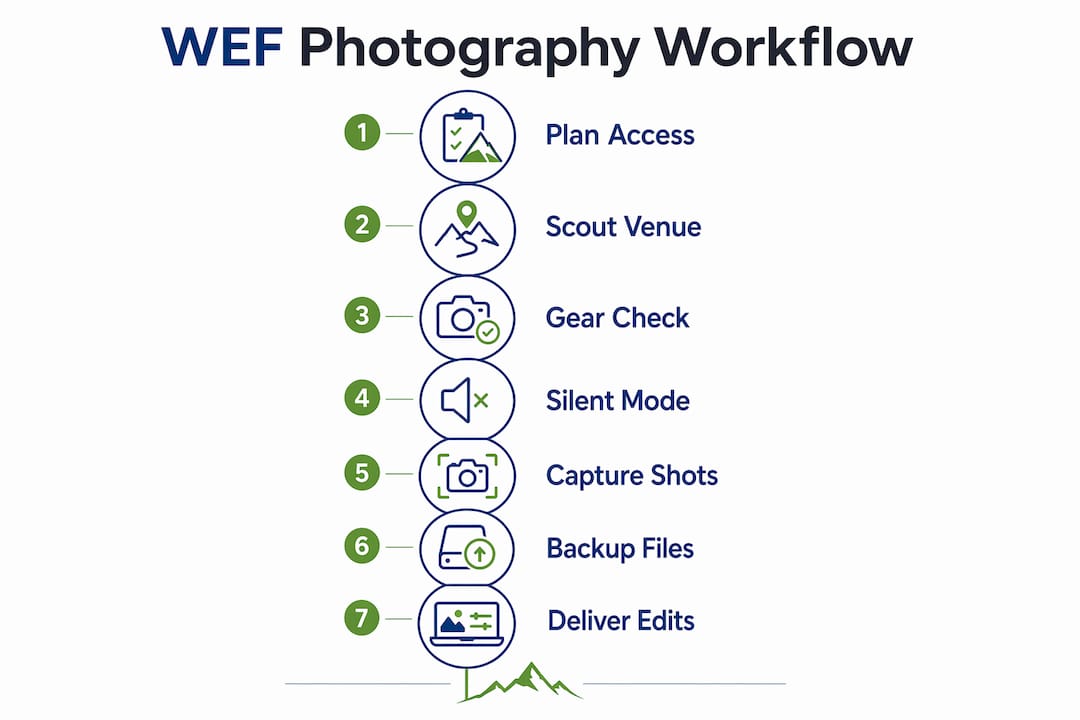
Preparation for WEF photography starts before you arrive in Davos. Arriving 45–60 minutes early gives you time to scout lighting conditions, identify the best angles, and review the session schedule for moments that require full coverage. Walking the congress center, chalets, and pavilions before crowds arrive reveals details that are impossible to assess mid-event.
Build a shot list with 3–5 anchor shots that your client has approved in advance. These anchors keep you focused when the schedule shifts or a key speaker runs late. Without them, you end up shooting reactively and delivering a gallery that lacks narrative structure.
- Confirm your media credentials and access zones at least 48 hours before the event.
- Walk every venue you are scheduled to cover and note the light sources, entry points, and security checkpoints.
- Review the official WEF program and mark the 5 moments your client considers non-negotiable.
- Coordinate with event staff to understand restricted areas and photographer protocols for each session.
- Prepare your gear the night before: charged batteries, formatted cards, and a tested backup body.
WEF spans multiple venues including private chalets and temporary pavilions, each with different security clearance requirements. Moving between them takes time, and missing a clearance window means missing the shot entirely.
Pro Tip: Layer your clothing for Davos alpine conditions. Thermal base layers under a professional jacket let you move between outdoor chalet sessions and heated congress halls without losing credibility or comfort.
What techniques keep you unobtrusive while capturing strong images?
The most important rule at a diplomatic summit is to be a safe pair of hands. That means silent shutter, no direct flash, and body language that signals you belong in the room. Executives and delegates notice photographers who are disruptive. One distraction can result in a security escort out of the venue.
Positioning is where most photographers leave value on the table. Stage front gives you clean speaker frames, but side angles reveal audience reactions and panel dynamics that tell a richer story. Networking areas between sessions are where the most candid and commercially valuable moments happen.
- Use silent electronic shutter mode at all times inside sessions and bilateral meetings.
- Position yourself at side angles during panels to capture both speakers and audience simultaneously.
- Work networking areas and coffee breaks for candid executive interactions.
- Avoid direct flash in any indoor setting. Use available light and push ISO instead.
- Respect all security zone boundaries without exception. Access lost is access gone for the entire event.
“The actual value at WEF comes from capturing networking and informal settings, not just the main stage. Clients and media consistently request images from smaller, private meetings where real decisions happen.”
Golden hour in Davos is a genuine asset. The soft light before sunset creates cinematic portrait quality that no indoor lighting can replicate. If your schedule allows, position key executive portraits for that window.
Pro Tip: Dress like an attendee, not a photographer. A clean jacket and no visible camera bag strap signals professionalism and gets you closer to conversations that a vest-wearing shooter never reaches.
How do you manage workflow and deliverables at WEF?
Speed and curation define professional WEF photography workflow. Clients expect same-day or next-day delivery of highlight galleries, which means your editing pipeline needs to be ready before you shoot the first frame. Arriving with Lightroom presets calibrated to each venue’s lighting conditions saves hours in post-production.
The goal is not volume. Select 150 high-impact images rather than delivering 800 mediocre ones. Clients at WEF are executives and communications teams with no time to cull a massive gallery. A tight, curated set with consistent color grading signals professionalism and earns repeat bookings.
- Back up every card to two separate drives immediately after each session, before moving to the next venue.
- Use a consistent file naming convention that includes venue, date, and session type for fast retrieval.
- Apply batch presets in Lightroom to your highlight selects before doing any fine-tuning.
- Tag your top 20–30 images immediately after each session for fast client preview delivery.
- Communicate your delivery timeline to the client before the event starts, not after.
| Delivery Type | Turnaround | Image Count |
|---|---|---|
| Same-day preview | 4–6 hours post-session | 20–30 selects |
| Full highlight gallery | Next day | 100–150 images |
| Complete archive | 48–72 hours | 300–500 images |
Checking your camera bag setup before any major assignment is worth the time. Redundant storage media and a portable SSD for on-site backup are as important as your lenses at an event where reshoots are impossible.
What are the most common mistakes at WEF photography assignments?
Most failures at WEF come from preparation gaps, not technical skill. Common errors include shutter speeds that are too slow, overuse of flash in restricted venues, and ignoring the event’s security protocols until access is revoked. Each mistake is avoidable with the right preparation.
- Slow shutter speeds: Anything below 1/160s in a session with moving subjects produces blur that no post-processing can fix. Set your minimum shutter speed in Auto ISO to 1/200s as a floor.
- Flash in restricted venues: Direct flash in bilateral meetings or private sessions is grounds for immediate removal. It also produces flat, unflattering images. Available light always produces better results at WEF.
- Ignoring venue dynamics: Photographers who stay in one position miss the informal moments in hallways and networking areas where the most commercially valuable images are made.
- Protocol violations: Not following photographer briefings or crossing into restricted zones destroys trust with event staff and ends your access for the entire event, not just the session.
- No contingency plan: Lighting changes, schedule shifts, and unexpected venue moves happen at every WEF. Photographers without a backup plan lose shots that cannot be recovered.
The role of photographers at summits has evolved significantly. Clients now expect both still images and short-form video content from the same assignment, which means your gear and workflow need to support both outputs simultaneously.
Key takeaways
Photographing WEF events successfully requires combining precise technical settings, strategic preparation, and unobtrusive professional conduct to capture authentic moments across multiple high-security venues.
| Point | Details |
|---|---|
| Gear and settings | Use a 24–70mm f/2.8, 70–200mm f/2.8, and fast primes; set shutter speed at 1/200s–1/500s minimum. |
| Preparation | Arrive 45–60 minutes early, build a 3–5 anchor shot list, and confirm access zones before the event. |
| Unobtrusive technique | Silent shutter, no flash, and professional attire keep you in the room and close to key moments. |
| Workflow speed | Deliver curated galleries of 150 images with same-day or next-day turnaround to meet client expectations. |
| Avoid common errors | Never drop below 1/160s shutter speed, never use flash in restricted sessions, and always follow protocols. |
What WEF photography taught me about shooting under pressure
I have worked in high-stakes outdoor and action environments for years, and WEF photography shares more with mountain shooting than most people expect. Both demand that you read the environment before you raise the camera. Both punish hesitation. And both reward photographers who have done the technical work so thoroughly that they can focus entirely on the moment in front of them.
The biggest shift I made was treating WEF assignments like expedition photography. I scout locations the way I scout a trail. I anticipate light the way I anticipate weather. The photographers who struggle at WEF are usually the ones who arrive expecting a controlled studio environment and find instead a fast-moving, multi-venue event where the best shots happen in the margins.
The other lesson is about social capital. The images that clients actually use from WEF are rarely the keynote shots. They are the candid handshake in a hallway, the executive laughing at a side table, the quiet moment before a panel begins. Those images require patience, positioning, and the kind of professional invisibility that only comes from genuine preparation. That is the real craft of photographing the World Economic Forum.
— Martin
How Bissig approaches high-profile event coverage
Covering events like WEF demands the same technical precision and environmental awareness that defines all of Bissig’s work across outdoor, action, and commercial assignments. Martin Bissig brings a Canon ambassador’s technical depth and an expedition photographer’s adaptability to every high-profile event assignment.
Whether you need a photographer who can move between a congress hall and an alpine chalet without missing a beat, or a videographer who delivers same-day highlight reels, Bissig’s approach to outdoor photography techniques translates directly to the demands of WEF-level event coverage. Explore the full portfolio and get in touch to discuss your next high-profile assignment at bissig.ch.
FAQ
What camera settings work best for WEF indoor sessions?
Set your shutter speed to a minimum of 1/200s, aperture at f/1.8–f/2.8, and ISO up to 6400 on a modern mirrorless body. Silent electronic shutter mode is required in most WEF sessions.
How early should you arrive to photograph WEF events?
Arrive 45–60 minutes before your first session to scout lighting, identify key positions, and review the schedule for critical moments.
Do you need special credentials to photograph WEF gatherings?
Yes. WEF requires media credentials and specific access clearances for each venue zone. Confirm your credentials and access levels at least 48 hours before the event starts.
What is the most common mistake in WEF conference photography?
Using shutter speeds below 1/160s causes motion blur that cannot be corrected in post. Set a minimum shutter speed floor in your Auto ISO settings before entering any session.
How many images should you deliver from a WEF photography assignment?
Deliver a curated gallery of 100–150 high-impact images for a full-day assignment. Clients value tight, professional selections over large unedited volumes.


