

Corporate photography is the practice of creating professional images that visually represent a company, its people, and its culture across marketing and internal communications. Every business that wants to build trust with clients, attract talent, or tell its story needs a library of strong visual assets. That library starts with corporate photography. It covers everything from executive headshots and team portraits to corporate event photography and lifestyle images that show your organization in action. The style has shifted sharply in recent years, moving away from stiff, gray-backdrop poses toward authentic storytelling that reflects how people actually work.
What is corporate photography and why does it matter?
Corporate photography is defined as any professionally produced imagery that represents a business for external marketing, internal communications, recruitment, or public relations. The term “business portrait photography” is sometimes used interchangeably, but corporate photography is the broader industry standard covering far more than headshots alone.
Consistent photography conveys professionalism and cohesion across digital platforms. That consistency is not cosmetic. Outdated or mismatched images signal to clients and partners that a company is not paying attention to detail. The visual impression your website, LinkedIn page, and press kit make is often the first impression you get to make.
Corporate photography also serves a strategic function. It gives your marketing team a shared visual language to use across every channel. Without it, you end up with a patchwork of phone photos, stock images, and years-old headshots that tell no coherent story.

What are the main types of corporate photography and their uses?
Corporate photography covers several distinct categories. Each one serves a specific business objective, and most organizations need more than one.
- Executive and leadership headshots. These establish professional identity and personal credibility. A CEO’s headshot on a company website or LinkedIn profile signals authority and approachability. The quality of that image reflects directly on the brand.
- Team portraits. Used on company websites, recruitment pages, and internal directories. A cohesive set of team photos communicates culture and helps candidates picture themselves working there.
- Corporate event photography. Conferences, award ceremonies, product launches, and trade shows all generate content that can be repurposed for social media, press releases, and annual reports. Corporate event photography captures the energy and scale of these moments in ways that written recaps cannot.
- Lifestyle and environmental portraits. These show employees in real workspaces, collaborating, presenting, or working in the field. They are the most powerful tool for authentic brand storytelling because they replace the generic stock photo with something real.
- Product and commercial photography in a corporate context. When a company needs images of its products for a catalog, pitch deck, or investor presentation, this falls under the broader corporate photography umbrella, though it overlaps with commercial work.
The most effective corporate photography programs combine at least three of these categories. A single headshot session does not give your marketing team enough material to work with across a full year of content.
How does corporate photography differ from commercial photography?
Corporate photography centers on people and culture, while commercial photography focuses on products and services for advertising. The distinction matters because the two disciplines require different skills, different planning, and different licensing structures.
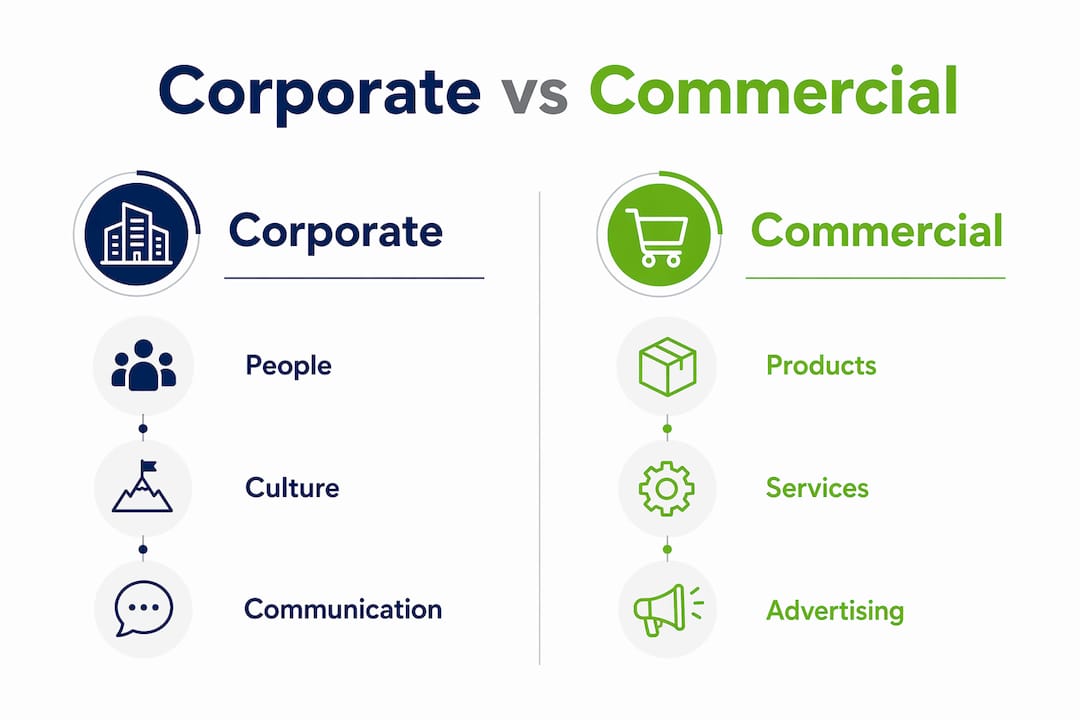
A corporate photographer shoots a CFO’s portrait for the annual report. A commercial photographer shoots a product for a magazine advertisement. Both are professional assignments, but the creative brief, the lighting approach, and the intended audience are entirely different.
The table below clarifies the key contrasts.
| Category | Corporate photography | Commercial photography |
|---|---|---|
| Primary subject | People, teams, company culture | Products, services, brand campaigns |
| Main purpose | Internal and external communications | Advertising and sales materials |
| Typical deliverables | Headshots, event coverage, lifestyle images | Product shots, campaign imagery, editorial spreads |
| Licensing focus | Non-exclusive commercial rights for broad use | Often exclusive rights tied to specific campaigns |
| Style | Authentic, documentary, portrait-driven | Highly stylized, concept-driven, product-centric |
Understanding this difference helps you brief the right photographer for the right job. Hiring a product photographer for a leadership portrait session, or vice versa, produces results that miss the mark. For a deeper look at the commercial side, Bissig covers the commercial photography discipline in detail.
What are current trends and best practices in corporate photography?
Modern corporate photography has evolved from stiff, posed images to authentic storytelling that captures employees in action. Candid moments like brainstorming sessions, client meetings, and team lunches have replaced the gray backdrop and forced smile. This shift is not just aesthetic. It reflects what audiences respond to. Real people in real situations build human connections with a brand far more effectively than a row of identical headshots.
Consistency across platforms is the second major best practice. Your website, LinkedIn company page, email signatures, and press materials should all draw from the same visual library. When each channel uses a different style, color palette, or image quality, the brand feels fragmented. That fragmentation erodes trust.
Technical execution still matters enormously. Corporate photographers must manage mixed lighting in conference rooms, fast-moving schedules at events, and the challenge of making a wide range of people look their best on camera. AI-based facial recognition now enables rapid, personalized photo delivery at large events, which is a meaningful upgrade for attendees who want their images quickly.
Licensing rights should be clarified upfront. Non-exclusive commercial rights allow companies to use images across websites, social media, and internal communications without future disputes. Negotiate this at the contract stage, not after the shoot.
Pro Tip: Align your photography brief with your marketing calendar. If you have a product launch in Q3 or a recruitment push in Q4, plan your shoot dates to produce assets that serve those specific campaigns.
What should businesses expect from corporate event photography services and costs?
Corporate event photography pricing and deliverables vary significantly based on event scale, crew size, and post-production needs. Setting clear expectations before you sign a contract saves time and avoids budget surprises.
Here is what a typical engagement looks like:
- Pricing range. Event photography starts around $1,500 for a half-day single-photographer shoot and rises to $8,000 or more for multi-day, multi-photographer conference coverage that includes same-day selects and retouching. The average corporate photographer in the US earned around $20.36 per hour as of late 2025, which gives you a baseline for evaluating day-rate quotes.
- Image volume. A full-day corporate conference can produce 3,000 to 5,000 or more raw photos per photographer. After professional culling and retouching, the final delivered set typically contains 500–1,500 images. That gap between raw captures and final assets is where the real work happens.
- Delivery timelines. Standard turnaround for edited corporate event photography runs 48–72 hours for initial highlights and 5–10 business days for the full retouched gallery. If you need same-day social media content, discuss that requirement before the event.
- Deliverables to confirm. Clarify file formats, resolution options, gallery access, and whether retouching is included or billed separately.
Pro Tip: Brief your photographer on your internal and marketing needs before the event. If you need images for a press release, a LinkedIn post, and an internal newsletter, tell them. That context shapes which moments they prioritize.
How can corporate photography enhance branding and marketing strategies?
Corporate photography acts as a visual handshake that signals trust, transparency, and professionalism to clients and partners. That handshake happens before a single word is read. A visitor lands on your website and forms an impression in seconds based entirely on what they see.
The practical applications extend well beyond the website. Strong corporate imagery supports:
- Recruitment. Authentic team and lifestyle photos on careers pages give candidates a genuine sense of company culture. Generic stock photos do the opposite.
- Social media. LinkedIn, Instagram, and X all reward original, high-quality imagery with better organic reach than stock photos.
- Investor relations and PR. Press releases and investor decks with professional photography communicate that the organization takes itself seriously.
- Internal communications. Town hall recaps, employee spotlights, and internal newsletters all benefit from real photography that reflects the actual people in the organization.
Inconsistency or outdated images erode credibility. A leadership team photo from five years ago, a website hero image shot on a phone, and a LinkedIn banner in a completely different style all send the same signal: this company does not invest in its own presentation. That signal reaches clients, candidates, and partners alike.
Businesses that treat photography as a defined communication asset rather than a one-time expense get measurably more value from every shoot. Plan shoots around specific campaigns, update headshots when leadership changes, and build a content calendar that draws from your visual library throughout the year.
Key Takeaways
Corporate photography is a strategic business asset that builds brand trust, supports marketing campaigns, and communicates company culture across every platform where your audience finds you.
| Point | Details |
|---|---|
| Corporate photography definition | Professional imagery representing a company’s people, culture, and activities for marketing and communications. |
| Types to prioritize | Combine headshots, team portraits, event coverage, and lifestyle images for a complete visual library. |
| Corporate vs. commercial | Corporate photography focuses on people and culture; commercial photography focuses on products and advertising. |
| Event photography costs | Pricing ranges from $1,500 for a half-day shoot to $8,000 or more for multi-day conference coverage. |
| Licensing matters | Secure non-exclusive commercial rights at the contract stage to use images freely across all channels. |
Why I think most businesses underinvest in corporate photography
Most companies treat corporate photography as a checkbox. They book a headshot session once every few years, use the same event photos until they are visibly outdated, and wonder why their brand feels flat. I have seen this pattern repeatedly, and the cost is real even if it is hard to measure on a spreadsheet.
The businesses that get the most from photography are the ones that treat it the way they treat copywriting or design. They plan shoots around business objectives. They brief photographers on the story they want to tell, not just the shots they need. They build a visual library and draw from it consistently across every channel.
The shift toward authentic, candid imagery is not just a trend. It reflects a genuine change in how audiences evaluate brands. People can spot a stock photo or a forced smile instantly. What they respond to is real. A photo of your team actually working, actually celebrating a win, or actually solving a problem for a client carries more weight than any polished but hollow image.
My advice: stop treating photography as a cost and start treating it as a communication investment. Brief your photographer the way you would brief a writer. Tell them what you need the images to say, who will see them, and what you want those people to feel. That conversation changes the quality of everything that comes out of the shoot.
— Martin
See how Bissig approaches visual storytelling for brands
Bissig brings the same storytelling discipline that drives adventure and outdoor photography to every professional visual project. Whether you need to understand how dynamic imagery translates to brand trust or you want to explore techniques that make corporate and event photography more compelling, the resources at Bissig cover the craft in depth. For photographers and brands looking to push their visual work further, the guide to action photography techniques offers practical methods that apply directly to fast-paced corporate events and lifestyle shoots. Strong corporate imagery and strong action photography share the same foundation: knowing what story you are telling before you press the shutter.
FAQ
What is the corporate photography definition?
Corporate photography is the professional practice of creating images that represent a company’s people, culture, and activities for use in marketing, communications, and public relations. It includes headshots, team portraits, event coverage, and lifestyle imagery.
How much does corporate event photography cost?
Corporate event photography typically starts around $1,500 for a half-day single-photographer shoot and can exceed $8,000 for multi-day, multi-photographer events with retouching included.
What are the main types of corporate photography?
The main types are executive headshots, team portraits, corporate event photography, and lifestyle or environmental portraits. Most organizations need a combination of all four to build a complete visual library.
How is corporate photography different from commercial photography?
Corporate photography focuses on people, teams, and company culture for communications purposes. Commercial photography focuses on products and services, primarily for advertising and sales campaigns.
How long does it take to receive corporate event photos?
Standard delivery runs 48–72 hours for initial highlight images and 5–10 business days for a fully retouched gallery, depending on image volume and post-production complexity.


