

Outdoor and adventure brands that rely on static imagery alone are leaving serious revenue on the table. Commercial videography, video content produced specifically to promote products, services, and brand identity, has proven to be one of the most powerful tools for driving purchasing decisions in the outdoor market. A single well-executed video campaign helped Fjallraven achieve a 1000% week-over-week sales increase for backpacks. This article breaks down what commercial videography actually is, what results you can realistically expect, how to produce content that performs, and how to measure whether your investment is paying off.
Table of Contents
- Understanding commercial videography: What it is and why it matters
- How commercial videography drives results for outdoor brands
- Essential production techniques for impactful commercial video
- Measuring and optimizing commercial video success
- What most brands miss about commercial videography
- Connect with expert commercial videographers
- Frequently asked questions
Key Takeaways
| Point | Details |
|---|---|
| Videos dramatically boost sales | Empirical data show video campaigns can increase conversions and sales by up to 1000 percent for outdoor brands. |
| Production quality matters | Results depend on planning, storytelling, and execution tailored to the outdoor industry’s needs. |
| Measure and optimize for success | Tracking performance and continuously refining your video strategy drives lasting brand impact. |
| Creative approach sets brands apart | Unique, story-driven videography delivers standout results for adventure and outdoor marketing. |
Understanding commercial videography: What it is and why it matters
Commercial videography is the practice of creating video content with a clear promotional objective. That objective might be driving product sales, building brand awareness, supporting a product launch, or creating content for paid advertising. It is distinct from documentary filmmaking, event coverage, or personal video content because every creative decision, from camera angle to music choice to pacing, is made in service of a business outcome.
The scope of commercial videography is broad. It covers:
- Product showcase videos that demonstrate gear features in real outdoor conditions
- Brand story films that communicate your company’s mission and values
- Athlete and ambassador content where real users demonstrate products authentically
- Social media clips designed for specific platforms like Instagram Reels or YouTube Shorts
- Long-form campaign films built for television, pre-roll advertising, or landing pages
- Behind-the-scenes content that builds trust and authenticity with your audience
What separates commercial videography from other types is intentionality. A wildlife documentary might capture stunning mountain footage, but it is not designed to make someone click “buy now.” Commercial video is engineered to move an audience through an emotional arc that ends in action.
“Great commercial video for an outdoor brand does not just show a product. It puts the viewer inside the experience, makes them feel the trail under their feet or the summit wind on their face, and then connects that feeling to your brand.”
Outdoor and adventure brands benefit from commercial videography in ways that most consumer product categories simply cannot replicate. Your products exist in extraordinary environments. A tent, a jacket, a trail shoe, or a mountain bike performs in conditions that are inherently cinematic. That natural drama gives your content a production value edge that is very difficult for, say, a kitchen appliance brand to achieve organically.
There is also a trust dimension. Outdoor consumers are a skeptical and informed audience. They research purchases thoroughly and respond strongly to authentic, performance-focused content. Seeing a product used in a real environment, at altitude, in rain, on technical terrain, builds credibility far more effectively than polished studio photography.
The data backs this up. Brands that invest in quality commercial video consistently see measurable sales improvements, with some outdoor brand campaigns recording double-digit percentage increases in conversion rates. If you are focused on enhancing your brand’s impact through visual content, commercial videography is the single highest-leverage tool available.
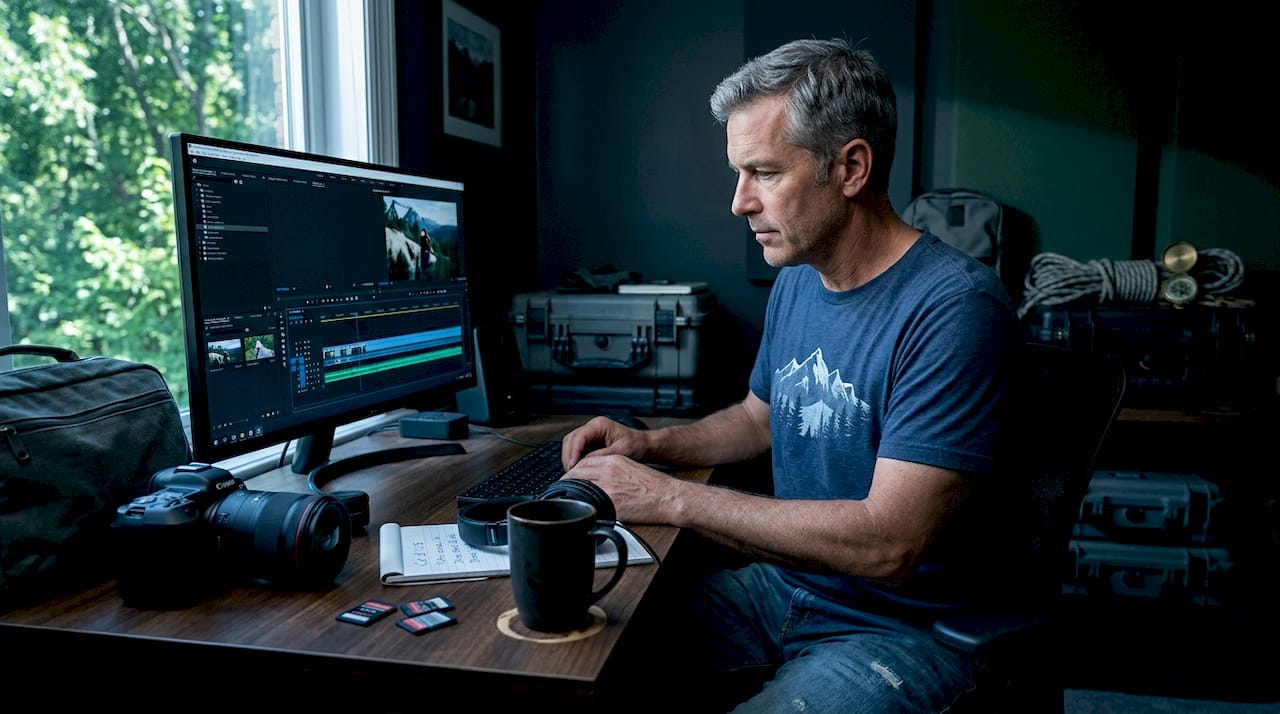
The shift is not just about aesthetics. It is about how modern outdoor consumers discover, evaluate, and ultimately purchase products. Video content now plays a central role across every stage of that journey, from first awareness through to final purchase decision.
How commercial videography drives results for outdoor brands
Numbers tell a clearer story than enthusiasm. When outdoor brands commit to quality commercial video, the results are concrete and often dramatic.
| Brand | Product | Video Campaign Result |
|---|---|---|
| Travelpro | Luggage | 7.9% average conversion rate increase, peaking at 31% |
| Built For Athletes | Backpacks | 12% conversion uplift from video content |
| Fjallraven | Backpacks | 1000% week-over-week sales increase |
These are not outliers. They represent what becomes possible when video is treated as a strategic asset rather than a nice-to-have content format. The conversion data from Travelpro is particularly instructive because luggage sits in a category where differentiation is genuinely difficult. If video can move the needle by 31% in a commoditized category, the potential for adventure and outdoor gear, categories with built-in visual drama, is significantly higher.
Why does video work so effectively?
The psychology behind video-driven consumer action operates on several levels. First, video reduces perceived purchase risk. When a buyer watches your jacket being tested in a blizzard or your boots navigating a technical scramble, they gain real confidence that the product performs as advertised. This is especially critical for high-ticket gear purchases.
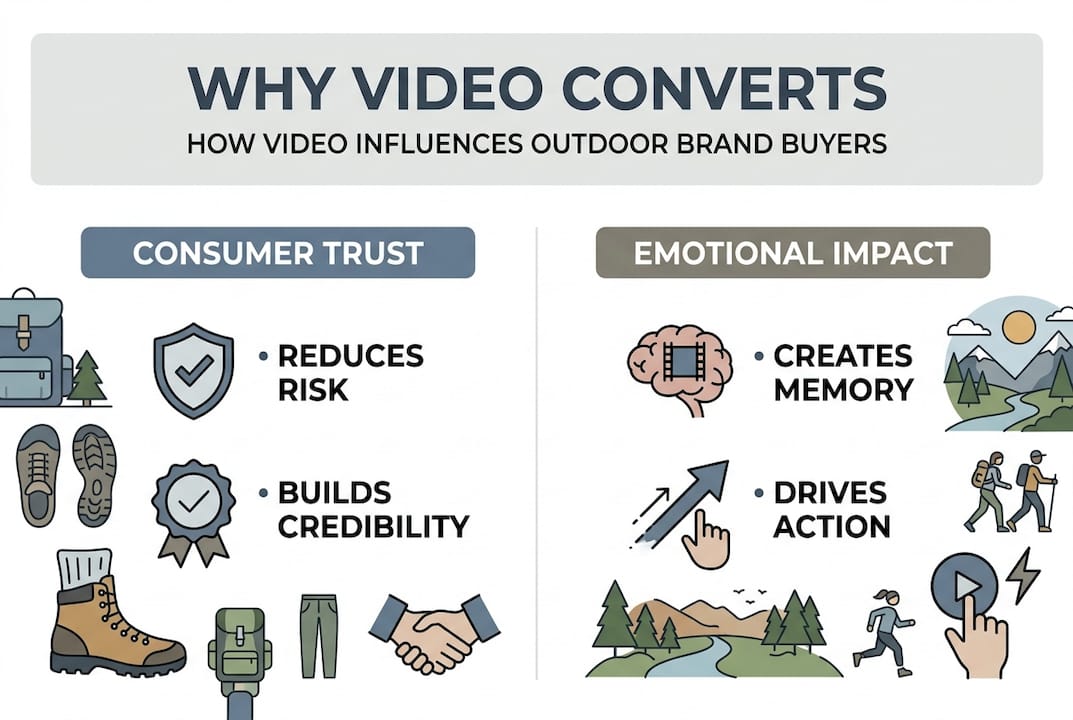
Second, video creates emotional memory. Neuroscience research consistently shows that emotion is the primary driver of purchase decisions, with rational justification following afterward. A well-crafted outdoor film that makes someone feel the freedom of a remote summit connects your brand to a powerful positive emotion in a way that a spec sheet cannot.
Third, video drives dwell time. The longer someone spends with your brand content, the more likely they are to convert. A visitor who watches a two-minute brand film on your product page is dramatically more engaged than one who scrolls past a static image in three seconds.
The compounding effect of videography’s impact on outdoor marketing extends beyond direct sales. High-quality commercial video also improves your organic search rankings, increases social media reach, and generates earned media when content is compelling enough to be shared by publishers and influencers.
Key performance benefits include:
- Higher product page conversion rates driven by authentic product-in-use footage
- Stronger social engagement as video generates more shares and comments than static posts
- Improved paid advertising efficiency because video ads consistently outperform image ads in cost per acquisition
- Brand recall uplift since video is remembered at a far higher rate than text or image content
When you add up direct conversion improvements, lower paid media costs, and the organic reach that great outdoor video generates, the ROI case becomes very strong very quickly.
Essential production techniques for impactful commercial video
Knowing that commercial video delivers results is only useful if you can actually produce content that performs. Here is how the best outdoor and adventure video campaigns get made.
-
Define your objective before you define your shot list. Every production decision should flow from a clear answer to one question: What do we want the viewer to feel, believe, or do after watching this video? If you are driving e-commerce conversions, your video needs product detail and a clear call to action. If you are building brand awareness, you need emotional storytelling and memorable imagery. Starting production without this clarity is one of the most expensive mistakes a brand can make.
-
Scout locations seriously. Outdoor shoots live or die on location quality. The best gear looks ordinary in an uninspiring environment. Invest time in finding locations that amplify your product’s purpose. A waterproof jacket deserves dramatic rain. A trail shoe deserves technical terrain. The environment is a production value multiplier that costs nothing except planning time.
-
Work with athletes who actually use the product. Authenticity is non-negotiable for outdoor audiences. If your ambassador cannot actually ride, climb, or run at a level that your audience recognizes as real, they will notice. This credibility gap destroys the trust that video is meant to build. Find athletes whose skill level and style genuinely align with your product.
-
Plan your shots around the story, not the product. The most common mistake brands make is leading with the product rather than the experience. Show the environment, build anticipation, create a narrative arc, and let the product reveal itself as the natural tool for the adventure being portrayed. Viewers watching great action video content lean forward rather than skip.
-
Master your audio environment. Outdoor shoots present complex audio challenges, wind noise, ambient sound, and distance all complicate clean recording. Great sound design, including natural ambient audio, scored music, and clean voiceover, is as important as the visual footage in creating a compelling commercial film.
-
Plan your post-production workflow before you shoot. Color grading, music licensing, graphics, and edit formats for different platforms all need to be factored into your budget and timeline before a single frame is captured.
Pro Tip: Shoot more coverage than you think you need. Outdoor environments are unpredictable, and lighting conditions change fast. Having extra angles and wider coverage gives your editor the flexibility to build a stronger narrative and adapt to what the footage actually delivers rather than what you planned.
The brands whose campaigns generate those dramatic conversion improvements are not getting lucky. They are applying action videography tips and discipline to every stage of production, from the initial brief through to final delivery. If you want to understand the full production and post-production process, structured learning through video basics and post-production resources can shorten your learning curve significantly.
Measuring and optimizing commercial video success
Creating a great commercial video is step one. Knowing whether it is actually working, and continuously improving it, is what separates brands that compound their results from those that produce video once and move on.
| Metric | What it measures | Why it matters |
|---|---|---|
| View rate | Percentage of impressions that result in a view | Indicates ad creative and targeting relevance |
| Watch time | How long viewers actually watch | Reveals where interest drops off |
| Click-through rate | Viewers who click after watching | Direct measure of call-to-action effectiveness |
| Conversion rate | Viewers who complete a purchase | The ultimate measure of commercial impact |
| Engagement rate | Likes, shares, comments relative to views | Signals emotional resonance and organic reach potential |
The conversion benchmarks from Travelpro give you a useful reference point. A 7.9% average conversion rate with peaks at 31% is what quality commercial video can deliver. If your numbers are significantly below those benchmarks, the issue is almost always in one of three places: targeting (reaching the wrong audience), creative (video is not resonating), or placement (video is appearing in the wrong context).
A practical optimization framework:
- Set a baseline before launching. Know your current conversion rate and engagement metrics before the video goes live so you can measure actual uplift rather than guessing.
- Use A/B testing on video length and opening hook. The first three seconds of a video determine whether most viewers continue watching. Test different openers against each other with real audience traffic.
- Analyze drop-off points. Most platforms tell you exactly where viewers stop watching. A consistent drop-off at the 45-second mark tells you something specific needs to change at that point in the narrative.
- Collect qualitative feedback. Run small-scale surveys with target customers after campaigns. Numbers tell you what is happening, but audience feedback often tells you why.
Pro Tip: Do not optimize for views in isolation. A video with 500,000 views and a 0.5% conversion rate is underperforming compared to one with 50,000 views and a 6% conversion rate. Align your success metrics with your actual business objective from the start.
The brands that consistently apply these videography strategies treat each campaign as a learning cycle rather than a standalone project. Video content that is measured, analyzed, and refined over time compounds its returns in ways that one-and-done productions never can.
What most brands miss about commercial videography
Here is the honest truth after working on commercial video campaigns across the outdoor and adventure space: most brands underestimate what video can do because they are thinking about it as content rather than as infrastructure.
Static imagery has its place. But when outdoor brands treat video as something they produce once for a product launch and then archive, they miss the durable commercial asset they are actually building. A well-made outdoor brand film does not go stale the way a paid social post does. It can generate sales, build brand equity, and attract retail partnerships for years.
The second thing most brands miss is that the value of commercial video is not just in the finished film. The production process, the relationship with a skilled outdoor filmmaker, and the creative development of your brand’s visual language all generate value that extends far beyond a single deliverable. Brands that treat their videographer as a strategic creative partner rather than a vendor get dramatically better outcomes.
The third misconception is that outdoor video is primarily about spectacular scenery. The scenery matters. But collaborating with outdoor photographers and filmmakers who understand the technical demands of the environment, combined with real storytelling craft, is what separates footage that makes someone stop scrolling from footage that simply looks expensive.
Brands that genuinely win with commercial video in the outdoor category are the ones who commit to creative depth, not just production quality.
Connect with expert commercial videographers
If this article has clarified what commercial videography can actually do for your brand, the next logical step is working with someone who has built a career capturing outdoor and adventure content that converts.
Understanding videography for outdoor marketing in theory is very different from executing a campaign that delivers real business results. Martin Bissig brings years of experience shooting commercial and editorial outdoor content across demanding environments worldwide, with the technical skill and storytelling instinct that outdoor brands need. Whether you are planning your first major video campaign or looking to upgrade your existing content, exploring mastering action videography as a starting point will give you the practical foundation to brief, produce, and evaluate outdoor video with confidence.
Frequently asked questions
How does commercial videography differ from other types of videography?
Commercial videography is made specifically to promote products, services, or brands, with every creative decision focused on driving audience engagement and measurable conversion outcomes rather than artistic or documentary goals.
What is the typical ROI for commercial video campaigns in outdoor industries?
Real-world case studies show conversion rate increases from 7.9% up to 31%, with some outdoor brands like Fjallraven recording 1000% week-over-week sales increases from dedicated video campaigns.
What’s the first step to producing a commercial video for an adventure brand?
Start by defining a single, clear objective for the video, whether that is driving product page conversions or building brand awareness, before moving into script planning and identifying the unique outdoor story your brand needs to tell.
How can brands track the success of their commercial videos?
Brands track performance using platform analytics covering views, watch time, click-through rates, and conversion rates, combined with A/B testing of creative variables and qualitative audience feedback to identify what is working and what needs adjustment.


