

Video is no longer a supplemental asset in outdoor marketing. It’s the engine behind trust, engagement, and real conversions. Too many outdoor and adventure brands still treat videography as a polish layer added after strategy is set, but performance videography has become a core performance driver that separates growing brands from stagnant ones. The brands winning in 2026 are the ones treating every video asset as a measurable investment tied directly to campaign goals. This article gives you the frameworks, data, and tactical clarity to do exactly that.
Table of Contents
- Why video is now essential in outdoor marketing
- Videography’s impact across the outdoor customer journey
- The big split: Online video vs. DOOH in outdoor marketing
- Mastering performance: Measuring and optimizing outdoor video ROI
- Perspective: What most outdoor brands miss about video’s real power
- Supercharge your outdoor marketing with expert videography
- Frequently asked questions
Key Takeaways
| Point | Details |
|---|---|
| Video is essential | Videography has become a must-have for building trust, engagement, and conversions in outdoor marketing. |
| Map video to the journey | Strategically deploy different video types at each stage of your outdoor buyer’s path for maximum impact. |
| Online and DOOH differ | Success depends on tailoring video content to the strengths of digital and DOOH channels. |
| Measure what matters | Track performance-based metrics like conversions and engagement, not just views. |
| Authenticity drives results | Using real outdoor creators and stories increases relatability and ROI in adventure campaigns. |
Why video is now essential in outdoor marketing
The outdoor and adventure sector runs on emotion. A static product shot of a waterproof jacket tells a story. A 30-second clip of that jacket holding up in a mountain downpour sells it. That gap between telling and selling is where video earns its place as a non-negotiable marketing tool.
Video builds trust, authentic engagement, and conversion power in ways that no static format can replicate. For adventure audiences, authenticity is the currency. They can spot staged content immediately, and they reward brands that show real terrain, real athletes, and real conditions with loyalty and purchase behavior.
The numbers back this up. Consumers prefer video over other content formats at a rate of 78% across categories, and in the outdoor space that preference is even more pronounced because the product experience is inherently physical and dynamic. You cannot communicate the feel of a trail, the weight of a pack, or the grip of a climbing shoe through a product description.
Here’s where video consistently outperforms static content in outdoor campaigns:
- Dwell time: Video holds attention 3x longer on product pages than images alone
- Social sharing: Dynamic outdoor footage generates significantly higher share rates than photo posts
- Purchase intent: Shoppers who watch a product video are far more likely to convert than those who only view photos
- Search visibility: Pages with video rank higher and attract more organic traffic
- Email engagement: Campaigns featuring video thumbnails see higher click-through rates
“Brands that continue treating video as optional are not just missing an opportunity. They are actively ceding ground to competitors who understand that video is now the primary trust-building mechanism for adventure consumers.”
For marketing professionals at outdoor brands, this means boosting your brand with outdoor visual content is not a creative decision. It is a strategic one with direct revenue implications.
Videography’s impact across the outdoor customer journey
Knowing video matters is one thing. Knowing where to deploy it is what separates smart campaigns from expensive ones. The outdoor customer journey has distinct phases, and each one calls for a different video approach.
Awareness is where short, punchy social teasers do the work. A 15-second clip of a mountain bike trail at sunrise, or a kayaker dropping into a rapid, stops the scroll and plants your brand in the viewer’s mind. These clips don’t need to sell anything. They need to create desire.

Consideration is where product demos and how-to videos earn their keep. Shoppers comparing two tents or two hydration packs want to see the product in action. Video answers questions that specs cannot.
Conversion is where user-generated content (UGC) becomes remarkably powerful. Real customers using your gear in real conditions carry more credibility than any polished brand film. Leading outdoor brands like Travelpro and ALPAKA have seen up to $269k in revenue from video, with conversion rates peaking at 31% and 12% daily rates from UGC alone.
Loyalty is sustained through community storytelling. Behind-the-scenes expedition footage, athlete interviews, and user story compilations keep existing customers emotionally connected to your brand between purchases.
| Touchpoint | Traditional approach | Video-powered approach |
|---|---|---|
| Awareness | Print ads, static social posts | Short social video teasers |
| Consideration | Product spec sheets | Demo and comparison videos |
| Conversion | Customer reviews text | UGC video testimonials |
| Loyalty | Email newsletters | Community story films |
5 high-leverage moments for deploying video in outdoor campaigns:
- Product launch announcements on social platforms
- Expedition or athlete partnership reveals
- Seasonal campaign kickoffs tied to weather or sport cycles
- Post-purchase onboarding sequences with gear tutorials
- Event recaps from races, festivals, or brand activations
Pro Tip: Build a video library organized by buyer journey stage before your next campaign. When you need content for a specific touchpoint, you pull from the library instead of scrambling to produce something new. Pair this with action videography tips to ensure every asset you create is technically strong and emotionally resonant. For deeper narrative impact, study memorable video storytelling approaches used in high-stakes productions.
The big split: Online video vs. DOOH in outdoor marketing
Not all outdoor video lives on a phone screen. Digital out-of-home (DOOH) advertising uses large-format digital screens in physical locations, think transit hubs, trailheads, ski resort lodges, and urban bike lanes, to deliver video content where your audience actually moves through the world.
Understanding the difference between content-driven online video and DOOH shapes how you plan creative, budget, and measurement.
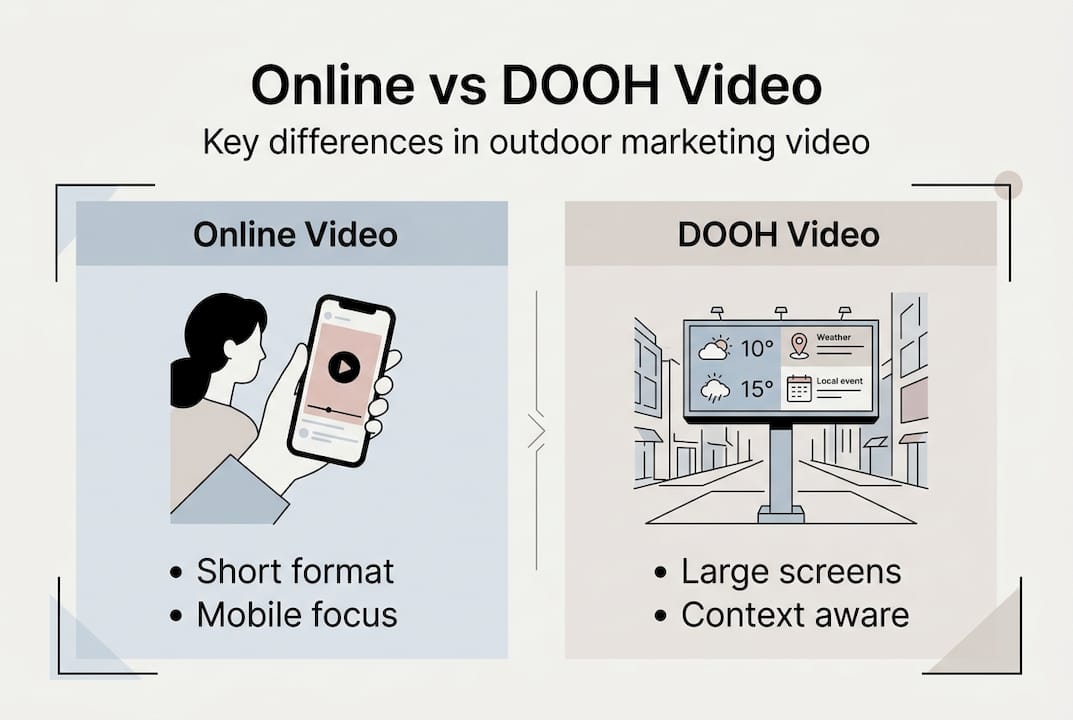
| Feature | Online/social video | DOOH video |
|---|---|---|
| Format | Vertical or square, short | Landscape, large-format |
| Targeting | Behavioral, interest-based | Location and context-based |
| Creative focus | Story, emotion, CTA | Impact, motion, brand recall |
| Measurement | CTR, conversions, views | Impressions, foot traffic lift |
| Production style | Authentic, lo-fi friendly | High visual impact preferred |
DOOH leverages large-format screens with motion, 3D effects, subtitles, and context-aware dynamic content to boost omnichannel synergy. That last part matters enormously. A DOOH campaign running alongside a social video campaign creates a multiplier effect, reinforcing brand messages across both physical and digital spaces.
When to use DOOH vs. online video:
- Use DOOH when you want mass awareness in high-traffic outdoor locations
- Use DOOH for seasonal campaigns tied to specific geographic markets
- Use online video when precise audience targeting and direct response matter most
- Use online video for product education and conversion-focused campaigns
- Combine both when launching a major product or brand campaign
Pro Tip: Design DOOH creatives with context-aware triggers. A ski brand can serve snowy mountain footage when temperatures drop below freezing, or a trail running brand can activate content near race event venues. This kind of environmental relevance dramatically increases attention and recall. See how this plays out in practice with the Veloplus DOOH campaign, a strong example of context-driven outdoor video execution.
Mastering performance: Measuring and optimizing outdoor video ROI
Producing great video is only half the job. The other half is knowing whether it worked and making it work better next time. Too many outdoor marketing teams celebrate view counts while ignoring the metrics that actually connect to revenue.
Views are a vanity metric. Performance metrics tied to the buyer journey are what drive real campaign improvement. That means tracking what viewers do after watching, not just how many watched.
4 essential KPIs for outdoor video marketing:
- Click-through rate (CTR): Are viewers taking the next step after watching?
- Conversion rate: How many viewers become buyers or leads?
- Dwell time: Are people watching through to the end, or dropping off early?
- Cost per acquisition (CPA): What does it actually cost to convert a viewer into a customer?
Smart testing ideas to improve performance:
- A/B test your opening hook: compare action-first openings vs. problem-statement openings
- Test different calls to action: “Shop now” vs. “See it in action” vs. “Find your trail”
- Segment by audience type: test whether casual outdoor enthusiasts respond differently than hardcore athletes
- Compare UGC clips against polished brand films for the same product
- Test video length: 15 seconds vs. 30 seconds vs. 60 seconds for the same campaign message
Pro Tip: Put authentic creators, guides, and real athletes on screen rather than actors. Audiences in the outdoor space are highly attuned to credibility. A guide who actually runs that trail every week carries more persuasive weight than a model who looks the part. This also reduces production risk because real expertise reads naturally on camera. Pair this approach with optimizing video performance techniques to ensure your raw authenticity is also technically polished.
Use platform-native analytics tools alongside third-party trackers to build a complete picture of performance. The brands that iterate fastest win.
Perspective: What most outdoor brands miss about video’s real power
Here’s the uncomfortable truth: producing more video does not automatically produce better results. We’ve seen brands with enormous production budgets consistently underperform scrappy competitors who simply understood their audience better and mapped their content more precisely.
The myth is that slicker equals stronger. In outdoor marketing, the opposite is often true. Audiences trust footage that looks like it was captured in the real world, not on a set. The brands growing fastest are the ones embedding real creators and guides into their content, not just hiring talent to hold the product.
The other thing most brands miss is iteration. They produce a campaign, run it, and move on. The brands achieving major growth treat every video asset as a learning opportunity. They test, measure, and refine. They build on what works and cut what doesn’t.
If you want to see what genuine real-world outdoor footage looks like when it’s done with both technical precision and authentic storytelling, that’s the standard worth chasing. Strategy without authenticity is just noise.
Supercharge your outdoor marketing with expert videography
The frameworks in this article only create results when paired with production quality that matches the ambition of your campaigns. Adventure audiences are visually sophisticated. They notice the difference between footage captured by someone who has actually stood on that ridge and someone who hasn’t.
Working with a specialist who understands the technical and emotional demands of outdoor media changes the output entirely. From building an outdoor photography workflow that scales with your campaign calendar, to partnering with an outdoor photographer Switzerland who brings both field experience and commercial storytelling expertise, the right collaboration accelerates results. Explore what collaborating with outdoor photographers can unlock for your brand’s next campaign.
Frequently asked questions
What kinds of videography work best for outdoor marketing?
Action-driven, authentic creator footage and short dynamic DOOH clips both perform strongly. User-generated video and context-aware DOOH consistently outperform polished but generic brand films in outdoor categories.
How can marketers measure the ROI of their outdoor video campaigns?
Track conversions, click-through rates, dwell time, and test multiple creative hooks and calls to action. Campaign success requires performance metrics, not just view counts, to connect video spend to actual revenue.
What is the advantage of using DOOH video for outdoor campaigns?
DOOH video enables attention-grabbing, context-responsive visuals on large screens, amplifying offline exposure and engagement. Large-format screens with dynamic content enhance omnichannel campaign reach by bridging physical and digital brand touchpoints.
Are there risks or pitfalls to avoid with outdoor brand videography?
Overproduced footage with little authenticity or videos poorly mapped to customer touchpoints waste budget and miss audiences. Mapping content to buyer pathways and prioritizing genuine storytelling are what separate high-performing campaigns from expensive mistakes.


