

Event photography is far more than pointing a camera at a crowd and pressing the shutter. At a fast-paced corporate event in the Swiss Alps, a photographer might shoot 800 to 2000 raw frames in a single day, make split-second exposure decisions in shifting alpine light, and deliver polished images within 72 hours. Most event organizers underestimate the depth of skill, preparation, and technical judgment involved. This guide breaks down exactly what event photography is, how the process works from start to finish, what techniques separate good results from great ones, and how modern tools are raising the bar for Swiss corporate and outdoor events.
Table of Contents
- Defining event photography: More than just taking pictures
- The event photography workflow: From planning to delivery
- Techniques for capturing dynamic outdoor and action scenes
- Candid versus posed: The art of authentic moments
- Evolving tools and trends: From AI culling to rapid delivery
- Our perspective: What most guides miss about event photography
- Capture your next Swiss event with expert photography
- Frequently asked questions
Key Takeaways
| Point | Details |
|---|---|
| Strategic approach | Event photography is a multi-step process that begins with planning and ends with timely, edited delivery. |
| Technical expertise | Capturing action outdoors demands specialized gear, anticipation, and adaptability to Swiss light and weather conditions. |
| Candid moments | A 70-30 balance of candid versus posed shots creates authentic and engaging event galleries. |
| AI-driven efficiency | AI tools now allow for rapid image selection and delivery, meeting the quick turnaround needs of corporate Swiss events. |
| Client-photographer trust | Strong communication and proactive planning set the foundation for impactful event photography results. |
Defining event photography: More than just taking pictures
Event photography is the practice of documenting live occasions, capturing both planned moments and spontaneous ones, in a way that tells a coherent visual story. It is not documentary journalism, nor is it portrait photography. It sits at the intersection of both, demanding speed, discretion, and a clear understanding of the client’s goals.
For corporate clients in Switzerland, especially those running outdoor or action-oriented events, this definition carries extra weight. Your photographer is not just capturing what happened. They are building visual assets for press releases, social media campaigns, sponsor reports, and internal communications. Every image has a job to do.
Core methodologies include pre-event planning, continuous shooting throughout the event, and selective editing afterward. These three stages are not optional extras. They are the backbone of a professional delivery.
The skills required go well beyond camera operation:
- Anticipation: Reading the room (or the mountain trail) to predict where the next key moment will happen
- Adaptability: Adjusting settings instantly as conditions shift, from bright midday sun to shaded forest trails
- Discretion: Staying invisible enough that participants behave naturally
- Brand awareness: Knowing which shots serve the client’s storytelling needs
“The best event photographers are not reactive. They are proactive. They know what the client needs before the client asks for it.”
For event photography in Zurich or any Swiss outdoor setting, this proactive mindset is the difference between a gallery of forgettable snapshots and a set of images that genuinely represent your brand.
Now that we’ve reframed what event photography truly entails, let’s break down each core stage of the process.
The event photography workflow: From planning to delivery
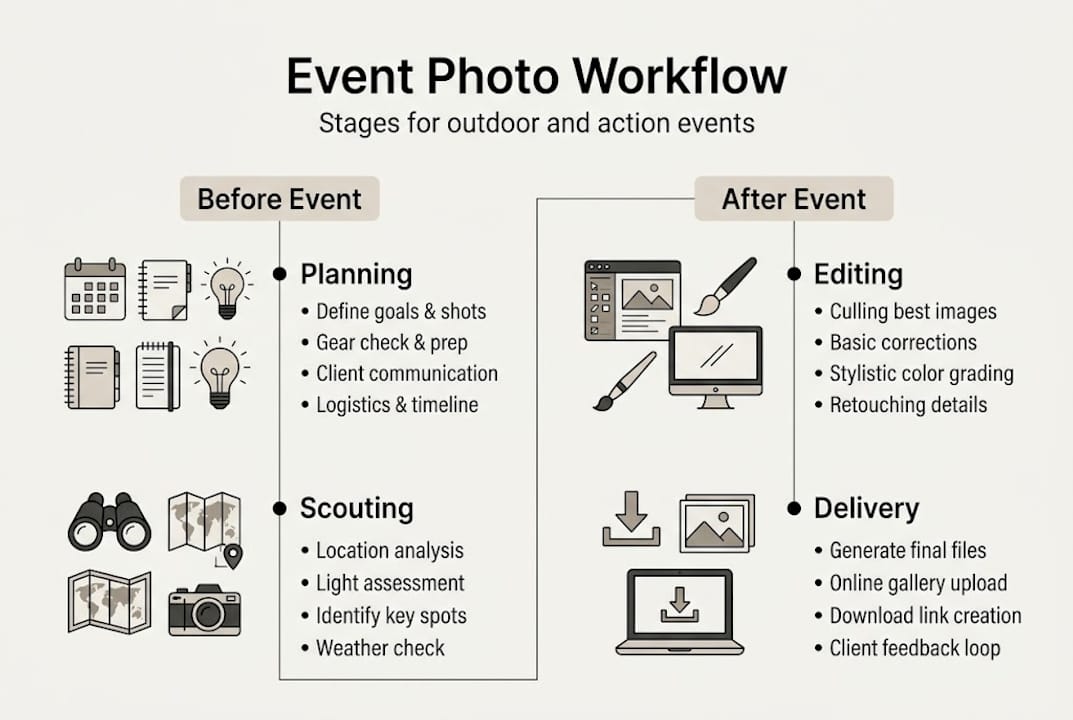
Understanding the workflow of an event photographer illuminates the skill set and systems required. A professional does not simply show up and start shooting. The process has five distinct phases, each with measurable outputs.
- Pre-event planning: The photographer reviews the event schedule, creates a shot list with the client, and scouts the venue. For outdoor events, this includes checking terrain, sun position, and weather forecasts.
- Arrival and setup: Arriving at least 30 to 60 minutes early allows time to test lighting, identify key positions, and meet key stakeholders who need to appear in coverage.
- Active shooting: Continuous coverage of the event, mixing wide establishing shots, close action sequences, and detail images. This is where volume is built.
- Culling and editing: Reviewing all frames, selecting the strongest images, and applying consistent color grading and retouching. This phase is where outdoor photography for events requires extra care due to variable natural light.
- Delivery: Providing the final gallery via a download link, often with a preview set sent ahead for urgent PR needs.
| Phase | Typical timeframe | Output |
|---|---|---|
| Pre-event planning | 1 to 3 days before | Shot list, venue notes |
| Shooting | Event duration | 800 to 2000 raw frames |
| Culling and editing | 24 to 72 hours | 150 to 300 edited images |
| Delivery | Within 72 hours | Full gallery, preview set |
Empirical benchmarks for Swiss events confirm 800 to 2000 raw frames shot, 150 to 300 edited selects delivered, with a 72-hour turnaround as the professional standard.
Pro Tip: Ask your freelance event photographer for a sample shot list before the event. It signals professionalism and ensures nothing critical gets missed.
Techniques for capturing dynamic outdoor and action scenes
While the workflow sets the structure, mastering technical techniques delivers the quality results organizers expect. Outdoor and action events in Switzerland present specific challenges that require deliberate gear choices and camera settings.
The fundamentals for action-focused coverage include:
- Shutter speed: Use 1/500s or faster to freeze motion in running, cycling, or climbing sequences
- ISO flexibility: Modern cameras handle ISO 3200 to 6400 cleanly, essential for shaded alpine terrain
- Aperture priority mode: Lets the camera adjust exposure while you control depth of field
- Telephoto lenses: A 70 to 200mm lens keeps you out of the action while filling the frame with it
- Two camera bodies: Redundancy for action events protects against equipment failure and allows two focal lengths to be ready simultaneously
Statistic: Photographers who use two camera bodies at outdoor events report 30% fewer missed moments compared to single-body setups.
Anticipating variable alpine light and weather is not a minor consideration. It is a core competency. Swiss outdoor events can shift from bright sun to overcast within minutes. Photographers who scout the venue in advance and plan for these changes consistently produce better results.
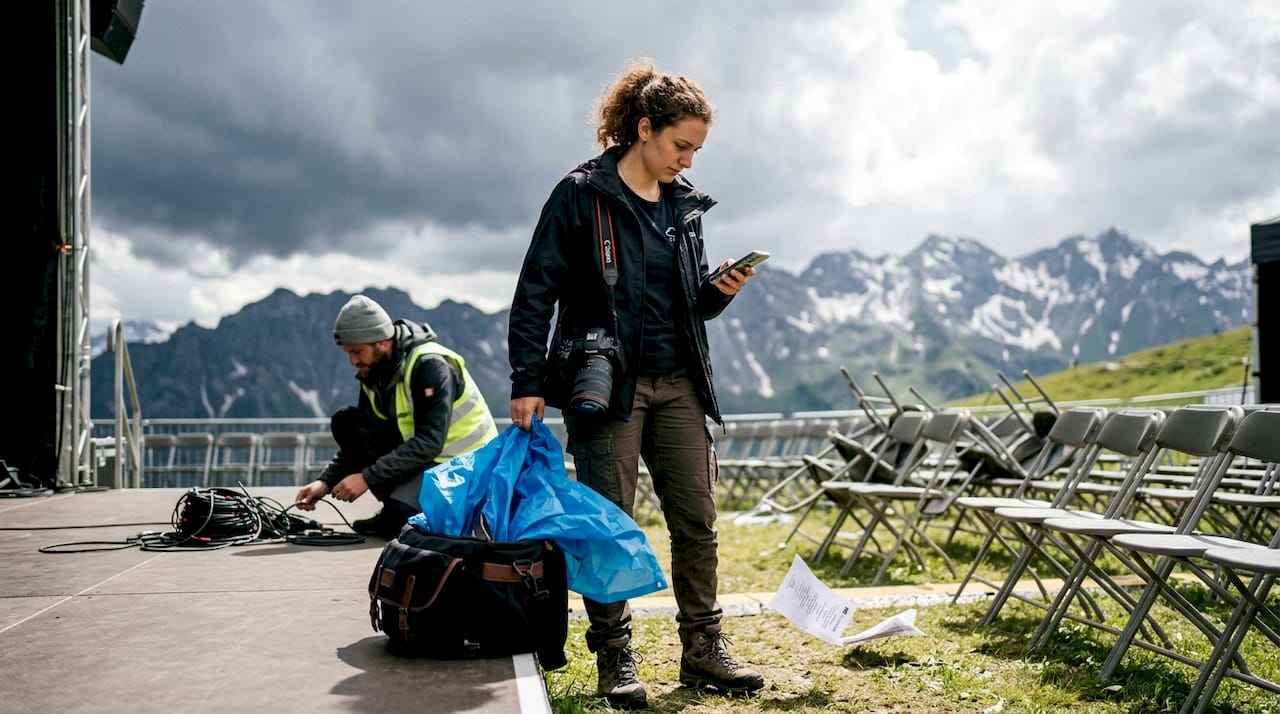
Common pitfalls include arriving without a clear shot list, ignoring the direction of natural light, and failing to communicate with event staff about key moments. These are avoidable with preparation.
Pro Tip: For mountain biking or trail running events, position yourself at a corner or descent where athletes naturally slow or shift their body weight. These spots produce the most dynamic and expressive frames.
Working as an action photographer in Switzerland also means knowing when to switch from stills to video. Reviewing action videography tips before a mixed-media event ensures you are prepared for both formats.
Candid versus posed: The art of authentic moments
Effective technical execution enables photographers to make strategic creative choices, most importantly in capturing authentic moments. The balance between candid and posed photography is one of the most debated topics in event coverage, and the data is clear.
Blend 70% candid with 30% posed for the strongest event storytelling. Candid images capture genuine emotion, energy, and interaction. Posed shots provide the structured, branded imagery that works well for official communications.
“Unposed moments are where brand personality lives. Posed shots are where brand identity is confirmed.”
For Swiss corporate events with an outdoor or athletic component, candid shots are especially powerful. A cyclist crossing the finish line, a team celebrating a summit, or a speaker connecting with an audience in an open-air setting, these moments cannot be staged convincingly.
| Shot type | Strengths | Best use cases |
|---|---|---|
| Candid | Authentic emotion, natural energy | Social media, press, storytelling |
| Posed | Controlled framing, brand messaging | Annual reports, sponsor materials |
| Mixed | Balanced narrative, versatile use | Full event galleries, PR packages |
Directing groups without losing authenticity is a skill. Rather than asking people to “smile for the camera,” skilled photographers give participants a task or a direction, such as walking toward a landmark or discussing a point together. This produces natural movement and genuine expressions.
For corporate event photography in Zurich or any high-stakes Swiss setting, this balance of candid and posed coverage ensures the final gallery serves every communication need your team has.
Evolving tools and trends: From AI culling to rapid delivery
Techniques and creativity thrive when backed by efficient tools. AI is changing event photography workflows in ways that directly benefit corporate clients.
AI culling can cut editing time by 40 to 60 percent. Instead of manually reviewing 1500 frames, a photographer uses software to flag the sharpest, best-exposed images first. This speeds up the entire post-production pipeline.
Key benefits for Swiss corporate clients:
- Same-day preview sets for urgent social media or press needs
- Faster full gallery delivery without sacrificing image quality
- Consistent color grading across large volumes of images
- Reduced turnaround costs as less manual labor is required
| Workflow type | Editing time | Delivery speed | Best for |
|---|---|---|---|
| Manual culling | 6 to 10 hours | 72 hours | Small events |
| AI-assisted culling | 2 to 4 hours | Same day to 48 hours | Large/fast events |
Same-day delivery is now a benchmark for Swiss corporate events where marketing teams need content immediately after the event ends.
Pro Tip: When briefing your photographer, specify whether you need a same-day preview set. This lets them prioritize certain sequences during culling and get key images to your communications team within hours.
For clients managing outdoor events, reviewing an outdoor photography workflow in advance helps set realistic expectations and improves collaboration.
Our perspective: What most guides miss about event photography
Most articles about event photography focus on gear lists and camera settings. That is useful, but it misses the real differentiator in high-stakes Swiss outdoor events.
The photographers who consistently deliver exceptional results are not the ones with the newest equipment. They are the ones who communicate relentlessly before the event, ask the right questions, and build enough trust with the client that they are given access to the moments that matter most.
Anticipation is a skill built through experience, not purchased through a camera upgrade. Knowing that a mountain bike race will produce its best image at a specific rocky section, because you scouted it the day before, is worth more than any piece of gear.
We have seen this play out repeatedly in dynamic Swiss settings. The value of collaborating with outdoor photographers who understand both the technical and human sides of an event is something no gear guide can quantify. Trust, communication, and preparation are the true differentiators.
Capture your next Swiss event with expert photography
You now understand what separates professional event photography from casual coverage. The planning, the technical precision, the balance of candid and posed, and the speed of modern delivery all combine to create images that work hard for your brand long after the event ends.
If your next corporate or outdoor event in Switzerland deserves that level of attention, working with a specialist makes the difference. Explore the portfolio of an action event photographer who knows Swiss terrain, or review the full range of outdoor photography services available for your next project. For a complete overview of what professional coverage looks like, visit bissig.ch and see the work firsthand.
Frequently asked questions
How is event photography different from regular photography?
Event photography prioritizes capturing authentic, spontaneous moments in fast-paced settings, requiring pre-planning, continuous shooting, and selective editing for key moments, unlike studio or portrait work.
How many images are typically delivered from a corporate event?
Most photographers shoot 800 to 2000 frames at an event and deliver around 150 to 300 fully edited selects, with a 72-hour turnaround as the standard.
What makes outdoor event photography in Switzerland unique?
Swiss outdoor events require venue scouting for alpine light and weather shifts, fast gear, and the ability to capture natural action without staging or interrupting participants.
How fast can event images be delivered?
With AI tools, same-day previews are possible for select images, while full edited galleries are typically delivered within 72 hours of the event.
What’s the typical mix of candid and posed shots?
Industry best practice is 70% candid and 30% posed, balancing authentic emotional moments with structured brand imagery for a complete and versatile gallery.
Recommended
- Streamline your outdoor photography workflow: 5 steps
- Master action videography: tips for dynamic outdoor footage
- Event photography in Zurich, Zug or Lucerne – Switzerland
- Why collaborate with outdoor photographers: boost your brand
- Understanding Motorcycle Photography Tips for Enthusiasts – Maker of Jacket


