

Most photographers who head into the mountains for the first time pack either too much or the wrong things entirely. Getting your mountain expedition photography essentials right is the difference between coming home with portfolio-worthy shots and dragging yourself back to basecamp with a blown knee, dead batteries, and nothing on the memory card worth keeping. This guide cuts through the noise and gives you the exact gear, packing logic, and fieldcraft thinking you need to shoot well at altitude, in cold, and under the kind of pressure that separates serious photographers from day-trippers with cameras.
Table of Contents
- Key Takeaways
- 1. Mountain expedition photography essentials: key selection criteria
- 2. Camera bodies worth trusting in the mountains
- 3. The right lenses for mountain photography
- 4. Tripods, support gear, and the L-bracket you should not skip
- 5. Battery management in cold environments
- 6. Essential accessories that most photographers underestimate
- 7. Practical packing and carrying solutions
- 8. Comparing gear trade-offs: weight, capability, and cost
- My honest take on gear versus mindset in the mountains
- Take your mountain photography further with Bissig
- FAQ
Key Takeaways
| Point | Details |
|---|---|
| Weather sealing is non-negotiable | Choose camera bodies and lenses rated for moisture and dust to survive mountain conditions. |
| Battery management saves shoots | Lithium-ion batteries lose 20-50% capacity in freezing temps, so carry at least 3-4 spares. |
| Lens range covers all scenarios | Use 14-35mm for landscapes and 300-600mm for wildlife to cover the full mountain shooting range. |
| Carry system matters as much as gear | A chest-mount or camera pod keeps your camera accessible without stopping to remove your pack. |
| Fieldcraft beats gear specs | Patience and reading the environment consistently produce better images than upgrading equipment. |
1. Mountain expedition photography essentials: key selection criteria
Before you buy a single piece of gear, you need to understand what the mountain will throw at you. Cold temperatures, rapid weather shifts, altitude-induced fatigue, and unpredictable light are the real variables. Every piece of gear you choose has to perform under those conditions, not just in a camera store.
Environmental demands come first. At altitude, temperatures drop fast, moisture appears from nowhere, and dust and grit work their way into every unsealed gap. Weather-sealed bodies and lenses are not a luxury upgrade. They are the baseline.
Weight is a constant negotiation. Every gram you carry costs you energy, and energy at altitude is finite. A heavier kit might give you marginally better image quality, but if you are too exhausted to reach the vantage point, it is worthless. Build your kit around the lightest gear that still meets your quality threshold.
Key criteria to evaluate before packing:
- Weather sealing: IP-rated or manufacturer-sealed bodies and lenses for rain, snow, and dust
- Battery performance: Lithium-ion batteries lose 20-50% capacity below 0°C, so plan for multiples
- Focal length range: 14-35mm for landscapes, 300-600mm for safe wildlife distances
- Total pack weight: Aim to keep your camera kit under 5 kg for multi-day expeditions
- Ethical standards: Leave No Trace principles apply to photography too. If an animal changes its behavior because of your presence, you are too close regardless of your lens reach.
Pro Tip: If you are shooting on federal lands in the US with a group, know that groups of 9 or more require a permit under the EXPLORE Act. Plan your logistics accordingly.
2. Camera bodies worth trusting in the mountains
Your camera body is the one piece of gear you cannot improvise around. It needs to fire reliably at -20°C, survive a sudden downpour, and still autofocus on a moving subject when your fingers are numb.
Full-frame mirrorless bodies from Canon, Sony, and Nikon currently lead the field for weather sealing and battery efficiency. The Canon EOS R5 and R6 Mark II, Sony A7R V, and Nikon Z8 all offer serious weather resistance and dual card slots, which matters when you are days from the nearest backup drive.
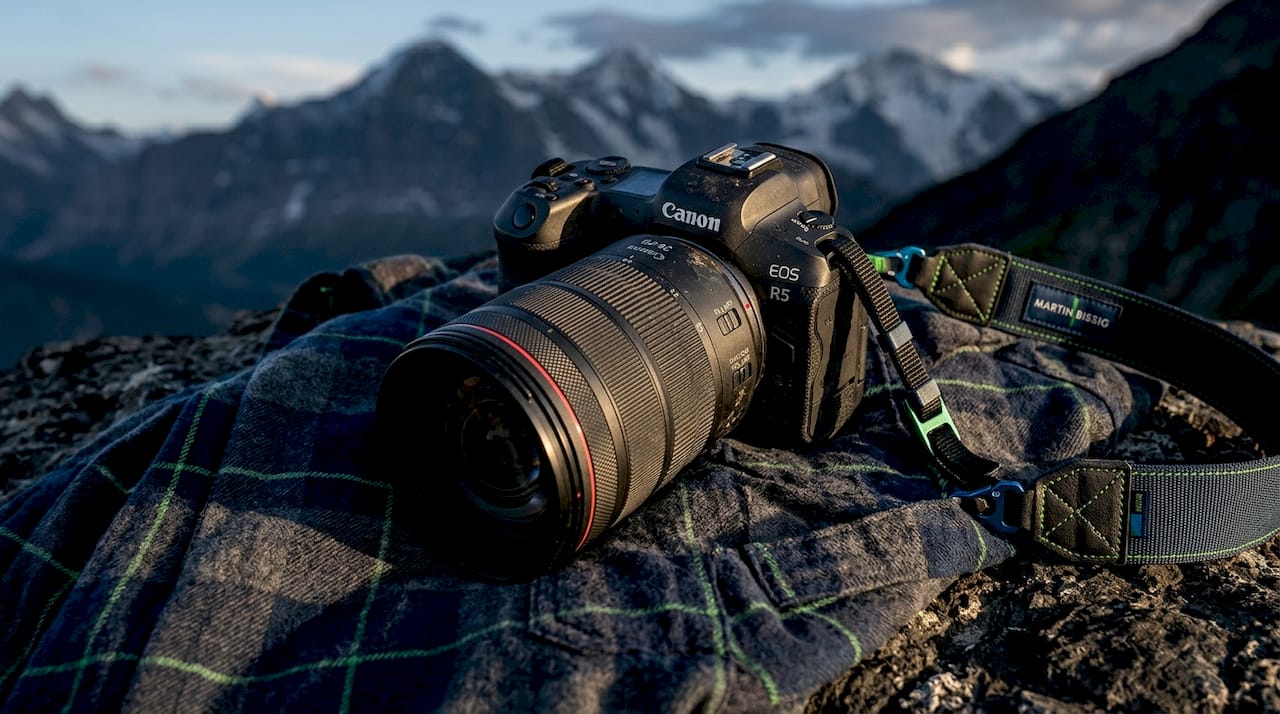
For photographers who want to reduce weight without sacrificing too much, APS-C bodies like the Canon EOS R7 or Fujifilm X-T5 offer excellent sealing and image quality at roughly half the weight of a full-frame setup. The crop factor also gives you an effective focal length boost, which helps when you are shooting wildlife with a shorter telephoto.
Pro Tip: Always shoot to two cards simultaneously in the mountains. There is no recovery option if a card fails on day four of a seven-day trek.
3. The right lenses for mountain photography
Lens choice shapes what stories you can tell. A single zoom covering a wide range sounds convenient, but the optical compromises often show up in exactly the conditions mountains create: high contrast, bright snow, and low-angle golden-hour light.
For landscape work, a wide-angle prime or zoom in the 14-35mm range gives you the sweeping compositions that define mountain photography. The Canon RF 15-35mm f/2.8 and Sony 16-35mm f/2.8 GM are workhorses here. For wildlife and distant ridgeline detail, a 100-400mm or 150-600mm zoom covers the necessary ground. You can find useful lens selection guidance for dynamic mountain environments that goes deeper into focal length trade-offs.
One lens many photographers underpack is a mid-range zoom in the 24-105mm or 24-70mm range. It handles camp life, portraits, and transitional moments that neither the wide nor the telephoto covers well.
4. Tripods, support gear, and the L-bracket you should not skip
A tripod on a mountain expedition is a commitment. It adds weight and bulk, but for long exposures at dawn, star trails, or any shot where you need absolute stillness, there is no substitute.
Carbon fiber tripods from brands like Gitzo and Really Right Stuff offer the best strength-to-weight ratio. Pair your tripod with a quality ball head and, critically, an L-bracket. L-brackets keep your camera’s center of gravity aligned over the tripod legs when switching between landscape and portrait orientations. Without one, switching orientation shifts the weight off-center and introduces micro-vibrations that kill sharpness in long exposures.
A gimbal head becomes worth its weight if you are shooting wildlife with a 400mm or longer lens. The balance it provides reduces fatigue during long waits and makes tracking moving subjects far more controlled.
5. Battery management in cold environments
Cold is the single biggest threat to your shooting day. At -20°C and below, batteries lose 30-50% of their capacity, and a battery that read 80% in your tent can hit zero within an hour of shooting in the field.
The fix is straightforward but requires discipline. Carry a minimum of three to four spare batteries. Keep them in an inner jacket pocket against your body heat when not in the camera. Rotate batteries actively rather than running one to zero. Avoid cycling the camera on and off repeatedly, as startup draws a significant charge spike each time.
A small USB power bank in your pack can top up batteries during breaks if your camera supports USB charging. This is not a replacement for spare batteries, but it extends your options on long days.
6. Essential accessories that most photographers underestimate
The difference between a good kit and a great kit often comes down to the accessories that do not make the headline gear lists.
- Polarizing filter: Cuts glare off snow and water, deepens blue skies, and cannot be replicated in post-processing. Use a slim-profile version to avoid vignetting on wide-angle lenses.
- Remote shutter release: Eliminates camera shake during long exposures. A wireless version removes one more cable to manage in the cold.
- Lens cloths and rain covers: Condensation when moving from cold outside air to a warm tent is a real risk. Microfiber cloths and a silica gel pack in your bag help manage moisture.
- Headlamp with red mode: For pre-dawn starts and navigating camp without killing your night vision before a sunrise shoot.
- Sensor cleaning kit: Dust at altitude is persistent. A basic blower and sensor swabs save you hours of spot removal in post.
Pro Tip: When moving from cold to warm environments, seal your camera in a zip-lock bag before entering. The condensation forms on the bag, not on your sensor or lens elements.
7. Practical packing and carrying solutions
How you carry your gear affects how often you actually use it. A camera buried in a pack gets used far less than one mounted on your chest or clipped to a shoulder strap.
Physical fitness directly impacts your ability to carry gear and reach the vantage points that produce the best images. A camera bag that fits well and distributes weight properly is not optional equipment. It is part of your physical strategy.
A camera pod or chest-mount system keeps your camera accessible and stable without swinging against your chest on technical terrain. Systems like the Magclip or Spider Holster let you grab the camera in seconds without removing your pack, which matters when light changes fast or wildlife appears without warning.
For multi-day expeditions, organize your pack so the camera body and one lens are always accessible in the top lid or a hip belt pocket. Keep remaining lenses and accessories in padded inserts lower in the main compartment, sorted by frequency of use.
8. Comparing gear trade-offs: weight, capability, and cost
Not every expedition demands the same kit. Here is a practical comparison to help you match your gear to your trip profile.
| Gear tier | Camera body | Lens range | Approx. kit weight | Best for |
|---|---|---|---|---|
| Professional full-frame | Canon EOS R5 | 15-35mm + 100-500mm | 6-8 kg | Commercial shoots, multi-week expeditions |
| Enthusiast full-frame | Sony A7C II | 24-105mm + 70-300mm | 4-5 kg | Week-long treks, editorial work |
| Lightweight APS-C | Fujifilm X-T5 | 10-24mm + 100-400mm | 3-4 kg | Day hikes, fast-and-light alpine starts |
| Compact mirrorless | Sony ZV-E10 II | 16-50mm kit lens | 1.5-2 kg | Casual trekking, social content |
The honest trade-off is this: professional gear gives you more latitude in post, better autofocus tracking, and superior weather sealing. But it costs you energy on every approach. For a day hike to a known viewpoint, the full professional kit makes sense. For a seven-day traverse with 1,000-meter daily elevation gains, the APS-C system might produce better images simply because you arrive at the shot with energy left to think about composition.
You can explore European Alps expedition documentation for real-world examples of how gear choices play out on extended mountain shoots.
Budget alternatives like the Canon EOS R8 or Nikon Z5 II offer solid weather resistance and full-frame sensors at a lower price point. The compromises are usually in autofocus speed and burst rate, which matter less for landscape work than for wildlife or action.
My honest take on gear versus mindset in the mountains
I have shot in the Karakoram, the Swiss Alps, and on remote trails where the nearest camera shop was three days of hiking away. What I have learned is that fieldcraft and patience consistently outperform gear upgrades. The photographers who come back with the best images are not always the ones with the heaviest kit. They are the ones who woke up early, read the weather correctly, and waited for the light to do what they knew it would do.
The mistake I see most often is over-packing in the name of being prepared. People bring three camera bodies and five lenses for a four-day trek, then spend the whole time managing gear instead of seeing. My rule is simple: if you have not used a piece of gear on your last three outings, it does not come on the expedition.
I also think the physical side gets underestimated. Carrying 7 kg of camera gear up a 1,500-meter ascent changes your relationship with that gear fast. Get fit before you go. Test your full kit on a local trail with real elevation. Find out what hurts and what slows you down before you are committed to a route.
The gear list matters. But the mindset you bring to the mountain matters more. You can find deeper thinking on this at Bissig’s expedition photography fieldcraft guide, which covers the mental and technical side of shooting in demanding environments.
— Martin
Take your mountain photography further with Bissig
If this guide has you thinking seriously about your next mountain expedition, the next step is building the skills to match the gear. Bissig’s work spans commercial expeditions in Pakistan, Switzerland, and beyond, and the knowledge behind those shoots is available through workshops and professional resources. Explore the full breakdown of outdoor photography styles and techniques to understand how different approaches apply to mountain environments. For photographers ready to sharpen their workflow from capture to delivery, the outdoor photography workflow guide covers exactly that. And if you want to work directly with a professional who has shot at altitude on four continents, visit Martin Bissig’s outdoor photography services to see what a collaboration looks like.
FAQ
What camera gear is truly essential for a mountain expedition?
A weather-sealed camera body, a wide-angle lens in the 14-35mm range, a telephoto zoom, at least four batteries, and a lightweight tripod with an L-bracket cover the core needs for most mountain expedition photography.
How do I protect batteries in freezing mountain temperatures?
Keep spare batteries in an inner jacket pocket against your body heat, rotate them actively, and avoid repeatedly cycling the camera on and off. At -20°C, cold reduces battery capacity by 30-50%, so carrying four or more spares is standard practice.
What is the best lens focal length for mountain landscape photography?
The ideal range for mountain landscapes is 14-35mm on a full-frame sensor for wide compositions. For wildlife, a 300-600mm telephoto allows you to shoot from a safe, ethical distance without disturbing animals.
How should I carry camera gear on a multi-day mountain trek?
Use a chest-mount or camera pod system to keep your camera accessible without removing your pack. Organize lenses in padded inserts inside your main pack, sorted by how often you use them, with your primary body always reachable from the top or hip belt.
Do I need a permit to photograph in mountain wilderness areas?
On US federal lands, groups of nine or more require a permit for photography under the EXPLORE Act. Smaller groups of five or fewer have no permit requirement. Always check local regulations before your expedition.


