

Outdoor brand campaigns are marketing initiatives that use physical spaces, from billboards to live activations, to create direct audience engagement at scale. The best examples of outdoor brand campaigns today combine digital out-of-home (DOOH) technology, interactive experiences, and cultural storytelling to move beyond passive impressions. Cadbury’s “Share the Love” campaign reached over 1.4 million people and converted at 16%. Disney’s levitating billboard in Madrid stopped pedestrians cold using real magnetic levitation, not CGI. These campaigns prove that creativity and technology, when combined with the right placement, produce results that paid digital ads simply cannot replicate.
1. Examples of outdoor brand campaigns using interactive DOOH
Interactive digital out-of-home advertising turns a passive medium into a two-way conversation. The results are measurable, shareable, and far more memorable than a static poster.
Cadbury’s “Share the Love” campaign is one of the clearest proof points. The campaign invited consumers to submit personal love notes via a mobile site, which then appeared on digital billboards in real time. The numbers back up the concept: 11,812 mobisite visits and 1,837 message submissions, with a 16% conversion rate across a reach of 1.4 million people. That conversion rate is exceptional for any out-of-home format.
The campaign also solved a problem most brand managers underestimate: content moderation at scale. Cadbury combined AI filtering with human review to screen all 1,837 submissions before they appeared publicly. That two-layer system protected brand safety without slowing down the real-time display. Any brand running user-generated content on a public screen needs this kind of pipeline in place before launch, not after.
- Real-time UGC on billboards creates emotional investment that static creative cannot match.
- A mobile site entry point lowers the participation barrier and generates trackable data.
- Social amplification multiplies reach well beyond the physical billboard footprint.
- Moderation infrastructure is a non-negotiable technical requirement, not an afterthought.
Pro Tip: Build your moderation workflow before you finalize your creative concept. The pipeline determines what content is actually possible to display safely at speed.
2. Augmented reality and live spectacle in high-traffic locations
Augmented reality moves outdoor advertising from something people walk past to something people stop and participate in. The format works best when the location itself is part of the concept.
Snapchat and OUTFRONT’s “Crowd Created” activation in Times Square is the clearest recent example. The campaign ran a live AR experience that reached approximately 400,000 pedestrians in a single four-hour window. That density of impressions in a compressed time frame is what separates a Times Square activation from almost any other outdoor format. The location was not incidental. It was the strategy.
The campaign also tapped directly into Gen Z’s preference for personalized, shareable brand experiences. Participants used Snapchat’s AR tools to contribute to a live visual display visible to everyone in the square. The result was a shared cultural moment, not just an ad. Passive walk-bys became active participants, and those participants then shared the experience on their own channels, extending reach far beyond the physical footprint.
- Choose locations where foot traffic density justifies the production investment.
- Time activations to peak pedestrian hours to maximize live participation.
- Design the experience so participants naturally want to share it on social media.
- AR works best when the digital layer adds something the physical environment cannot provide alone.
3. Physical activations that extend brand storytelling
The most memorable outdoor activations use physical reality to make a brand claim that no digital ad can fake. When the effect is real, the audience trust is real.
Disney’s levitating billboard campaign in Madrid demonstrated this principle at its most literal. The billboards used real magnetic levitation technology to make Star Wars imagery appear to float in mid-air. No CGI, no screen trick. That physical authenticity is what generated the social sharing. People filmed it because they needed to prove to their followers that what they were seeing was actually happening. A purely digital effect would not have produced the same reaction.
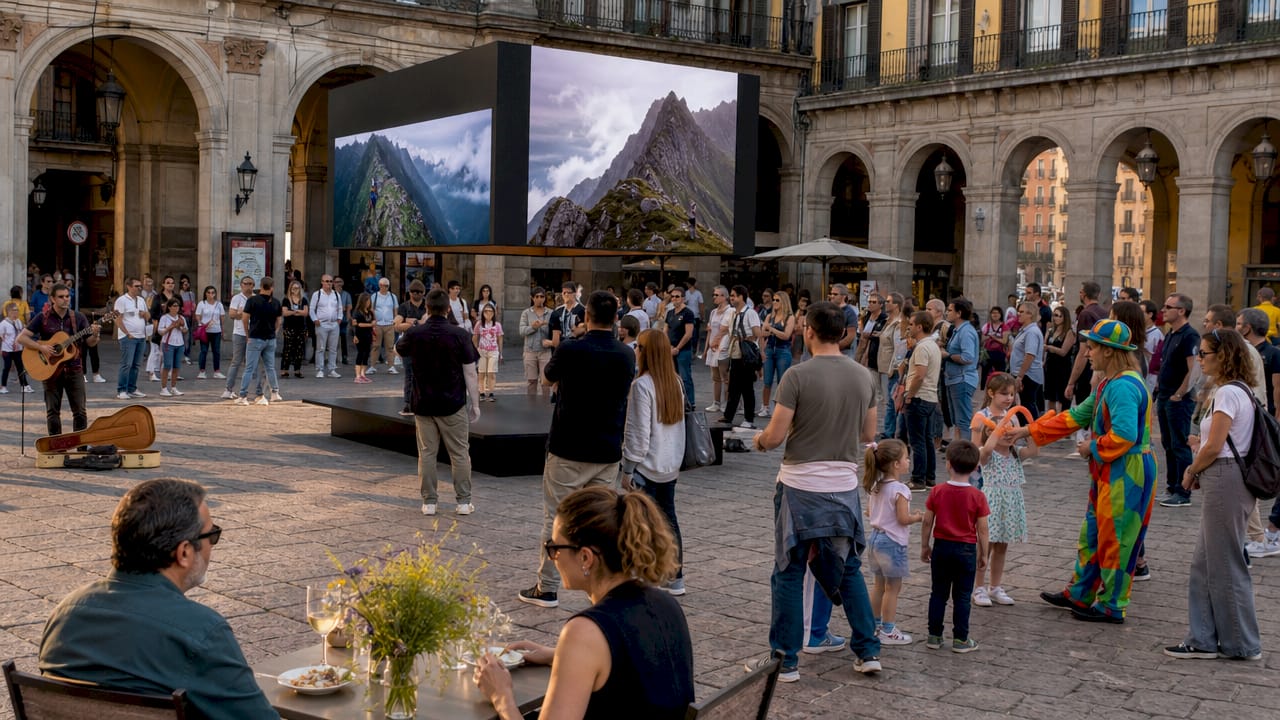
Disney’s Toronto campaign extended this logic into synchronized environmental storytelling. A DOOH billboard ran alongside a fountain programmed to move in sync with the on-screen content. The campaign reached nearly 100,000 pedestrians and generated over 1 million Instagram likes. The fountain was not decoration. It was proof that contextualized placements that align creative with the surrounding environment significantly enhance audience impact.
Budget constraints can actually sharpen physical activations rather than limit them. Selleys’ billboard stunt condensed multiple product challenges into a single installation because the budget did not allow for multiple executions. The budget-driven creative adaptation concentrated audience focus and increased campaign impact. Fewer elements, executed well, outperformed a broader campaign that would have diluted attention.
- Identify one physical effect that proves your brand claim without any digital assistance.
- Choose a location where the surrounding environment reinforces the creative concept.
- Design the activation so bystanders feel compelled to document and share it.
- Treat budget constraints as a creative brief, not a creative obstacle.
- Plan the social amplification strategy before the installation goes up, not after.
Pro Tip: Technical realism builds trust in a market saturated with digital displays. If your activation can be achieved physically, do it physically. The audience will notice the difference.
4. Cultural storytelling and lifestyle ecosystems in outdoor branding
The most durable outdoor campaigns do not sell products. They sell a way of seeing the world. Brands that understand this build audiences, not just customers.
Vivobarefoot’s “Unknow Yourself” campaign made this shift explicit. Rather than leading with performance claims, the campaign framed its products as tools for lifestyle change. The creative positioned barefoot walking as a philosophical reorientation, not a footwear choice. That narrative approach gives the audience something to believe in, which is far more durable than a feature comparison. For brand managers working in the outdoor and adventure category, this is the template worth studying.
Helly Hansen’s “Alive Camp” activation in China took the ecosystem approach even further. The campaign blended fashion, heritage, and physical activity into a single participatory experience. Outdoor consumers in China, in particular, expect participatory lifestyle ecosystems that go beyond celebrity endorsements. “Alive Camp” met that expectation by creating an environment where the brand’s values were lived, not just displayed. The result was deep consumer allegiance that a billboard alone could never generate.
Participatory brand experiences that blend cultural resonance with physical activity produce the strongest long-term brand connection. The outdoor category is uniquely positioned to deliver this because the product and the environment are the same thing. A trail running shoe brand that activates on a trail is not just advertising. It is demonstrating. That demonstration is the campaign.
- Lead with a cultural narrative, not a product feature.
- Design activations that participants experience physically, not just observe.
- Align the activation environment with the lifestyle the brand represents.
- Measure depth of engagement, not just reach, to evaluate campaign success.
For brand managers building their outdoor campaign imagery checklist, lifestyle alignment between the visual environment and the brand narrative is the single most important creative decision.
Key Takeaways
The most effective outdoor brand campaigns combine physical authenticity, real-time participation, and cultural storytelling to produce engagement that digital-only formats cannot replicate.
| Point | Details |
|---|---|
| Interactive DOOH drives measurable results | Cadbury’s campaign hit a 16% conversion rate and 1.4 million reach through real-time UGC on billboards. |
| Physical realism builds audience trust | Disney’s magnetic levitation billboard generated mass social sharing because the effect was genuinely real. |
| Location is a creative decision | Times Square’s 400,000 daily pedestrians made Snapchat’s AR activation viable at scale. |
| Budget constraints sharpen focus | Selleys’ condensed billboard concept increased impact by concentrating attention on fewer, stronger elements. |
| Lifestyle storytelling outlasts product claims | Vivobarefoot and Helly Hansen built brand allegiance by framing products within a broader cultural identity. |
What I’ve learned from watching outdoor campaigns succeed and fail
The campaigns that stick are not the ones with the biggest budgets. They are the ones where the creative team understood the environment before they designed the execution. I have watched brands spend significant money on outdoor activations that failed because the placement was wrong. The billboard was in the right city but the wrong context. The AR experience was technically impressive but gave the audience no reason to participate. The physical installation was beautiful but invisible from the street.
The shift toward outdoor videography for brand storytelling has made this problem more visible, not less. When a campaign gets filmed and shared, every flaw in the placement logic gets amplified alongside the creative. A fountain synchronized to a Disney billboard works because the environment was designed into the concept from the start. That is the discipline most campaigns skip.
The other thing I keep seeing is brands underestimating moderation. User-generated content on a public screen sounds simple until the first inappropriate submission appears in real time. Cadbury’s AI plus human review pipeline was not a technical detail. It was what made the campaign possible at all. Any brand manager planning a UGC outdoor activation needs to budget for that infrastructure the same way they budget for the screen rental.
The outdoor category is also where professional outdoor photography makes the biggest difference in campaign credibility. A lifestyle ecosystem activation photographed poorly undermines the entire narrative. The image has to match the ambition of the concept.
— Martin
Bissig’s outdoor photography for brand campaigns
Brand managers who want their outdoor campaigns to perform at the level of the case studies above need imagery that matches the ambition of the concept. Bissig specializes in outdoor photography and videography for commercial clients, capturing the kind of dynamic, authentic visuals that make lifestyle campaigns credible and shareable.
Whether you are building a DOOH campaign, a physical activation, or a lifestyle ecosystem, the visual foundation determines how far the content travels. Bissig’s work as a Canon ambassador and his experience across adventure sports, mountain environments, and action sequences gives brand teams access to imagery that holds up at billboard scale. Explore Bissig’s approach to outdoor photography techniques and see how professional visuals can anchor your next campaign. For brands working in the outdoor and adventure category, the portfolio at bissig.ch/outdoor-photographer-switzerland is the right starting point.
FAQ
What makes an outdoor brand campaign successful?
Successful outdoor campaigns combine a clear physical or digital hook with a location that amplifies the concept. Measurable engagement metrics, such as conversion rates and social sharing, confirm whether the execution worked.
How does DOOH differ from traditional outdoor advertising?
DOOH uses digital screens to display dynamic, real-time content, including user-generated submissions and synchronized environmental effects. Traditional outdoor advertising uses static printed formats with no interactive capability.
What is a realistic conversion rate for interactive outdoor campaigns?
Cadbury’s “Share the Love” DOOH campaign achieved a 16% conversion rate across 1.4 million impressions. That figure is a strong benchmark for interactive outdoor formats with a mobile participation component.
Why do physical activations generate more social sharing than digital displays?
Physical effects, such as magnetic levitation or synchronized fountains, create genuine surprise that audiences want to document and share. A digital screen effect can be dismissed as edited content, but a real physical phenomenon demands proof.
How should brand managers approach user-generated content on outdoor screens?
Build a moderation pipeline combining AI filtering and human review before the campaign launches. Cadbury’s approach of AI plus human review for 1,837 submissions is the operational model to follow for brand safety at scale.


