

Commercial photography is the practice of creating images specifically to promote a product, service, or brand. Unlike personal or editorial photography, every frame in a commercial shoot has a business objective behind it. Whether you’ve seen a polished sneaker ad on Instagram or a lifestyle image in a travel catalog, that’s commercial photography at work. This guide breaks down the commercial photography definition, the major types, how shoots actually run, and what the business benefits are. If you’re trying to decide whether to hire a commercial photographer or just understand the field, you’re in the right place.
Table of Contents
- Key takeaways
- What is commercial photography, exactly?
- The main types of commercial photography
- How a commercial photography project actually runs
- Why quality commercial photography pays off
- What’s changing in commercial photography today
- My take on what commercial photography is really about
- Work with a commercial outdoor photographer
- FAQ
Key takeaways
| Point | Details |
|---|---|
| Business purpose defines it | Commercial photography is defined by its intent to promote or sell, not just by technical skill. |
| Many specialized types exist | From product to lifestyle to corporate headshots, each type serves a distinct marketing goal. |
| Workflow matters as much as the shot | Structured briefs, consistent shooting, and formatted delivery are what make images usable at scale. |
| Licensing determines legal use | A commercial use license is required to promote or sell; editorial licenses do not cover this. |
| Quality imagery builds trust | Polished, consistent visuals directly affect how consumers perceive a brand’s credibility. |
What is commercial photography, exactly?
At its core, commercial photography means creating images for business use. The commercial photography definition is straightforward: photography commissioned to promote products, services, or brands through paid advertising and marketing channels. That includes billboards, websites, brochures, and social media posts. What separates it from other photography is intent and destination.
Editorial photography, by contrast, appears in magazine articles or news stories to inform or narrate. Personal photography has no commercial purpose at all. Commercial photography exists purely to persuade or present a business to the world.
This distinction matters legally, too. A commercial use license permits images to be used for promotion and sales. An editorial license restricts usage to news or educational contexts and explicitly forbids promotion. Using an editorial image in an ad campaign, even accidentally, creates real legal exposure. Always verify the license scope before a campaign goes live.
One more thing worth clarifying: commercial work is defined by its business use, not just by a photographer’s technical abilities. The objective drives everything, from concept to delivery.
Pro Tip: When briefing a photographer, specify exactly where the images will be used. A social media post, a billboard, and a product catalog each require a different license scope, and the cost reflects that.
The main types of commercial photography
Explaining commercial photography means acknowledging how many forms it takes. The field is not a single discipline. It breaks into several specialized sub-genres, and each one serves a different marketing purpose.
Here’s a comparison of the most common types and what they accomplish:
| Type | Primary purpose | Typical deliverables |
|---|---|---|
| Product photography | Showcase items for e-commerce or catalogs | White background shots, detail shots, scale shots |
| Food photography | Sell food and beverage products or restaurant experiences | Styled hero shots, menu imagery |
| Fashion photography | Promote clothing, accessories, and lifestyle brands | Editorial-style lookbook images, campaign shots |
| Lifestyle photography | Communicate brand values through real-life contexts | People using products in natural settings |
| Corporate/headshots | Build professional brand identity | Portraits, team photos, office imagery |
| Architectural/real estate | Market properties or showcase interior design | Wide-angle interior and exterior shots |
| Event photography | Document brand activations or product launches | Coverage images for PR and social media |
The most common categories include advertising, product, food, fashion, lifestyle, corporate headshots, and architectural photography. Each one has its own technical demands. Product photography requires precise lighting control. Lifestyle photography demands skilled direction of people in motion. Corporate headshots rely on a photographer’s ability to put subjects at ease quickly.
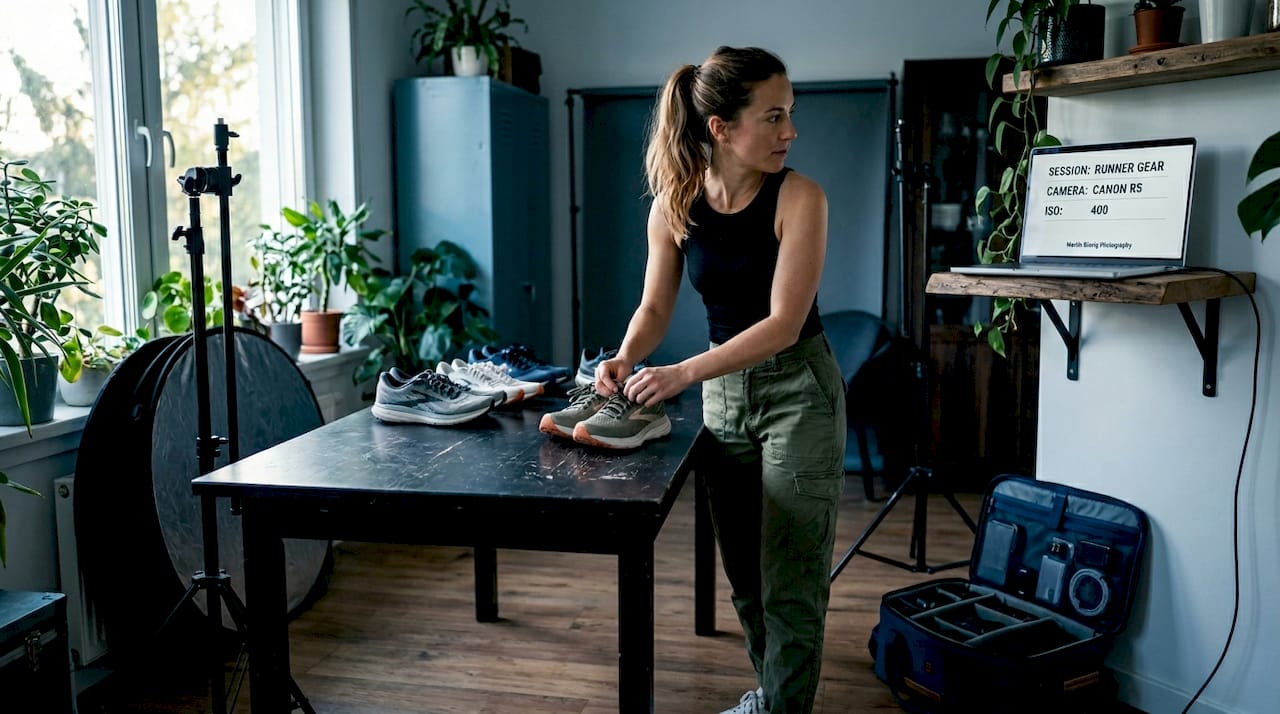
One distinction that confuses many people is the difference between commercial and advertising photography. Commercial photography leans functional and product-focused, while advertising photography trends toward creative, emotion-driven storytelling. A white-background product shot for a catalog is commercial. A cinematic image of someone running at sunrise to sell athletic shoes is advertising. Both live under the commercial photography umbrella, but they require very different creative approaches.
For e-commerce specifically, every product needs four images at minimum: a white-background hero shot, a scale shot showing relative size, a detail shot highlighting texture or features, and a lifestyle shot showing it in context. That four-image minimum is the industry baseline, not a luxury.
How a commercial photography project actually runs
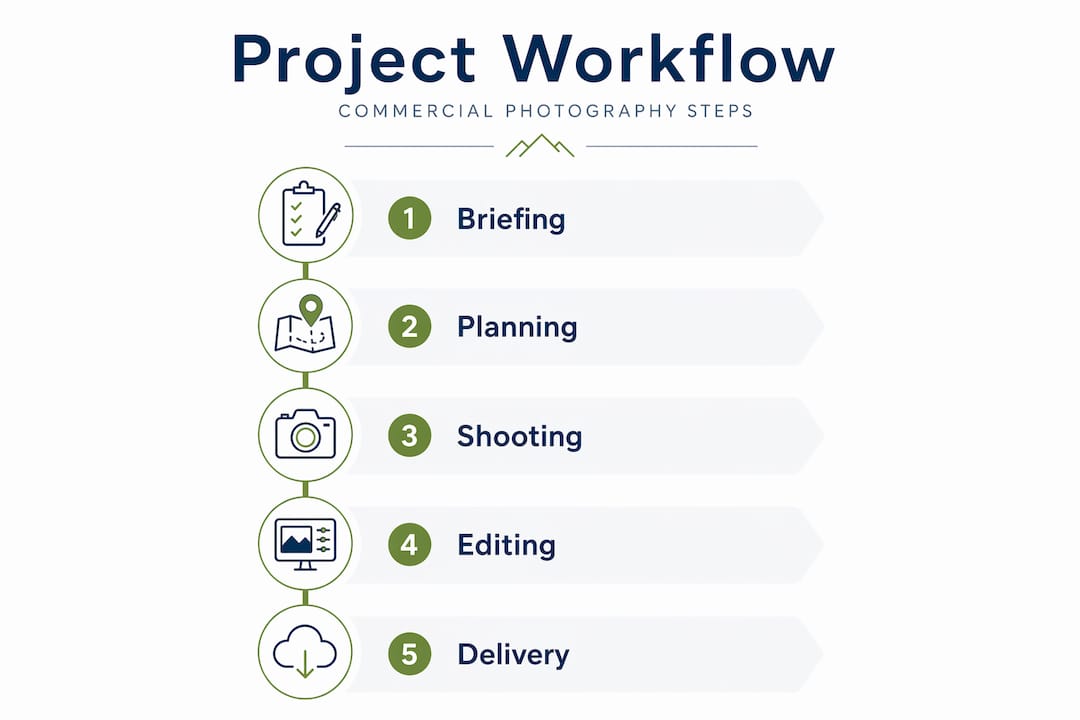
Most people think a commercial shoot is just showing up with a camera. In practice, it runs more like a production pipeline. The typical workflow has three major phases: concept development, shooting, and post-production delivery. Each phase connects directly to marketing objectives.
Here’s how a well-run commercial shoot unfolds:
- Creative brief. The client provides a document specifying the visual style, required formats, aspect ratios, intended channels, and brand guidelines. Without this, a shoot produces beautiful images that don’t fit anywhere.
- Pre-production. The photographer organizes props, locations, models, lighting setups, and shot lists. For product shoots, e-commerce teams often plan “families” of items shot with consistent lighting and angles to make editing faster and catalog presentation uniform.
- Shooting. Images are captured with precision. White balance, exposure, and lighting are locked in on set to minimize expensive post-production corrections later.
- Editing and retouching. Images are color-graded, retouched, and formatted to match the channels they’re headed to. A web banner needs different cropping and resolution than a print brochure.
- Delivery and licensing. Files are delivered in specified formats, with usage rights documentation confirming what the client can legally do with the images.
Pro Tip: Ask for a shot list before every shoot. A detailed shot list is the single best tool for staying on budget and making sure the images you paid for are actually captured.
Commercial photographers treat shoots like supply chains, delivering files tailored to specific downstream uses such as ads, web banners, and catalogs. Consistency across an entire catalog shoot or campaign is not accidental. It’s the result of a structured process.
Why quality commercial photography pays off
The benefits of commercial photography go beyond having nice pictures. They translate directly into business outcomes. Here’s what professional imagery actually does for a brand:
- Strengthens brand messaging. A consistent visual language across a website, social media, and print materials tells a coherent brand story. Inconsistent imagery confuses potential customers about who you are.
- Builds consumer trust. Professional images signal that a business takes quality seriously. Blurry or inconsistent product photos create doubt before a purchase decision is even made.
- Increases conversion rates. In e-commerce, image quality is one of the highest-leverage factors in purchase decisions. Shoppers cannot touch your product. What they see is all they have.
- Supports multiple platforms. One well-planned commercial shoot generates assets for your website, paid ads, email campaigns, social media, and print. Done right, you’re not commissioning five separate shoots.
- Differentiates you from competitors. Generic stock photography blends in. Images that actually show your product, your team, or your environment stand out in crowded digital feeds.
Avoiding inconsistent or low-quality imagery is just as important as the benefits above. A single off-brand image in an ad campaign can undermine months of brand-building work. That’s not an exaggeration. It’s a real operational risk for businesses that skip professional commercial photography services.
What’s changing in commercial photography today
The commercial photography field has shifted significantly in recent years, driven by social media formats and a cultural demand for more genuine visuals.
Social media campaigns now require multi-format content across various aspect ratios. A single hero image no longer covers a campaign. Brands need square crops for Instagram feeds, vertical crops for Stories and TikTok, horizontal versions for desktop banners, and compressed thumbnails for mobile ads. A shoot that once delivered one campaign image now needs to deliver twenty usable variants.
At the same time, consumers seek authenticity even in commercial photos. Overly staged or retouched imagery is increasingly met with skepticism. Brands that blend editorial aesthetics with commercial purpose, showing real people in realistic contexts rather than polished artificial setups, perform better in engagement metrics. This is why lifestyle photography has grown so much as a commercial sub-genre. It looks documentary, but it’s planned and controlled.
The growing influence of influencer photography also complicates licensing. Images created by influencers for brand campaigns often start with unclear usage rights. Verifying license scope before a campaign launches is not a technicality. It’s an operational necessity.
My take on what commercial photography is really about
I’ve worked on commercial projects for outdoor brands, gear companies, and sports organizations for years now. What I’ve learned is that most people hiring a commercial photographer for the first time underestimate how much of the value comes from planning, not shooting.
The photographers who consistently deliver for brands aren’t just technically skilled. They understand marketing. They ask what the image needs to do, where it will live, and what emotion or action it should trigger. That context shapes every decision on set, from the direction of light to the posture of the athlete in the frame.
The misconception I encounter most often is that commercial photography means rigid, corporate, lifeless images. Some of my most commercially successful work looks like it belongs in an adventure magazine. The difference is that every creative choice was made in service of a specific brand message, not just aesthetic preference. Authentic outdoor imagery and commercial purpose are not opposites. Done well, they amplify each other.
My advice to any brand commissioning commercial work: give the photographer your brief, your brand guidelines, and your distribution plan before the shoot, not after. The images will be more usable, the shoot will run more efficiently, and you’ll get a final product that actually earns back your investment.
— Martin
Work with a commercial outdoor photographer
If your brand operates in outdoor sports, adventure travel, or active lifestyle markets, generic studio photography will rarely capture what your audience responds to. Bissig specializes in commercial photography and filmmaking for brands that live outdoors. Whether you need campaign imagery, action sequences, or lifestyle content for multi-channel distribution, the work is built around your marketing objectives from the first brief to final delivery. Explore outdoor photography services from Bissig, or get a deeper look at styles and techniques used across outdoor commercial projects. If you’re ready to see how professional outdoor imagery can work for your brand, the portfolio speaks for itself.
FAQ
What does a commercial photographer do?
A commercial photographer creates images for business use, including product shots, lifestyle campaigns, corporate headshots, and advertising visuals. Their work is designed to promote or sell a product, service, or brand across specific marketing channels.
What is the difference between commercial and editorial photography?
Commercial photography is used to promote or sell and requires a commercial use license. Editorial photography is used in news or educational contexts and cannot legally be used for promotional purposes.
What are the main types of commercial photography?
The main types include product, food, fashion, lifestyle, corporate/headshots, architectural, and event photography. Each serves a distinct marketing goal and requires specific technical and creative approaches.
How much does a commercial photography shoot cost?
Costs vary widely based on usage rights, shoot complexity, location, and deliverables. A basic product shoot may cost a few hundred dollars, while a full campaign with broad licensing rights can run into the tens of thousands.
Why does licensing matter in commercial photography?
A commercial use license grants the legal right to use images in advertising and promotion. Using an editorial-only image commercially without the correct license creates legal risk and can result in substantial fines.


