

Action photography has a reputation for being all about speed, shutter dials, and luck. But that oversimplification leaves out the most important parts: anticipation, creative vision, and the ability to read a scene before anything happens. Whether you’re shooting mountain bikers on loose trails, climbers edging across granite faces, or kayakers punching through whitewater, the difference between a forgettable frame and a career-defining image almost never comes down to how fast your shutter fires.
Table of Contents
- Defining action photography and what sets it apart
- Essential techniques and camera settings explained
- Anticipating the shot: Timing, creativity, and composition
- Overcoming outdoor action photography challenges
- What most photographers miss about action photography
- Ready to elevate your action photography?
- Frequently asked questions
Key Takeaways
| Point | Details |
|---|---|
| More than just speed | Action photography blends technical skill with anticipation to capture the story in motion. |
| Master key camera settings | Fast shutter speed, continuous autofocus, and preparation are essential for dynamic shots. |
| Creativity is crucial | Great action images rely on timing, composition, and telling a visual story, not just freezing movement. |
| Adapt and anticipate | Outdoor environments demand planning, fast reflexes, and problem-solving for the best results. |
| Embrace unpredictability | Accept challenges as opportunities for creative breakthroughs in your action photography journey. |
Defining action photography and what sets it apart
Action photography is a genre built around movement, energy, and decisive moments. It differs from standard sports or event photography in a critical way: sports photography often documents an outcome (a goal, a finish line), while action photography captures the raw physical experience of moving through the world. The energy in the frame matters more than the scoreboard.
At its core, outdoor storytelling through action photography requires more than pressing a button at the right millisecond. It demands that you understand bodies in motion, read terrain, and put yourself in a position where compelling images become possible rather than accidental. As the discipline makes clear, “action photography requires anticipating the moment and understanding movement.” That anticipation is a skill you build through observation and repetition, not a talent you’re born with.
Here’s what separates genuine action photography from everything else:
- Subject-driven storytelling: The athlete, climber, or rider is a character in a visual narrative, not just a moving object.
- Environmental context: The landscape, light, and conditions are part of the story, not a backdrop to ignore.
- Emotional resonance: The best frames convey fear, joy, effort, or freedom, things a viewer feels before they can name.
- Precision timing: Milliseconds matter, and the difference between a peak action frame and a soft miss can be invisible until you open the file on a monitor.
- Physical positioning: The photographer’s body position and access often determine image quality more than any camera setting.
“Great action photography is not about capturing what happened. It’s about making viewers feel like they were there.”
This mindset shapes everything. Once you stop chasing technically acceptable images and start asking what story you want to tell, your entire approach changes.
Essential techniques and camera settings explained
With a solid definition in place, let’s look at how to actually set up your camera and compose remarkable action shots in outdoor environments.
The technical foundation of action photography starts with three interlocking settings. Shutter speed does the heavy lifting for motion control. A speed of 1/1000s will freeze most cyclists and trail runners. Motocross riders, cliff jumpers, or anything involving rotational force often need 1/2000s or faster to eliminate motion blur from fast-moving extremities. For intentional pan shots where you want a sharp subject against a streaked background, 1/125s to 1/250s gives you creative motion blur while preserving the subject’s form.
Aperture choices directly impact both depth of field and available light. Wide apertures (f/2.8 or f/4) isolate subjects from busy backgrounds and pull in more light for faster shutter speeds. In bright alpine conditions, you may find yourself stopped down to f/8 or f/11 to manage exposure. Neither is wrong. The goal is always to serve the image, not to follow a formula.
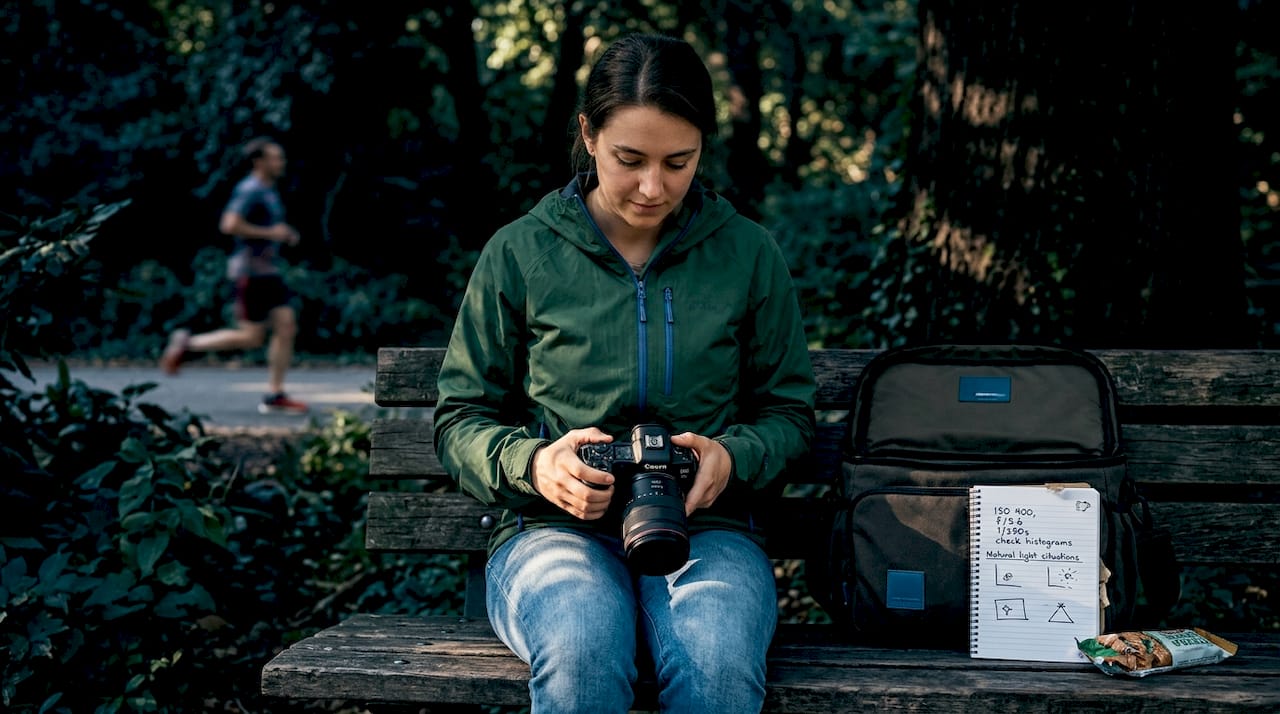
ISO is your flexibility tool. Modern mirrorless cameras from brands like Canon produce clean files at ISO 3200 and even ISO 6400. Don’t be afraid to push ISO when conditions demand it. A sharp image at ISO 6400 beats a blurry one at ISO 400 every time. Media professionals use fast shutter speeds, continuous autofocus, and burst mode to capture the best possible frames out of a sequence, and ISO confidence is part of that system.
| Situation | Shutter speed | Aperture | ISO range |
|---|---|---|---|
| Mountain biking on trail | 1/1000s or faster | f/4 to f/5.6 | 400 to 1600 |
| Rock climbing close-up | 1/500s | f/2.8 to f/4 | 200 to 800 |
| Whitewater kayaking | 1/1600s or faster | f/5.6 | 800 to 3200 |
| Snowboarding in flat light | 1/1250s | f/4 | 1600 to 6400 |
| Panning a trail runner | 1/160s to 1/250s | f/6.3 | 200 to 400 |
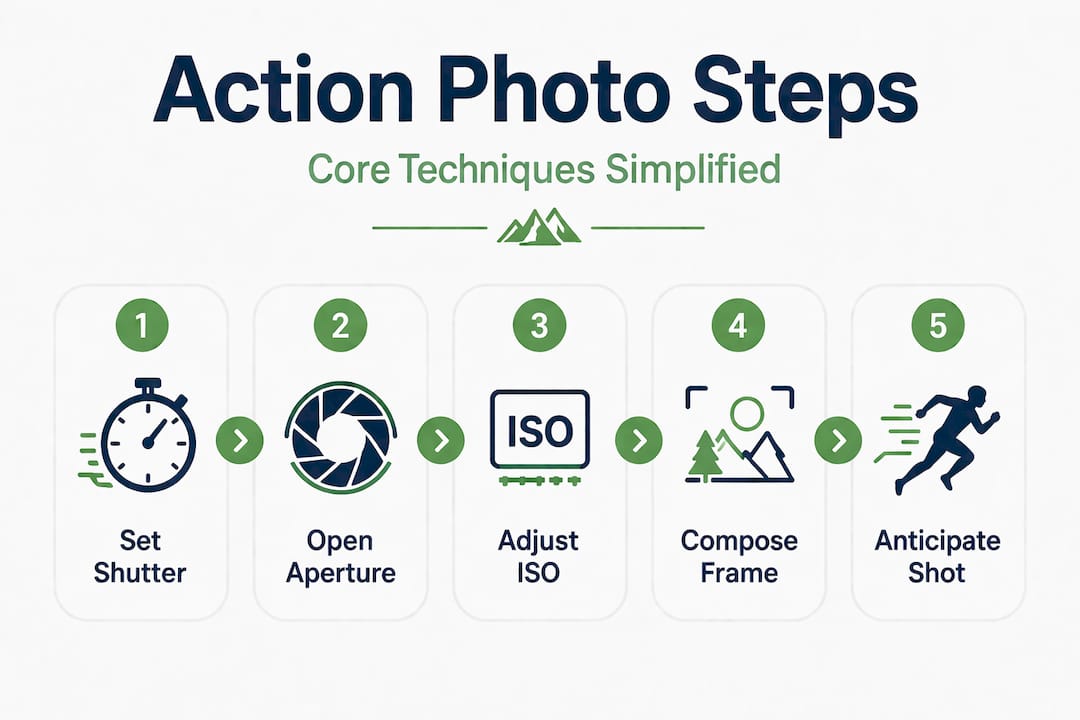
Focus mode selection is often underestimated. Use continuous autofocus (AI Servo on Canon, AF-C on most other systems) whenever your subject is moving toward or away from you. Single-point AF gives you precision control, while zone or subject-tracking modes work well when movement is unpredictable. Pair continuous focus with burst mode (at least 8 to 10 frames per second) to capture the exact peak of an expression or movement.
A practical, repeatable setup process for on-location shooting looks like this:
- Scout the location before your athlete arrives. Identify the best light angles, background options, and safe shooting positions.
- Set base exposure using a test shot of the environment at your expected shutter speed.
- Switch to continuous AF and test focus tracking on a practice run or rehearsal.
- Lock in burst mode and confirm your memory card has adequate write speed for sustained shooting.
- Adjust ISO reactively as clouds, tree cover, or the direction of travel changes the available light.
Pro Tip: Shoot in RAW format even when you’re running through fast sequences. The processing flexibility in post for recovering highlights in snow or shadows on a rock face far outweighs the extra storage cost.
If you’re interested in how these principles extend into moving images, the fundamentals of action videography share much of the same technical DNA, especially around shutter speed and subject tracking. The step-by-step action guide on this site covers even deeper technical workflows for different outdoor disciplines.
Anticipating the shot: Timing, creativity, and composition
While camera mastery is crucial, the real magic often comes from timing and artistic choices. The photographers who consistently produce standout images aren’t simply reacting to what unfolds in front of them. They’re working two or three steps ahead.
Capturing decisive outdoor action moments requires planning and fast reflexes, and the planning part is easy to underestimate when you’re focused on technique. Experienced photographers spend real time studying how an athlete moves: Which hand do they favor on a technical trail feature? Where does a rider’s weight shift before a jump? At what point in a climb does the most interesting body position occur? These observations become your targeting system.
Positioning and scene awareness are equally important. Most beginners set up where they feel comfortable or where access is easiest. Experienced shooters position themselves where the background, light, and subject converge to create something compelling. A low angle looking up at a climber against a dramatic sky communicates power differently than a high angle looking down at the same climber above a void. Both are valid. Both tell different stories.
Here’s how reactive and proactive shooting approaches compare:
| Approach | What it looks like | Strengths | Weaknesses |
|---|---|---|---|
| Reactive | Shooting as action unfolds without prior planning | Captures spontaneous moments | Inconsistent results, often missed peaks |
| Proactive | Scouting, planning, pre-visualizing the frame | Consistently strong compositions | Can miss unplanned magic if too rigid |
The best photographers blend both. They set up a proactive frame, then stay flexible enough to respond when something unexpected and better happens within it.
For composition in outdoor action photography, a few principles consistently produce stronger images:
- Leading lines: Trails, ridgelines, river currents, and rock faces naturally guide the eye toward your subject. Use them.
- Negative space: Leaving open space in the direction of movement creates visual tension and energy.
- Environmental scale: Including the landscape communicates the challenge and the context of the effort.
- Peak action frame: Look for the moment of maximum extension, rotation, or expression. For a jump, that’s the apex. For a climb, it might be the stretch for a hold.
Pro Tip: Before a shoot, close your eyes and mentally picture the three or four frames you most want to capture. This pre-visualization forces you to commit to specific creative decisions rather than spraying the shutter and hoping. It also makes you faster on location because you already know what you’re looking for.
Check out these professional tips for sharper shots to build on these composition principles with more technical depth.
Overcoming outdoor action photography challenges
Even the best photographers face tough conditions. Here’s how to handle the unexpected and turn obstacles into opportunities.
Fast-paced outdoor environments test a photographer’s technique, preparation, and adaptability in ways that controlled studio or urban settings simply don’t. Weather changes without warning. Subjects don’t always perform at their peak when the light is right. And physical access to the ideal shooting position can be limited, dangerous, or both.
Light is the most common challenge and the most manageable if you build flexibility into your process:
- Work golden hours first. Schedule high-priority shots at sunrise or in the hour before sunset when directional light adds texture and dimension. Midday flat light can flatten even dramatic action.
- Embrace overcast conditions. Cloudy days produce soft, even light that works beautifully for close-up technical shots where texture and detail matter more than dramatic shadows.
- Use the environment for light control. Tree lines, cliff faces, and snowfields all reflect and diffuse light differently. Moving your shooting position by even a few meters can completely change how light falls on your subject.
- Carry a circular polarizer. In high-contrast outdoor conditions, a polarizer reduces glare from wet rocks, water surfaces, and snow, recovering detail that otherwise blows out.
- Shoot into the sun deliberately. Backlit action shots with a subject silhouetted against bright sky or water create powerful graphic images that work across editorial and commercial applications.
Unpredictable subjects are another constant in adventure and outdoor photography. An athlete might be too tired, too cautious, or simply not performing at their best on the day you’ve traveled to shoot. The solution is to stay curious and adaptable rather than rigidly attached to a single shot idea.
“The most memorable outdoor action images often come from sessions where everything went wrong except the photographer’s attitude.”
When the planned shot falls apart, ask yourself what else is available. A portrait of an exhausted climber at the top of a failed route can be more honest and compelling than a perfect summit image. An athlete adjusting gear in harsh weather often tells a richer story than the action itself.
For deeper insights into adventure videography challenges, including how conditions affect both photo and video work simultaneously, there’s a detailed resource worth exploring on this site.
What most photographers miss about action photography
With these challenges in mind, consider what truly makes action photography impactful beyond just crisp images.
After years of shooting in demanding outdoor environments, from steep alpine terrain to remote river gorges, the pattern is consistent: photographers who obsess over gear and technical perfection plateau. Photographers who obsess over story keep growing.
The most technically perfect action image in the world goes unnoticed if it has nothing to say. A slightly soft frame of a climber mid-fall, eyes wide with effort, rope cutting across the frame, will be shared, published, and remembered. Clients, editors, and audiences don’t experience images through a histogram. They experience them through feeling.
The conventional wisdom in action photography tells you to shoot faster, track more precisely, and run your camera settings like a formula. That’s not wrong. It’s just incomplete. What it misses is that once you’ve mastered the technical side, the work that connects is driven by creative risk, storytelling instinct, and a willingness to embrace outcomes you didn’t plan.
Breaking the compositional and technical rules you’ve learned is only possible once you understand them well enough to know why you’re breaking them. Motion blur used intentionally conveys exhaustion or speed far more effectively than a frozen frame sometimes. A dark, underexposed dramatic image can communicate more threat and gravity than a perfectly exposed one.
The long-term value of outdoor photography approach that prioritizes narrative over perfection is that it connects with people at scale. Brands want images that move their audience. Magazines want images that stop readers mid-scroll. Neither of those outcomes comes from a technically flawless but emotionally hollow frame.
Embrace the imperfect, the chaotic, and the unplanned. Those are often the images that define a career.
Ready to elevate your action photography?
If this article sparked ideas, there’s a lot more depth available to keep building on them. Whether you’re refining your fundamentals or looking to specialize in a specific outdoor discipline, the resources on this site are built for photographers who take this work seriously.
Explore outdoor photography styles and techniques to understand how different approaches serve different creative and commercial goals. When you’re ready to go deeper into a complete technical workflow, the step-by-step action guide covers everything from gear selection to post-processing decisions for outdoor action work. If you’re looking for professional collaboration, Martin Bissig brings years of experience shooting for global brands, magazines, and adventure clients across demanding environments worldwide.
Frequently asked questions
What is the difference between action and sports photography?
Action photography emphasizes movement and decisive moments in any outdoor or physical context, while sports photography focuses more on athletes and events, sometimes as part of action scenes. Action photography prioritizes the experience of motion rather than the competitive result.
Which camera settings work best for capturing fast-moving subjects?
A fast shutter speed, wide aperture, and continuous autofocus are ideal for sharp action shots. As noted in field practice, media professionals use fast shutter speeds, continuous autofocus, and burst mode together to maximize the number of usable frames from any sequence.
How do you anticipate the perfect moment for an action shot?
Study your subject, position yourself strategically, and be ready to shoot before the peak of action occurs. Decisive outdoor action moments consistently require both advance planning and the reflexes to execute when the moment arrives.
What are some common mistakes to avoid in action photography?
Missing focus, using too slow a shutter speed, and failing to anticipate movement are the most frequent errors. Building a consistent pre-shoot checklist around fast shutter speeds and burst mode eliminates most of these issues before they happen.
How can action photography benefit outdoor storytelling?
Action shots convey drama, energy, and a compelling narrative that makes outdoor stories memorable across editorial and commercial contexts. Since “action photography requires anticipating the moment and understanding movement,” the resulting images carry an authenticity that staged or documentary-style work often cannot match.
Recommended
- Step-by-step action photography: a complete outdoor guide
- Sharper action shots: professional tips for photography
- Master action videography: tips for dynamic outdoor footage
- What is outdoor photography? Styles, techniques, pro tips
- AI in Street Photography: My Key Partner | Journal | Arnd v. Wedemeyer
- Portrait photography tips for stunning couple photos


