

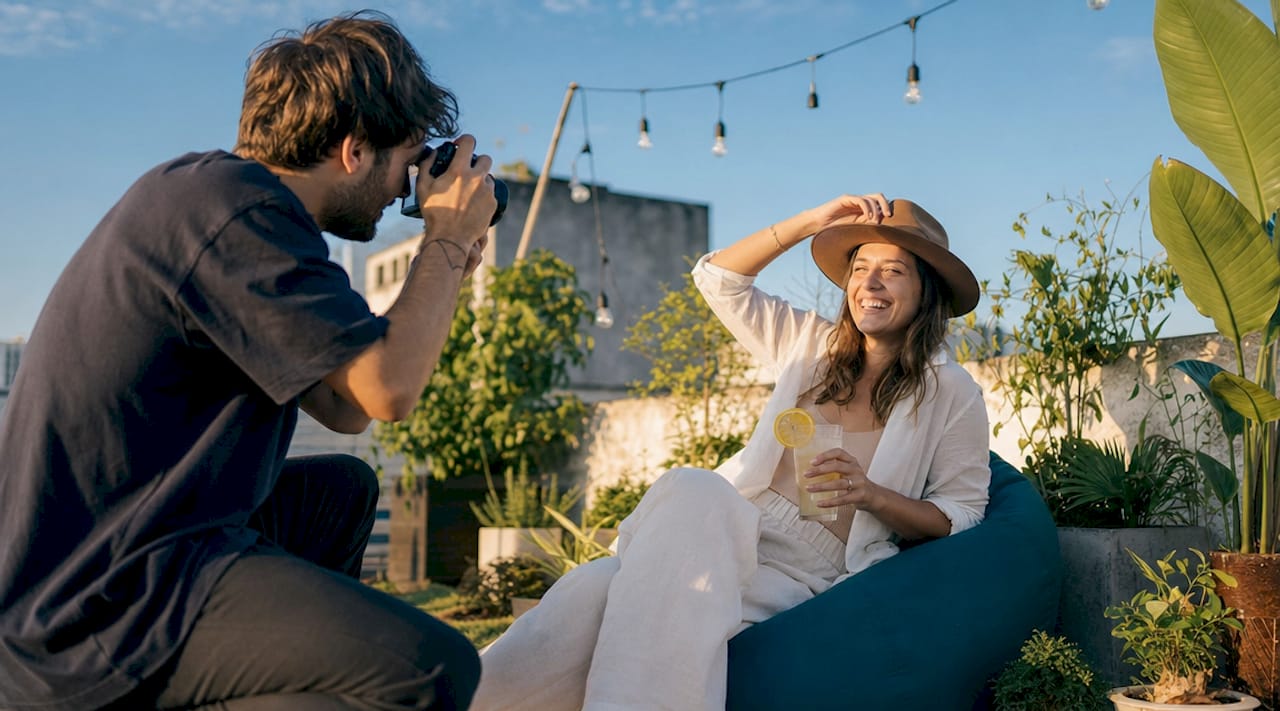
Lifestyle photography is a photographic style that portrays people living genuine moments through a blend of subtle guidance and natural interaction. Unlike traditional portrait sessions, it does not rely on stiff poses or studio setups. According to Shopify, lifestyle photography captures real-life moments in natural, everyday settings with a storytelling focus. Think of a family laughing over pancakes, a couple dancing in the kitchen, or friends sharing coffee at a neighborhood cafe. The genre sits at the intersection of portraiture and documentary photography, and understanding that balance is what separates forgettable snapshots from images that genuinely move people.
What is lifestyle photography and how is it defined?
Lifestyle photography is defined as a genre that documents people in real or recreated everyday situations, with the photographer providing gentle direction rather than scripted poses. Allison Busch describes it as sitting between portrait and documentary photography, balancing direction and candidness to produce natural yet intentional images. Portrait photography centers on appearance and controlled setups. Documentary photography is entirely hands-off. Lifestyle photography borrows from both, giving the photographer creative control without stripping the subject of authenticity.
A common misconception, noted by Great Big Photography World, is that lifestyle photography involves zero posing. In reality, gentle direction is what makes the images work. Without any guidance, subjects often freeze up or perform for the camera. With too much direction, the images feel manufactured. The lifestyle photography definition lives in the productive tension between those two extremes.
How does lifestyle photography compare to portrait and documentary styles?
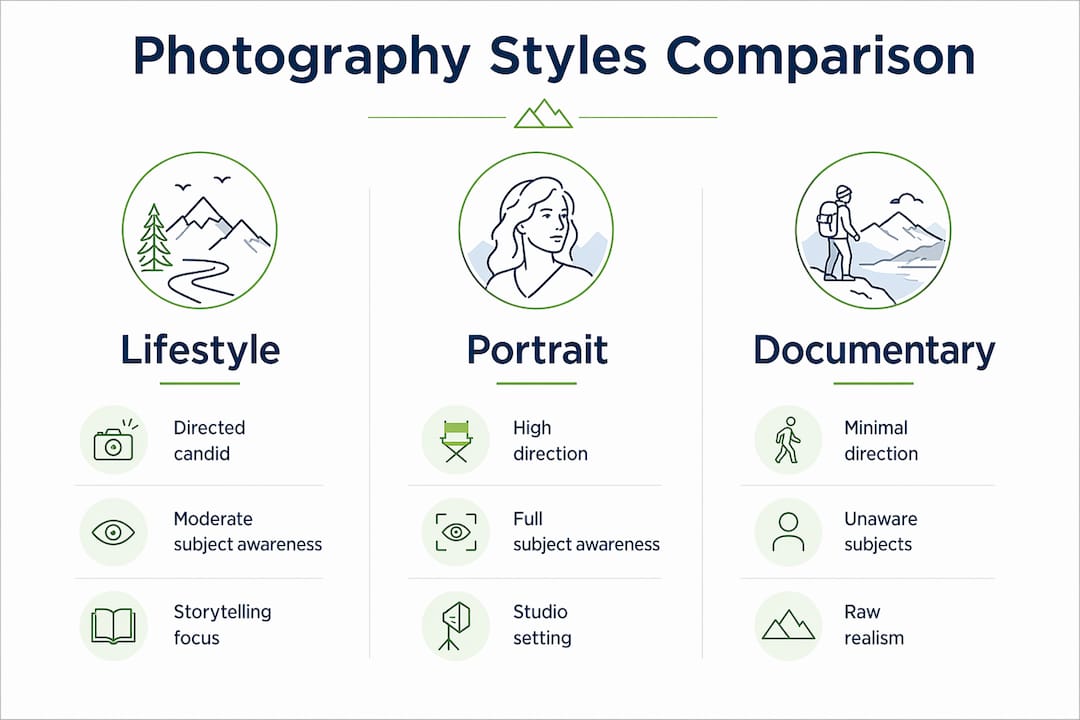
The clearest way to understand lifestyle photography is to place it alongside its closest relatives. Portrait photography prioritizes a subject’s appearance, usually in a controlled environment with deliberate lighting and fixed expressions. Documentary photography, sometimes called photojournalism, captures unposed, spontaneous moments without any photographer interference. Lifestyle photography occupies the middle ground, gently shaping situations so that authentic moments can unfold within them.
| Style | Direction level | Subject awareness | Primary goal |
|---|---|---|---|
| Portrait | High | Full | Controlled appearance |
| Lifestyle | Moderate | Full | Authentic interaction |
| Documentary | None | Often unaware | Unfiltered reality |
| Candid | None | Often unaware | Spontaneous moments |
The table above shows why lifestyle photography is the most versatile of the four for commercial and editorial work. Brands like those featured on Shopify’s blog use lifestyle images because they show products integrated into real life, not placed on a white background. Editorial clients want the emotional resonance that only genuine interaction delivers.
Pro Tip: When explaining your approach to new clients, describe yourself as a “director of moments” rather than a photographer who poses people. This framing immediately reduces subject anxiety and sets accurate expectations for the session.
How do photographers use direction and candidness in lifestyle sessions?
The defining technique in lifestyle photography is what Photography Icon calls the directed candid. The photographer sets a scene and then captures the authentic moments that unfold naturally within it. Subjects do not follow fixed poses. They engage in real interactions, which produces genuine smiles and unguarded emotions that no amount of posing can replicate.
The practical application of this technique relies on prompts focused on actions rather than expressions. Here is how that looks in practice:
- Ask a family to start making breakfast together rather than telling them to smile at the camera.
- Tell a couple to walk to a specific spot and talk about their favorite travel memory, then photograph the conversation.
- Prompt friends to show each other something on their phones, then capture the reaction.
- Ask a subject to pick up their child and spin them, rather than holding them for a posed hug.
- Encourage a subject to interact with their environment, such as flipping through a book or arranging flowers, and photograph the absorption.
According to a Sedona Advertising Agency guide, prompting with actions reduces subject self-consciousness and increases dynamic, authentic images. This is the practical payoff of the directed candid approach. The photographer creates a framework in which genuine life unfolds, rather than simply waiting for moments to appear. That distinction separates skilled lifestyle photographers from those who just point a camera and hope.
Photography Icon also notes that the key creative skill is calibrating direction to achieve a balance between flattering composition and genuine interaction. Too many prompts and the session feels like a film shoot. Too few and subjects drift into awkward stillness. The best lifestyle photographers read the room and adjust their level of involvement in real time.
What role does environment and storytelling play in lifestyle photography?
Environment is not a backdrop in lifestyle photography. It is a narrative element. Shopify’s guide confirms that locations like home, cafe, or outdoors add emotional and contextual layers that deepen viewer connection. A kitchen tells a story of domesticity and warmth. A mountain trail communicates adventure and freedom. A city rooftop suggests ambition and urban energy. The setting shapes what the viewer feels before they even register the subjects in the frame.
Choosing and managing your environment well requires a structured approach. Follow these steps before every lifestyle session:
- Scout the location in advance and identify the best light sources, whether windows, open shade, or golden hour angles.
- Remove visual distractions. Clutter, mismatched objects, and anything that breaks the story coherence should be cleared before shooting.
- Select wardrobe that complements the environment. Christine Wright Photography notes that wardrobe and environment management are critical even in casual shoots to maintain visual coherence.
- Plan for movement within the space. Identify two or three areas where subjects can naturally interact, and move between them during the session.
- Adapt to changing light. Soft indoor light and golden hour outdoor light add warmth and authenticity, while hard midday sunlight flattens and hardens the image.
Marmalade Photography confirms that managing light effectively is one of the most important technical skills in lifestyle work. Skilled photographers adapt to whatever lighting scenario they encounter rather than waiting for perfect conditions.
Pro Tip: Before the session, ask clients to remove any items from the space that feel out of place or overly personal, such as stacks of mail or mismatched furniture. A clean environment lets the subjects carry the story without visual competition.
For photographers interested in how photographic storytelling shapes emotional impact, the principles that apply to lifestyle work extend directly into editorial and outdoor photography as well.
What practical tips help capture compelling lifestyle photos?
Strong lifestyle images come from preparation and presence in equal measure. Here are the most effective practices for aspiring photographers:
- Plan wardrobe with intention. Ask clients to wear coordinated but not matching outfits. Solid colors and natural tones photograph better than busy patterns and tend to age well.
- Encourage movement. Static subjects produce static images. Give people something to do and photograph the doing.
- Work with natural light whenever possible. Position subjects near windows indoors or in open shade outdoors. Avoid placing subjects directly in harsh sunlight.
- Allow longer sessions. Allison Busch notes that lifestyle sessions last longer than traditional portraits because subjects need time to relax and interact authentically. Budget at least 90 minutes for family sessions.
- Shoot in bursts during action moments. When a family is laughing or a couple is mid-conversation, use burst mode to capture the peak expression within the movement.
- Avoid over-directing. Give one prompt, step back, and observe. Resist the urge to adjust every detail. The best moments often happen between your instructions.
For equipment, a 35mm or 50mm prime lens gives you a natural field of view that does not distort subjects. A 85mm lens works well for tighter environmental portraits where you want to compress the background. You do not need expensive gear to produce strong lifestyle images. You need strong observation skills and the patience to let moments develop.
How does lifestyle photography compare to candid photography?
Lifestyle photography and candid photography are related but distinct. Wikipedia’s entry on candid photography defines it as photography where subjects are unposed and often unaware of the camera. Lifestyle photography, by contrast, involves subject awareness and photographer prompts. The subjects know they are being photographed. The photographer shapes the conditions. The goal is controlled authenticity rather than pure spontaneity.
| Characteristic | Lifestyle photography | Candid photography |
|---|---|---|
| Subject awareness | Yes | Often no |
| Photographer direction | Gentle prompts | None |
| Session planning | Required | Not applicable |
| Outcome control | Moderate | Low |
The practical difference matters for client work. Candid photography suits street photography, photojournalism, and event coverage where the photographer observes without intervening. Lifestyle photography suits family sessions, brand campaigns, and editorial work where the photographer needs to deliver specific emotional outcomes reliably. Both styles value authenticity, but lifestyle photography builds that authenticity on a foundation of intentional preparation. For photographers exploring how these principles apply in outdoor settings, outdoor photoshoot ideas for natural portraits offer a practical starting point.
Key takeaways
Lifestyle photography produces authentic, emotionally resonant images by combining gentle direction with real interaction inside a carefully chosen environment.
| Point | Details |
|---|---|
| Directed candid technique | Set a scene with action-based prompts, then capture the genuine moments that unfold. |
| Environment as narrative | Location, light, and setting carry emotional meaning and shape the viewer’s connection to the image. |
| Direction without scripting | Gentle prompts reduce self-consciousness and produce dynamic images without manufactured expressions. |
| Lifestyle vs. candid | Lifestyle involves subject awareness and photographer guidance; candid photography does not. |
| Session length matters | Longer sessions allow subjects to relax, which produces more authentic and usable images. |
Why the balance between direction and authenticity is everything
I have spent years working in outdoor and action photography, and the lesson that transfers most directly to lifestyle work is this: the photographer’s job is to create conditions, not control outcomes. When I shoot athletes on a mountain trail or climbers on a rock face, I am not telling them how to move. I am positioning myself where the light and the action will converge, and then I am ready when the moment happens. Lifestyle photography works the same way.
The photographers who struggle with lifestyle sessions are usually the ones who try to direct too much. They want every frame to look like the last one they saw on Instagram. The result is images that look technically correct but feel hollow. The photographers who excel are the ones who set up a genuine situation, give their subjects something real to do, and then get out of the way.
The other thing I would push back on is the idea that lifestyle photography is somehow easier than portrait or documentary work. It is not. It requires you to manage light, environment, wardrobe, subject psychology, and composition simultaneously, while staying invisible enough that the subjects forget you are there. That is a high-level skill set. If you are just starting out, practice on people you know in environments you understand. The comfort level in the room directly determines the quality of the images you take home.
— Martin
Take your lifestyle photography outdoors
Lifestyle photography and outdoor photography share the same core principle: real environments produce real emotions. When you move a lifestyle session outside, you gain natural light, dynamic backgrounds, and the kind of physical freedom that loosens subjects up faster than any indoor setting. At Bissig, the work spans commercial outdoor campaigns, editorial adventure shoots, and natural portrait sessions across some of the most visually compelling locations in Switzerland and beyond. If you want to see how outdoor photography techniques translate directly into stronger lifestyle images, the portfolio and guides at Bissig offer a practical reference point for photographers at every level. The same skills that capture a mountain biker mid-air apply directly to capturing a family mid-laugh.
FAQ
What is the lifestyle photography definition in simple terms?
Lifestyle photography is a genre that documents people in real or recreated everyday situations using gentle direction rather than fixed poses. The goal is authentic, emotionally resonant images that feel lived-in rather than staged.
How is lifestyle photography different from candid photography?
Candid photography captures subjects who are often unaware of the camera with no direction from the photographer. Lifestyle photography involves subject awareness and gentle prompts to shape natural interactions within a planned environment.
What equipment do you need for lifestyle photography?
A 35mm or 50mm prime lens is the most practical choice for lifestyle work because it matches natural human perspective without distorting subjects. Natural light is the preferred light source, though a reflector can help manage shadows in challenging conditions.
How long should a lifestyle photography session last?
Lifestyle sessions typically run longer than traditional portrait sessions, with 90 minutes being a practical minimum for family or group work. The extra time allows subjects to relax and interact naturally, which produces more authentic and usable images.
Can lifestyle photography techniques apply to automotive or wedding photography?
Yes. The directed candid approach applies across genres. Lifestyle automotive photography uses the same principles to show vehicles in real-world contexts, and authentic wedding photography relies on lifestyle techniques to capture genuine emotion rather than posed ceremony shots.


